AP Syllabus focus: ‘The incidence of taxes and subsidies in perfectly competitive markets depends on the elasticities of supply and demand.’
Taxes and subsidies create wedges between what buyers pay and sellers receive. Who actually bears a tax burden or captures a subsidy benefit depends less on legal rules and more on market responsiveness, summarized by elasticities.
Tax Incidence and Elasticity
Key idea: economic vs statutory incidence
Tax incidence: The way the burden of a tax is divided between buyers and sellers, measured by changes in the price buyers pay and the price sellers receive.
The party that writes the cheque to the government is not necessarily the party that bears the burden.
Statutory incidence: who is legally responsible for remitting the tax.
Economic incidence: who experiences lower real income because prices and quantities adjust.
How a per-unit tax creates a wedge
A per-unit tax drives a wedge between the price paid by buyers and the price received by sellers, causing the market to reallocate the burden through price changes.

Per-unit tax on a competitive market: the supply curve shifts up by the tax amount, creating a vertical wedge of size between the buyer price () and seller price (). The new equilibrium shows a higher price paid by consumers, a lower price received by producers, and a reduced quantity traded. Source
= price paid by buyers (dollars per unit)
= price received by sellers (dollars per unit)
= per-unit tax (dollars per unit)
The same logic applies regardless of whether the tax is “levied on consumers” or “levied on producers”; competitive market adjustment produces an equivalent wedge.
The elasticity rule for tax incidence
Tax incidence depends on relative price elasticities:
If demand is more inelastic than supply, buyers bear more of the tax (the buyer price rises by more).
If supply is more inelastic than demand, sellers bear more of the tax (the seller price falls by more).
The more inelastic side of the market bears the larger share of the tax burden because it changes quantity less when price changes.
Intuition in terms of constraints:
A side with few alternatives or strong necessity (inelastic) cannot easily escape the tax by changing behavior, so market prices adjust against it.
Extreme cases (useful benchmarks)
Perfectly inelastic demand: buyers bear (nearly) the entire tax; quantity changes little.
Perfectly elastic demand: sellers bear (nearly) the entire tax; buyers refuse higher prices.
Perfectly inelastic supply: sellers bear (nearly) the entire tax; they cannot reduce quantity supplied.
Perfectly elastic supply: buyers bear (nearly) the entire tax; sellers require a fixed received price.
What “bearing the tax” means
The burden shows up as:
Higher buyer price (buyers lose purchasing power).
Lower seller received price (sellers’ net revenue per unit falls).
Typically lower equilibrium quantity, which also affects how many units are taxed.
Subsidy Incidence and Elasticity
Subsidies mirror taxes
A per-unit subsidy creates a wedge in the opposite direction: the government pays an amount per unit traded, pushing a gap between buyer and seller prices.
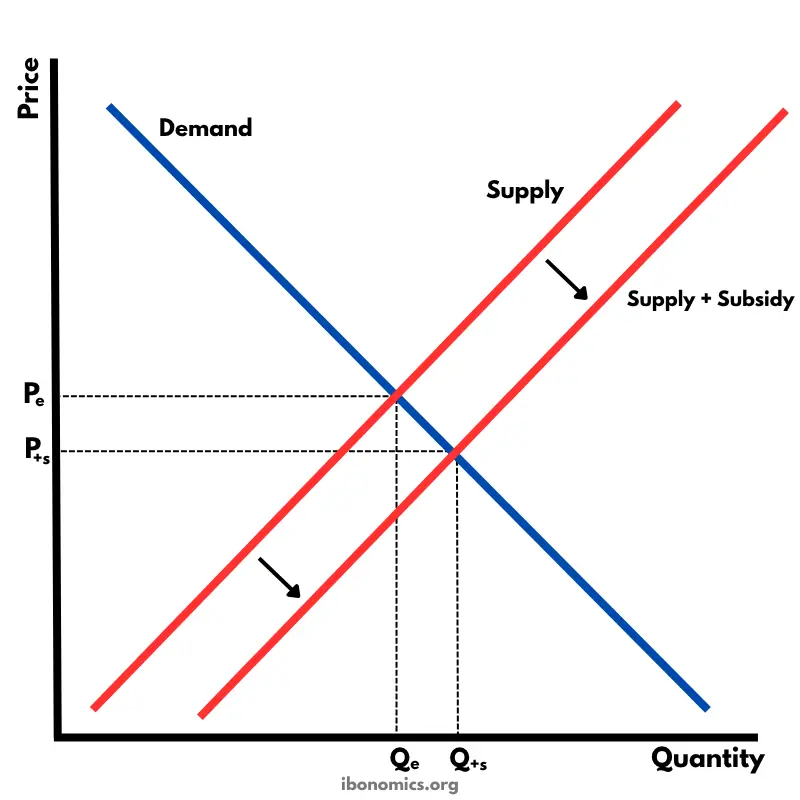
Per-unit subsidy diagram: the subsidy shifts the supply curve downward/right by the subsidy amount, lowering the market price paid by consumers and increasing equilibrium quantity. The vertical distance between the original supply curve and the subsidized supply curve represents the per-unit subsidy. Source
The market then determines who benefits via price changes.
If demand is more inelastic than supply, buyers capture more of the subsidy (buyer price falls more).
If supply is more inelastic than demand, sellers capture more of the subsidy (seller received price rises more).
As with taxes, the more inelastic side captures more of the subsidy’s value because it adjusts quantity less.
Common pitfalls to avoid
“The side taxed pays.” In competitive markets, the tax remitter can differ from the tax bearer; elasticities determine the split.
“Steeper curve always means bigger burden” without context. What matters is elasticity (responsiveness), not just steepness at a glance; units and scale can mislead.
Assuming incidence is fixed over time. Elasticities can change as consumers and firms find substitutes, change technology, or reallocate resources, changing the burden/benefit split.
Graph-based interpretation (no calculations required)
On a standard supply-and-demand graph:
A tax shifts the relevant curve to create a vertical wedge of size between the buyer price and seller price at the new equilibrium.
The side facing the larger price change (relative to the pre-tax price) bears more burden.
More inelastic curves correspond to larger price movement and smaller quantity movement, reinforcing the elasticity rule.
Practice Questions
Question 1 (3 marks) In a perfectly competitive market, a per-unit tax is introduced. Demand is relatively inelastic and supply is relatively elastic. Explain who bears most of the tax burden and why.
Identifies that consumers/buyers bear most of the tax burden (1).
Links the result to demand being more inelastic than supply (1).
Explains that the inelastic side changes quantity less / has fewer alternatives, so the buyer price rises by more than the seller price falls (1).
Question 2 (6 marks) A government introduces a per-unit subsidy in a perfectly competitive market. Supply is relatively inelastic and demand is relatively elastic. (a) Explain how the subsidy affects the prices received by sellers and paid by buyers. (3 marks) (b) Explain which side captures most of the subsidy and relate your answer to elasticities. (3 marks)
States that the subsidy creates a wedge between buyer and seller prices (1).
States sellers receive a higher effective price (seller received price rises) and/or buyers pay a lower price (1).
Notes the equilibrium adjusts through price changes (and typically quantity increases) consistent with a subsidy (1). (b)
Identifies that sellers capture most of the subsidy (1).
Links this to supply being more inelastic than demand (1).
Explains the inelastic side adjusts quantity less, so more of the subsidy shows up as a higher seller received price rather than a lower buyer price (1).
FAQ
In a perfectly competitive market, incidence is largely independent of statutory assignment.
What changes is which curve is shifted to represent the wedge, but the final buyer and seller prices (and the split) are determined by relative elasticities.
An ad valorem tax creates a wedge proportional to price, so the size of the wedge changes with the price level.
This can make pass-through vary as the market price changes, whereas a specific tax keeps a constant per-unit wedge.
Yes. Elasticities often become larger in the long run.
Consumers find more substitutes or change habits (demand becomes more elastic).
Firms can enter/exit or change technology (supply becomes more elastic).
As elasticities change, the burden/benefit split can shift.
Pass-through is the fraction of a tax (or subsidy) reflected in the buyer price.
Higher pass-through generally occurs when demand is more inelastic relative to supply; lower pass-through occurs when supply is more inelastic relative to demand.
Visual steepness depends on axis scaling and units, so a curve can look steep without being relatively inelastic in elasticity terms.
To avoid errors, focus on responsiveness: availability of substitutes, share of budget, time horizon (demand), and flexibility of inputs/capacity (supply).