

AP Syllabus focus: ‘In the object model, an object's size, shape, and internal structure are ignored, and it is treated as a single point.’
Modeling motion often requires simplifying real objects so their movement can be described clearly. In AP Physics 1, a key simplification is treating an object as a single point, focusing on its motion without distraction from shape or size.
What “Modeling an Object as a Point” Means
In kinematics, you frequently use an object model that replaces a real object with an idealised representation. Here, the representation is a point-like object whose motion can be tracked with a single position value along a line.
Object (point-particle) model: A modelling choice where an object’s size, shape, and internal structure are ignored, and the object is treated as a single point located at a representative position.
This model does not claim the object is literally point-sized; it states that the object’s dimensions and details are irrelevant to the question being asked.
Why This Model Is Useful in AP Physics 1
Treating an object as a point reduces motion to a small set of measurable quantities that depend only on time and a chosen coordinate axis.
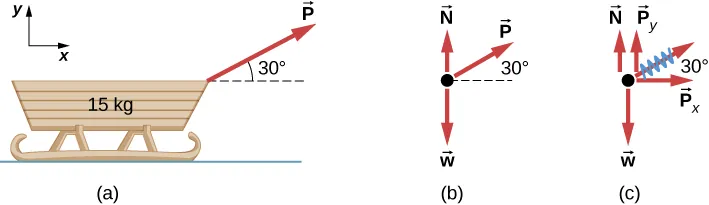
A free-body diagram replaces a possibly complicated object with a single dot and represents each external interaction as a force vector acting on that point. This visual makes explicit what it means to “ignore size and shape” in the particle model: only the net effect of forces on the object’s motion is kept. Source
This makes it possible to describe motion cleanly using a single position coordinate and to compare motion between different objects without dealing with geometry.
Key advantages:
Simpler descriptions: One position value fully specifies location in one dimension.
Cleaner reasoning: You can focus on changes in motion rather than physical dimensions.
Easier data interpretation: Measurements like “where is it?” become unambiguous within the model.
What Is Ignored (and What That Implies)
The syllabus statement is precise: size, shape, and internal structure are ignored. In practice, that means:
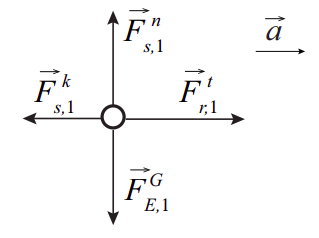
This diagram shows a standard particle-model free-body diagram: the object is reduced to a dot, and all external forces are drawn as vectors starting at that dot. It highlights the modeling principle that contact details and shape are omitted, while the forces that control translation remain fully represented. Source
Size ignored: No need to track different points on the object (front vs back).
Shape ignored: Orientation and geometry are not part of the description.
Internal structure ignored: Parts of the object are not modelled separately.
Important implication: if two different points on the same real object would have meaningfully different motions for the problem, the point model may not be appropriate.
Choosing the Representative “Point”
When you model an object as a point, you must choose what physical location that point represents. The representative point should be:
Consistent: Use the same reference point throughout the situation.
Measurable or well-defined: A marked spot, a geometric centre, or another clearly identified location.
Relevant to the motion being described: The chosen point should capture the object’s overall motion.
If different reasonable choices (front, centre, back) would lead to noticeably different results for position or displacement, that is a sign the object’s size cannot be ignored for that scenario.
When the Point Model Is Appropriate
The point model is most appropriate when the object’s dimensions are small compared with the distances involved in the motion, or when the problem only cares about the object’s overall translation.
Typical indicators that the point model is appropriate:
The object travels a distance much larger than its size.
Only the path of the object as a whole matters, not its orientation.
You are not asked about contact details that depend on shape (for example, which edge reaches a location first).
When the Point Model Breaks Down
The point model becomes unreliable when ignored features (size/shape/structure) affect the outcome. Watch for:
Rotation or tipping matters to the situation (orientation changes become essential).
Extended contact matters (different parts contact at different times).
Deformation matters (object stretches or compresses significantly).
The object’s dimensions are comparable to key distances in the problem.
In these cases, treating the object as a single point can hide important physics, even if the motion is “mostly” along one line.
A Quick Modelling Check You Should Be Able to State
A strong AP-level modelling statement links the simplification to what is being neglected:
“We model it as a point because its size is negligible compared with the distance travelled, so all parts of the object have approximately the same displacement for this analysis.”
“We cannot model it as a point because orientation/extent affects the result, so different points on the object do not share the same motion description.”
Practice Questions
(1–3 marks) A train travels along a straight track between two stations. State whether it is reasonable to model the train as a point object when finding its average velocity, and give one reason.
Correct decision (reasonable) (1)
Reason linked to size vs journey distance or all parts share approximately the same translational motion (1)
Clear physics statement (not just “it’s simpler”) (1)
(4–6 marks) A rigid ladder is carried horizontally along a corridor and must pass through a narrow doorway. Discuss whether the ladder can be modelled as a point object for (i) describing its motion down the corridor and (ii) determining whether it can pass through the doorway. Justify each decision using the idea of ignoring size, shape, and internal structure.
(i) Point model reasonable for motion down corridor with justification about translation and negligible role of shape (2)
(ii) Point model not reasonable for doorway clearance with justification that size/shape determine outcome (2)
Explicit link to what is ignored in the object model (size/shape/structure) (1)
Clear, coherent comparison between the two tasks (1)
FAQ
Choose a point that is clearly defined and can be used consistently.
Good choices include a marked point, the geometric centre, or another agreed reference point, as long as the object’s size is irrelevant to the question.
No. The point model ignores geometry, not mass.
You can still treat the object as having mass while representing its position with a single point.
Sometimes, but only if rotation does not affect what you are asked to determine.
If the result depends on orientation (clearance, contact timing, which end arrives), the point model is not appropriate.
It means internal details are not included in the model.
If internal parts move differently (for example, sloshing, shifting loads), then internal structure can affect the motion and the point model may fail.
Compare the object’s size to the scale you can resolve experimentally.
If differences caused by choosing different points on the object are smaller than your measurement uncertainty, treating it as a point is often justified.
