

AP Syllabus focus: ‘Vectors can be resolved into components using a chosen coordinate system.’
Choosing a coordinate system is a strategic step that makes two-dimensional vector problems clearer and more algebra-friendly. A good choice simplifies signs, reduces the number of nonzero components, and keeps your interpretation consistent across diagrams, equations, and graphs.
What “choosing a coordinate system” means
A coordinate system is the set of decisions that define how you describe direction and location in space: where zero is, which way is positive, and what directions you call and . In AP Physics 1, you typically use perpendicular (Cartesian) axes.
Coordinate system: A defined origin and set of axes (with chosen positive directions) used to assign coordinates and components to vectors.
Your coordinate choices do not change the physical situation; they change only how you describe it. The same vector can have different component values in different coordinate systems, but it represents the same magnitude and direction in space.
How to choose axes to make components useful
When the syllabus says vectors can be resolved into components using a chosen coordinate system, it implies you must pick axes before you split a vector into parts.
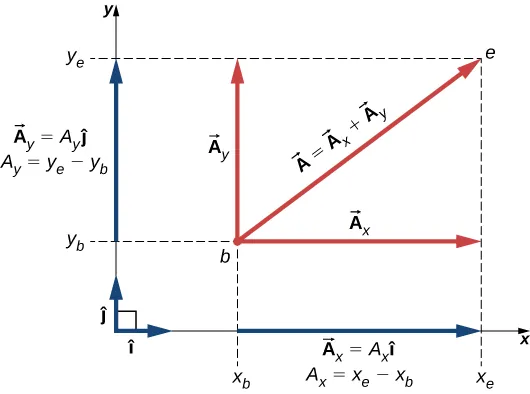
A single vector is drawn in an – coordinate system and resolved into perpendicular component vectors along each axis. The dashed construction lines emphasize that the components form a right triangle whose legs are the - and -components. This is the standard geometric meaning of “resolving a vector into components” in 2D. Source
Pick an origin (zero point)
Choose an origin where positions are easiest to reference (common choices: a starting point, a corner, or a point where motion begins).
Changing the origin shifts position coordinates, but it does not alter the vector itself (for example, a displacement between two points is the same regardless of where you place zero).
Choose axis directions and positive sense
Decide what directions will be called positive and positive .
Keep the axes perpendicular unless the problem explicitly suggests otherwise.
Write your choice on the diagram (even a small “” arrow prevents sign errors).
A strong default in many kinematics setups is:
to the right
upward
But you are free to choose differently if it simplifies the vector components you will use.
Align an axis with an important direction (when possible)
To reduce complexity, align one axis with:
the direction of motion, if motion is mostly along one line in a plane
a symmetry direction in the geometry
any direction that makes one component become zero or makes signs consistent across multiple vectors
This is the practical reason coordinate choice matters: it can turn a two-component problem into something close to a one-component problem.
Vector components in a chosen coordinate system
A component is the signed amount of a vector pointing along one axis of your chosen coordinate system.
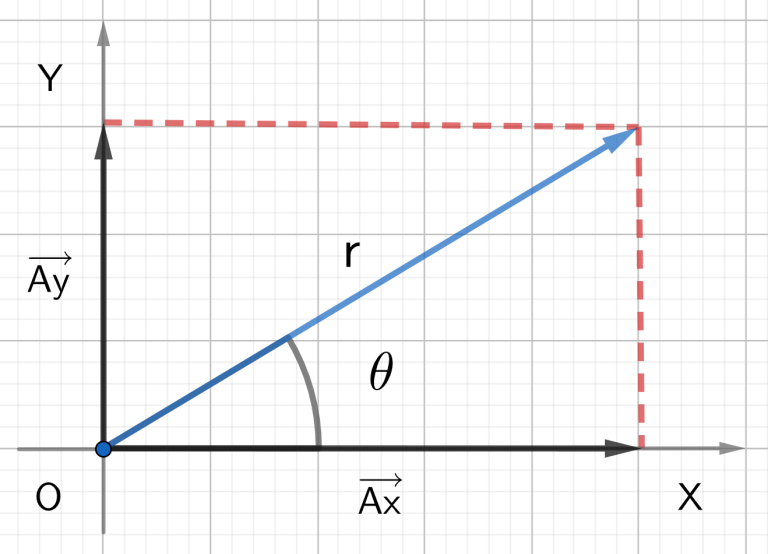
A vector at an angle is decomposed into perpendicular components along the - and -axes, forming a right triangle. This picture makes it clear why component magnitudes are related to the vector’s magnitude and direction angle through basic trigonometry. The labeled axes and origin highlight that components are defined relative to a chosen coordinate system. Source
Component: The signed projection of a vector along a chosen axis (for example, the -component is the part along the -axis).
Once axes are chosen, every vector in the plane can be described by an -component and a -component, each with a sign based on whether it points along the positive or negative axis direction. A negative component does not mean “smaller”; it means the vector points opposite your chosen positive direction.
To communicate components clearly, use consistent notation (for example, and for vector ). Component subscripts always refer to your chosen axes, not to “horizontal” or “vertical” unless you specifically chose them that way.
= vector being represented (units depend on the quantity)
= -component of (same units as )
= -component of (same units as )
= unit vector in the direction (dimensionless)
= unit vector in the direction (dimensionless)
In AP Physics 1 Algebra, you do not need calculus-based vector notation, but this form helps you remember that components are tied to a chosen pair of perpendicular directions.
Sign conventions and consistency checks
After choosing axes, apply sign rules consistently:
A component is positive if it points along the positive axis direction.
A component is negative if it points opposite the positive axis direction.
If a vector is exactly along one axis, the perpendicular component is zero.
Quick consistency habits:
Label axes before assigning component signs.
Keep the same axis choice for all vectors in the same diagram unless you explicitly start a new coordinate system.
If you reverse an axis direction (for example, redefine to point left), all -components for that system flip sign.
Communicating your coordinate choices
AP-style solutions earn clarity marks when the coordinate system is explicit. Good communication includes:
a small axis sketch with arrows showing and
a sentence stating the choice (for example, “Let be east and be north.”)
component labels on vectors (for example, , ) that match the stated axes
Practice Questions
Question 1 (2 marks) A displacement vector points left and upward. You choose to the right and upward. State the signs of and .
is negative (1)
is positive (1)
Question 2 (5 marks) A student describes a velocity vector as “ east and north.”
(a) Choose a coordinate system and state it clearly using and axes. (2 marks)
(b) Write the vector in component form by giving and with units. (2 marks)
(c) If another student instead chooses to point west (with still north), state the new value of (with sign and units). (1 mark)
(a) Any clear choice consistent with the description, e.g. east, north (2)
(b) and (2)
(c) (1)
FAQ
No. Translating the origin changes position coordinates, but a given vector (like a displacement between two points, or a velocity at an instant) keeps the same components as long as the axes’ directions stay the same.
Perpendicular axes make the $x$- and $y$-components independent, so you can treat them separately without cross-coupling. This is why standard kinematics and vector addition are most straightforward in Cartesian coordinates.
A coordinate (like $(x,y)$) describes a point’s location relative to the origin. A component (like $(A_x,A_y)$) describes how much of a vector points along each axis. They use similar notation but represent different ideas.
Only the sign of components along that axis changes. For example, reversing the $x$-axis flips $A_x \to -A_x$ for every vector described in that coordinate system, while $A_y$ is unchanged.
Pick $+x$ and $+y$ to match two perpendicular compass directions and state them explicitly, e.g.
$+x$ east, $+y$ north
Then assign component signs based on whether the vector points with or against each chosen positive direction.
