

AP Syllabus focus: ‘Two-dimensional motion can be analyzed with one-dimensional kinematic relationships after separating the motion into components.’
Two-dimensional kinematics becomes manageable when you treat motion along perpendicular axes separately. This approach relies on careful component bookkeeping, consistent sign conventions, and recognising that the same time interval applies to both axes.
Key Idea: Components Make 2D Motion “Two 1D Problems”
In two dimensions, position, velocity, and acceleration each have an x-part and a y-part. You analyse each axis with familiar one-dimensional kinematics, then combine results to describe the full motion.
Component: the part of a vector that lies along a chosen axis (for example, the x-component lies along the x-axis).
A central benefit is that motion in the x-direction does not mathematically “mix” with motion in the y-direction in the kinematic equations; they share only the same time variable.
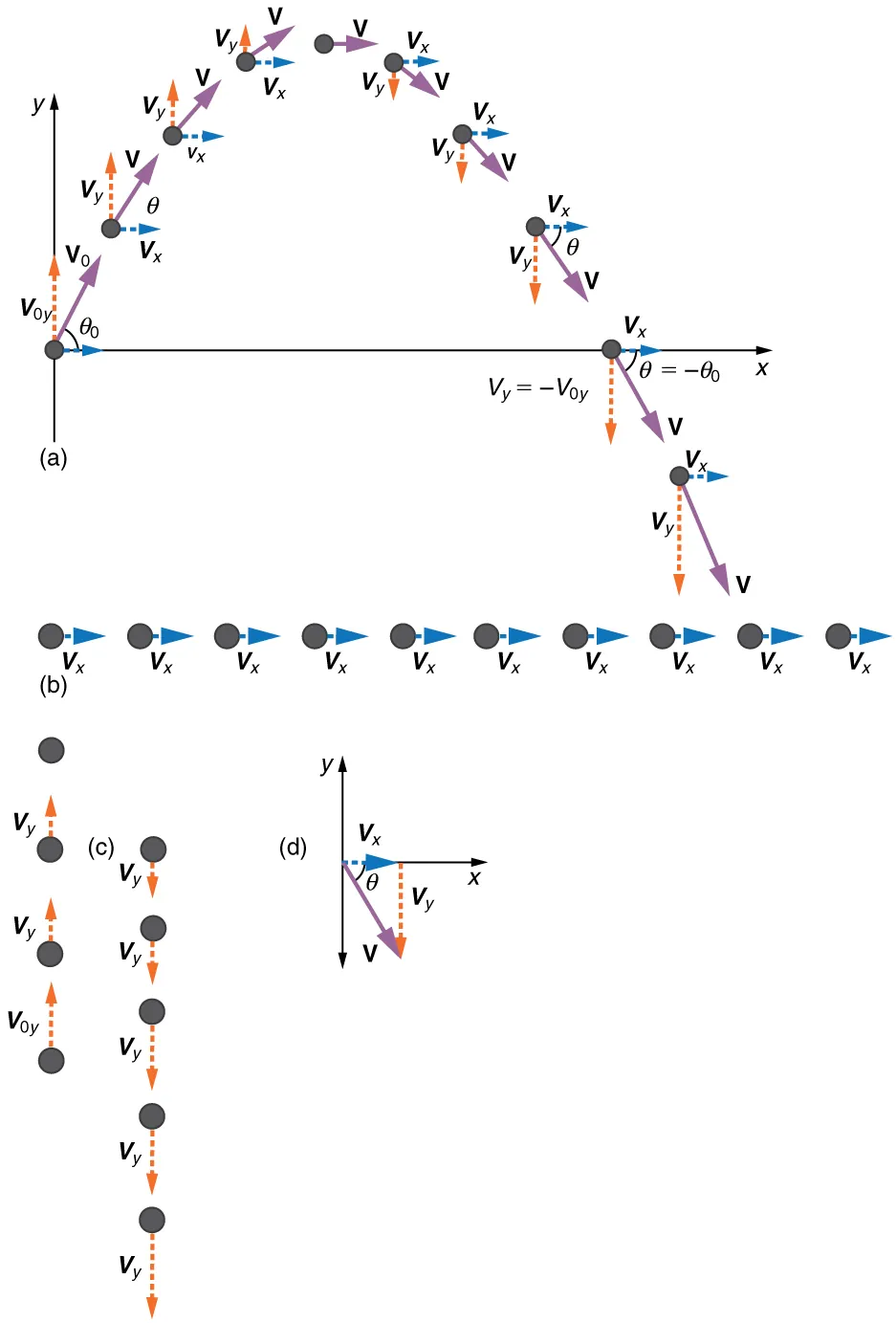
A multi-panel projectile-motion diagram showing the full trajectory with the velocity vector decomposed into and , plus separate panels emphasizing that stays constant (when ) while changes under constant downward acceleration. This is a visual proof of “two 1D problems, same time,” which is exactly what you leverage when solving AP Physics 1 component kinematics. Source
How to Break Motion Into Components (Workflow)
1) Choose axes and define signs
Pick perpendicular axes (commonly x horizontal, y vertical).
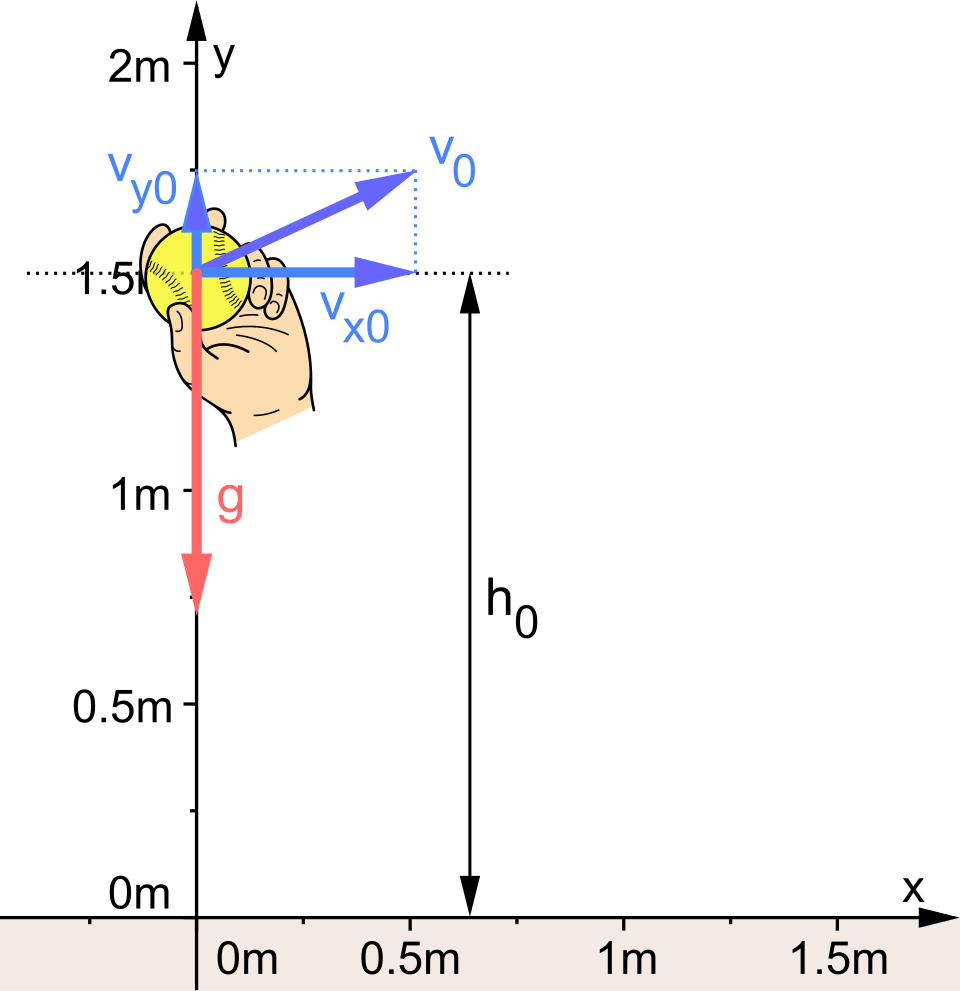
A projectile-motion coordinate setup showing the - and -axes, the projectile’s position relative to the origin, and the direction of gravitational acceleration. This kind of diagram is the standard “first sketch” that makes later component equations unambiguous. Source
Define positive directions and stick to them.
Record initial conditions separately: initial position, initial velocity, and acceleration in x and y.
2) Write what you know for each axis
Treat each axis independently:
Along x: track displacement in x, velocity in x, acceleration in x.
Along y: track displacement in y, velocity in y, acceleration in y.
The key constraint linking the axes is that the elapsed time is the same for both x and y descriptions.
= displacement vector, in m
= x-displacement, in m
= y-displacement, in m
3) Apply one-dimensional kinematics along each axis
Use any one-dimensional constant-acceleration relationships (when acceleration is constant) separately for x and y. For algebra-based problem solving, the most important habit is matching the right variables to the right axis and never combining x-quantities into y-equations.
4) Recombine only at the end (if needed)
Sometimes you need the overall (resultant) velocity or displacement.
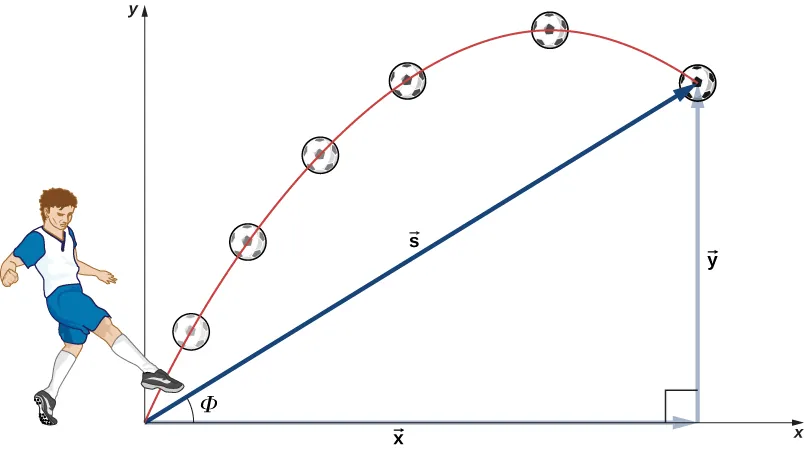
A displacement-vector diagram where the total displacement is the hypotenuse of a right triangle whose legs are the horizontal and vertical components. It illustrates how magnitudes and directions are recovered from perpendicular components using geometry after the component-wise kinematics are finished. Source
In that case, combine the perpendicular components using geometry:
The resultant magnitude depends on both components.
The direction depends on the ratio of the components and the sign conventions you chose.
Interpreting What “Independent Axes” Really Means
“Independent” does not mean “unrelated in the real world”; it means the mathematical update rules are separate:
A change in x-velocity comes from x-acceleration only.
A change in y-velocity comes from y-acceleration only.
The time interval is shared, so timing conditions (like “when it reaches a certain height” or “after 3 seconds”) affect both axes simultaneously.
Common Pitfalls to Avoid
Mixing component labels (using a y-displacement in an x-equation).
Flipping signs mid-problem (changing what “positive y” means).
Combining components too early (finding a resultant speed before solving for the needed time).
Forgetting that initial conditions apply per axis (vx0 and vy0 can be very different).
Practice Questions
(1–3 marks) A particle moves so that its displacement over a time interval is 6 m in the x-direction and 8 m in the y-direction. Determine the magnitude of the displacement.
Uses perpendicular component combination: (1)
Calculates (1)
(4–6 marks) An object has constant accelerations and . Initially, and , with initial position at the origin. After , find (i) and , and (ii) and .
Uses and gets (1)
Uses and gets (1)
Uses and gets (1)
Uses and gets (1)
Clear separation of x- and y-components with consistent units/signs (1)
FAQ
Yes. You can evaluate each axis at any chosen time, but events (like “hits the ground”) define a specific time that must then be used in both axes.
Only when the question explicitly asks for overall magnitude or direction (for example, speed or displacement magnitude), and typically after you have solved for time and components.
Choose an equation that contains the variables you know and the single unknown you want, but apply it separately to x and to y using only that axis’s quantities.
Write a one-line sign convention first (for example, “+y upward”), then label every component with its axis and sign before substituting into equations.
You can still separate the vector quantities into x and y parts, but you cannot rely on constant-acceleration kinematic equations; you must use the appropriate time-dependent relationships for each axis.
