

AP Syllabus focus: ‘Perpendicular vector components can be found using trigonometric relationships and the Pythagorean theorem.’
Vectors in two dimensions are often easier to use when split into perpendicular parts. This page focuses on using right-triangle trigonometry and the Pythagorean theorem to move between a vector’s magnitude/angle and its components.
Why resolve vectors into components?
Many physics quantities are vectors (force, velocity, displacement). In 2D, you can treat one vector as two independent, perpendicular “shadow” vectors along chosen axes (often and ). This lets you apply algebra separately in each direction.
Components (what you are finding)
Components: The perpendicular vector parts (e.g., and ) whose vector sum equals the original vector .
Components are not extra vectors added to the situation; they are just an equivalent representation of the same vector.
The right-triangle picture
Resolving a vector uses a right triangle:
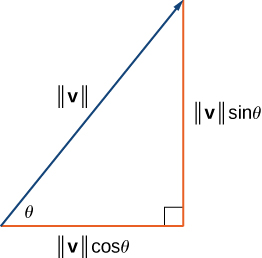
A 2D vector is drawn as the hypotenuse of a right triangle, with the legs representing the perpendicular components along the coordinate axes. The labels show how the components relate to the magnitude via and when is measured from the + axis. This picture helps prevent the common sine/cosine swap by making “adjacent” and “opposite” explicit. Source
The hypotenuse is the vector’s magnitude .
The legs are the component magnitudes and .
The angle is measured from one axis to the vector (you must state which axis you’re using).
Trig relationships for components
If is measured from the + axis toward the vector, then:
The adjacent side corresponds to the -component.
The opposite side corresponds to the -component.
Use cosine for adjacent/hypotenuse and sine for opposite/hypotenuse. The sign of each component comes from direction (left/down negative if your axes define them that way), not from the trig function alone.
= magnitude of the vector (units of the vector)
= -component (same units as )
= -component (same units as )
= angle from + axis to the vector (radians or degrees, consistent with your calculator)
= magnitude of the vector (units of the vector)
= -component (same units as )
= -component (same units as )
A common mistake is swapping sine and cosine because the angle is actually measured from the axis. If is from +, then the “adjacent” side is , so the roles of sine/cosine switch.
Using the Pythagorean theorem appropriately
The Pythagorean theorem applies only when the components are perpendicular:
Valid: and axes (90° apart)
Not valid: two components chosen along non-perpendicular directions
When you compute , the squared terms remove signs; magnitude is always non-negative.
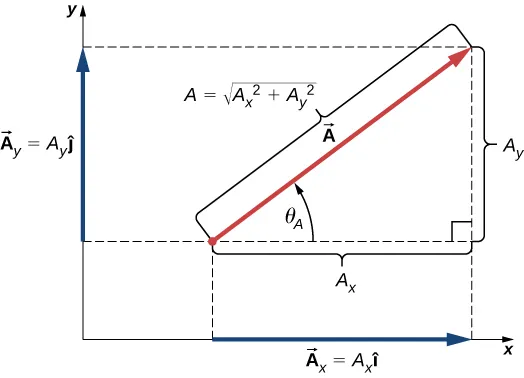
The vector and its perpendicular components are shown forming a right triangle, so the magnitude follows from the Pythagorean theorem: . By tying the geometry to the algebra, the figure clarifies why this magnitude formula is valid specifically for orthogonal – components. It also reinforces that component signs affect direction, not the nonnegative magnitude. Source
Direction must be handled separately.
Angle from components (direction)
To find direction from known components, the basic trig idea is:
(when is from +)
However, the correct direction depends on the quadrant (signs of and ). Many calculators provide an “atan2” function (or equivalent) to determine the correct quadrant; otherwise, you must adjust the angle based on signs.
Checklist for AP Physics 1 Algebra problems
Choose axes and define + directions clearly.
Identify the angle’s reference axis (from + or +).
Use sine/cosine based on opposite/adjacent relative to that angle.
Assign signs to and from direction.
Use the Pythagorean theorem only for perpendicular components.
Practice Questions
Q1 (1–3 marks) A vector has magnitude at an angle of above the + axis. State and .
(1)
(1)
Correct values with units: , (1)
Q2 (4–6 marks) A displacement has components and . Find (i) the magnitude and (ii) the direction as an angle measured anticlockwise from the + axis.
Use (1)
Substitute: (1)
Correct magnitude: (1)
Use or (1)
Recognise quadrant (negative , positive ) and adjust angle (1)
Correct direction: from + (1)
FAQ
Identify which component is adjacent to the given angle.
If the angle is from +$y$, then $|A_y|=A\cos\theta$ and $|A_x|=A\sin\theta$.
Then apply signs based on left/right and up/down.
Switch the calculator mode to match the problem or convert units.
Degrees to radians: multiply by $\pi/180$.
Radians to degrees: multiply by $180/\pi$. Using the wrong mode typically gives a plausible-looking but incorrect component.
Angles are periodic: adding $360^\circ$ (or $2\pi$) gives the same direction. Also, a negative angle (clockwise) can represent the same direction as a positive anticlockwise angle, e.g., $-45^\circ$ equals $315^\circ$.
Check signs first: $(A_x,A_y)$ determines the quadrant. Then ensure the final angle places the vector in that quadrant. If available, use $\text{atan2}(A_y,A_x)$, which returns an angle consistent with both signs.
Yes for perpendicular components: $|A_x|\le A$ and $|A_y|\le A$ because $| \cos\theta |\le 1$ and $| \sin\theta |\le 1$. If a computed component exceeds $A$, it signals a trig/angle/reference-axis error.
