

AP Syllabus focus: ‘Projectile motion has zero acceleration in one dimension and constant, nonzero acceleration in the other dimension.’
Projectile motion is best understood by splitting a two-dimensional path into two independent one-dimensional motions. This makes the curved trajectory predictable using simple constant-acceleration ideas, without needing calculus.
Core idea: two independent directions
In ideal projectile motion (neglecting air resistance), the motion separates into perpendicular components that do not affect each other:
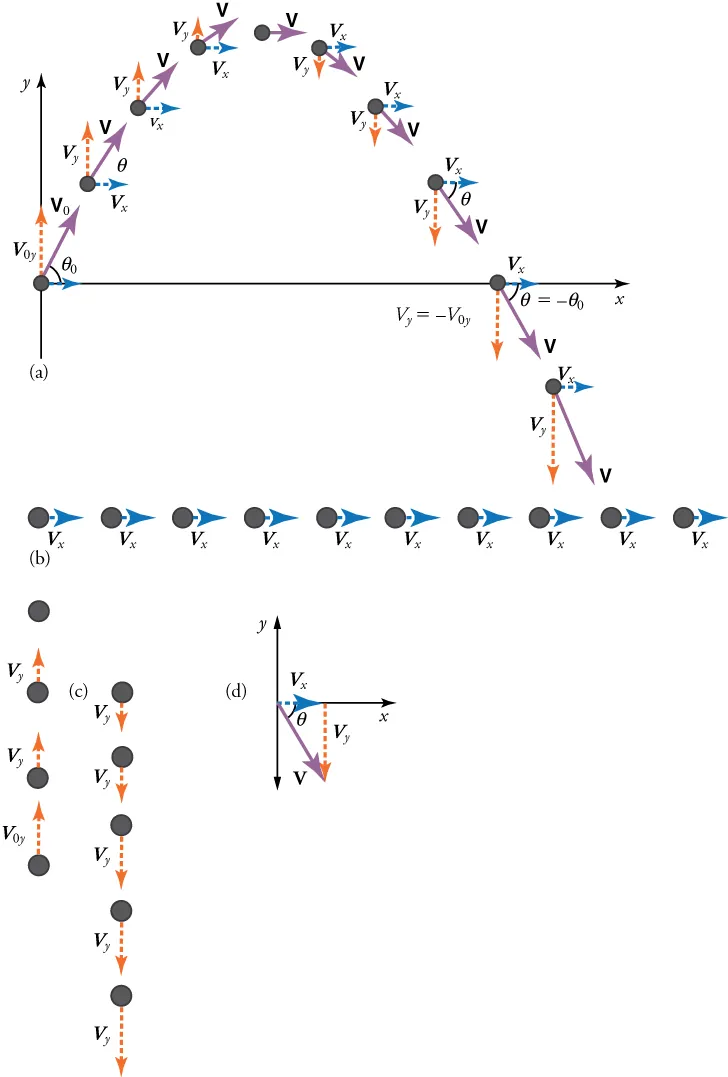
Four-panel diagram showing (a) the full 2D trajectory with and components, (b) constant horizontal motion, (c) changing vertical motion with at the peak, and (d) recombining components to get the total velocity vector. It reinforces that only the vertical component changes due to constant downward acceleration , while keeps constant. Source
Horizontal (x) direction: zero acceleration, so horizontal velocity stays constant.
Vertical (y) direction: constant, nonzero acceleration downward due to gravity.
This is exactly what the syllabus statement means: one dimension has , the other has constant .
Modeling assumptions used in AP Physics 1
Projectile motion problems typically rely on these assumptions:
The object is treated as a point mass (no size or rotation effects).
Air resistance is negligible, so gravity is the only force after launch.
Gravity is constant and downward near Earth’s surface (often use if specified).
Choose a coordinate system with +x horizontal and +y upward (most common).
Projectile motion (ideal) defined
Projectile motion (ideal). Motion of an object that, after launch, moves under the influence of gravity alone, producing constant downward acceleration and no horizontal acceleration.
Components: what stays the same and what changes
A key skill is keeping track of what can change in each direction.
Horizontal component (x)
at all times.
is constant, so equal to its initial value .
Horizontal displacement grows linearly with time.
Vertical component (y)
is constant and downward, so (if +y is up).
changes by equal amounts in equal time intervals.
At the highest point of the trajectory:
but is still (acceleration does not “turn off”)
A common misconception is that acceleration is zero at the top; only the vertical velocity is zero there.
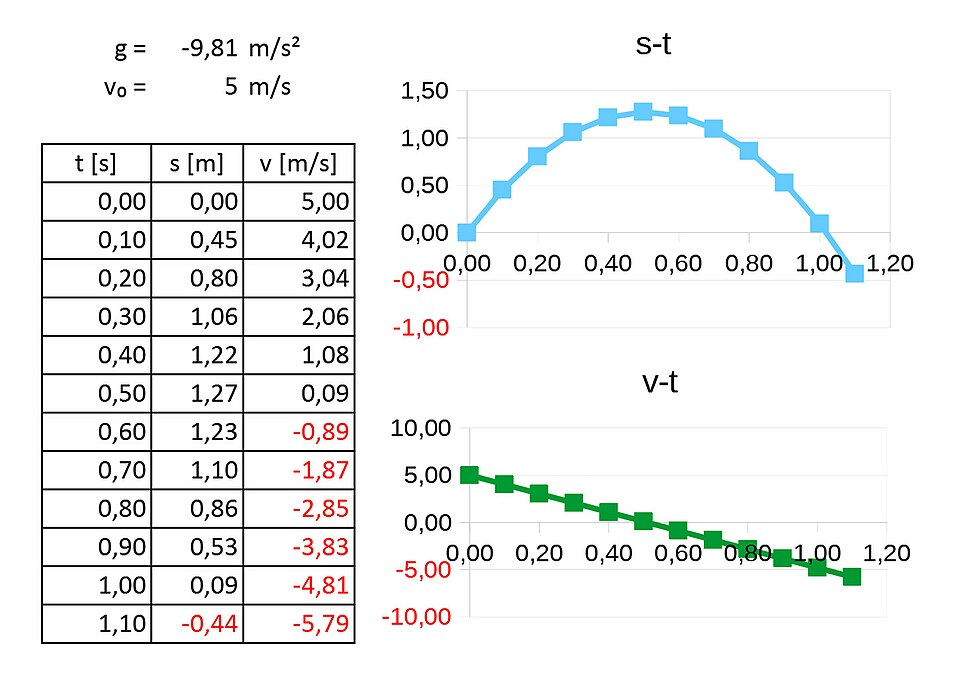
Position–time and velocity–time graphs for a vertically launched projectile under constant acceleration. The graph crosses zero at the top of the motion while maintaining a constant (negative) slope, illustrating that acceleration remains constant even when the instantaneous vertical velocity is zero. Source
Relating launch speed and angle to components
Launch conditions are usually given as an initial speed at an angle above the horizontal, which must be resolved into components.
= initial horizontal velocity (m/s)
= initial speed (m/s)
= launch angle above horizontal (degrees or radians)
= initial vertical velocity (m/s)
= horizontal acceleration (m/s)
= vertical acceleration (m/s)
= gravitational field strength near Earth (m/s)
Once components are found, treat x and y as separate 1D motions that share the same time .
Time links the two one-dimensional motions
The x- and y-motions are independent in cause, but they stay synchronized because they occur over the same time interval.
Use the vertical motion to determine key times (time to peak, total flight time).
Then use that same time in the horizontal motion to find horizontal displacement.
Symmetry (only for same launch and landing height)
If a projectile lands at the same vertical level it was launched from (and air resistance is ignored):
Time going up equals time coming down.
The speed on landing equals the launch speed, but the vertical component reverses sign.
The trajectory is symmetric about the peak.
If the landing height differs from the launch height, the motion is still component-based, but the symmetry statements above no longer apply.
What “range” means in this context
Range is the horizontal distance travelled during the time the projectile is in the air. It depends on:
initial speed and angle (through and )
gravitational acceleration
whether launch and landing heights are the same
total time of flight determined from vertical motion
Practice Questions
(2 marks) A ball is launched and moves as an ideal projectile. State the acceleration in the horizontal direction and the acceleration in the vertical direction (take upward as positive).
(1)
(or “constant downward ”) (1)
(5 marks) A projectile is launched with speed at angle above the horizontal from level ground and lands back at the same level, with air resistance negligible. Explain, using component reasoning, why (i) the horizontal velocity is constant, (ii) the vertical velocity changes, and (iii) the time to rise equals the time to fall.
Identifies only gravity acts after launch, so no horizontal force (1)
Concludes is constant because (1)
States gravity provides constant downward acceleration (1)
Concludes changes due to constant nonzero (1)
Uses symmetry about the peak for equal start/end height: changes from to in same time as from to under constant (1)
FAQ
It’s a simplifying model so only gravity acts, making $a_y$ constant and $a_x=0$.
With air resistance, $a_x$ becomes nonzero and $a_y$ is no longer constant; horizontal speed drops quickly and the path is not symmetric.
Yes, in the ideal model. Height only affects the vertical motion’s time in the air.
As long as air resistance is neglected, $a_x=0$ regardless of starting height.
Pick +x along the main horizontal direction of motion and +y upward.
Set $y=0$ at launch or at ground level, then keep $a_y=-g$ consistent with that choice throughout.
At equal heights, the speed is the same (though the vertical velocity has opposite sign).
This follows from symmetry under constant $a_y=-g$ and unchanged $v_x$.
Because the velocity direction changes: $v_x$ stays constant while $v_y$ changes due to $-g$.
A changing velocity direction produces a curved path even when one component of acceleration is zero.
