

AP Syllabus focus: ‘Contact forces occur when objects touch and are macroscopic effects of interatomic electric forces.’
Contact forces are the everyday pushes and pulls you feel directly: floors supporting you, ropes pulling objects, and air resisting motion. In AP Physics 1, these forces are modeled macroscopically but originate microscopically.
What a Contact Force Is (and Isn’t)
Contact forces require physical contact between objects, unlike long-range forces (in AP Physics 1, essentially just gravity). Even though they look “mechanical,” their root cause is electrical interaction between atoms and molecules.
Contact force: A force on an object due to direct interaction with another object at the surface(s) where they touch, arising from microscopic electromagnetic interactions.
A key idea: surfaces never truly “interpenetrate.” When objects touch, their electron clouds interact, leading to forces that prevent overlap and can also resist sliding.
Microscopic cause: interatomic electric forces
At the atomic scale:
Atoms contain charged particles (electrons and protons).
When two materials are pressed together, the electron clouds come very close.
The net effect is typically a strong repulsive interaction at very short distances, plus possible weaker attractive effects (depending on materials and surface conditions).
Macroscopically, we do not calculate these electric forces directly; we represent their combined effect as a few familiar contact forces.
The Normal Force: Support from Surface Deformation
When an object presses on a surface, both objects deform (often imperceptibly). The material’s internal electromagnetic bonds resist this compression and create a force on the object, perpendicular to the surface.
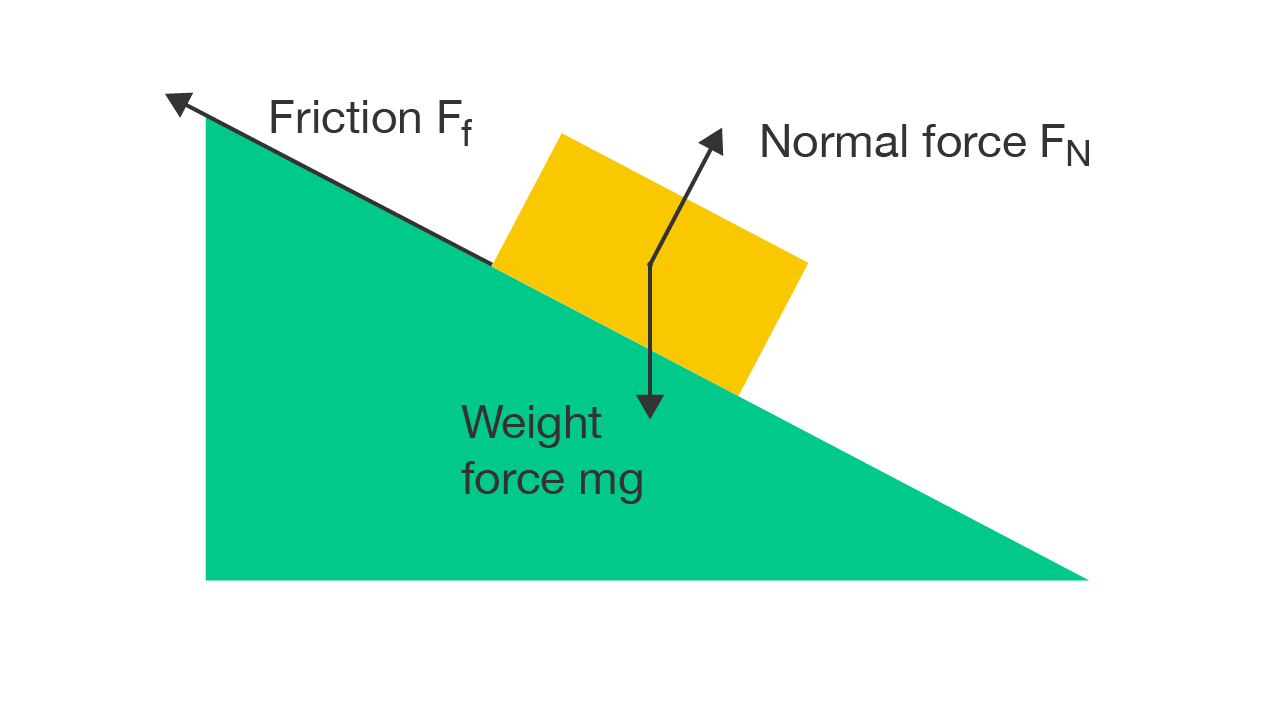
Free-body style diagram for a block on an incline showing the normal force perpendicular to the surface, friction parallel to the surface, and weight vertically downward. This picture helps you translate a real contact interaction at a surface into the simplified forces used in AP Physics 1. Source
Normal force: The contact force exerted by a surface on an object, directed perpendicular (normal) to the surface, due to microscopic repulsion and deformation at the contact.
Important features for AP modeling:
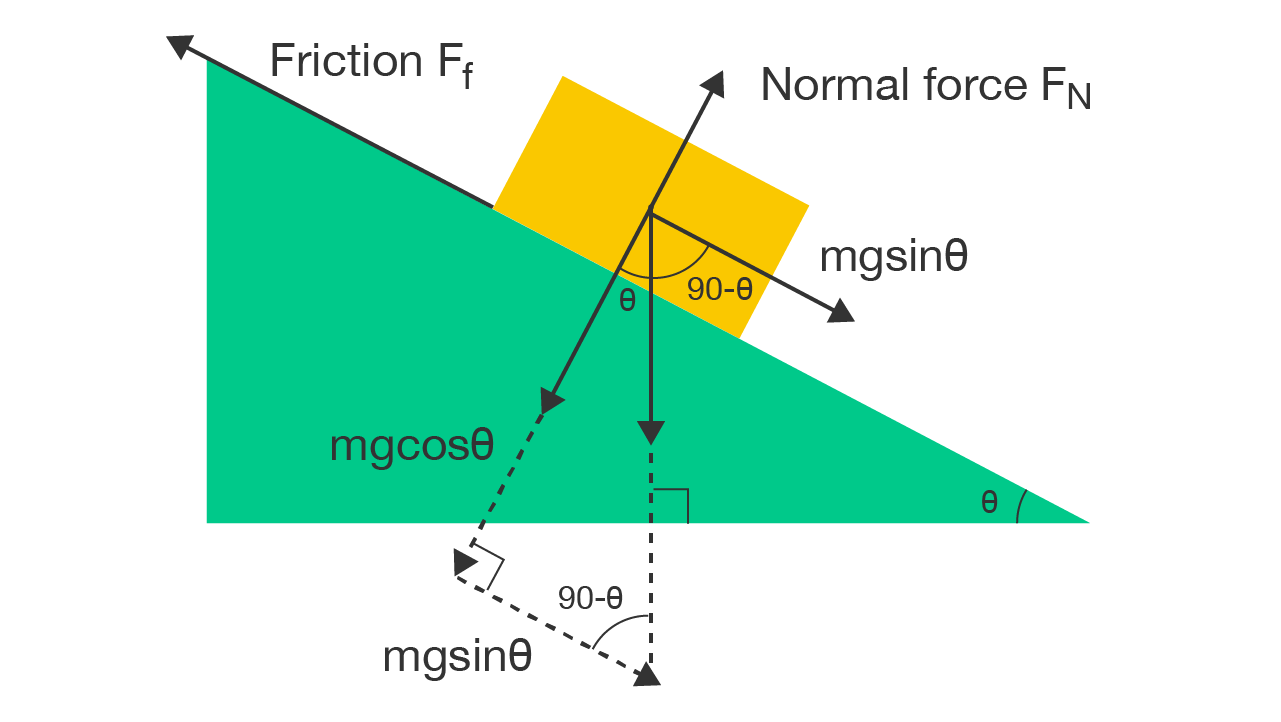
Incline-plane diagram that explicitly resolves the weight into components (parallel) and (perpendicular) while also showing and friction. The component picture clarifies why the normal force adjusts with surface angle and why friction acts along the surface rather than perpendicular to it. Source
Direction: perpendicular to the surface, not automatically “up.”
Magnitude: adjusts to satisfy the object’s motion constraints (it is not automatically equal to weight).
Origin: collective electromagnetic interactions as the surface resists compression.
Friction: Tangential Contact Force from Microscopic “Sticking”
Real surfaces have microscopic roughness and can also experience molecular adhesion. When two surfaces touch:
Tiny high points (asperities) can interlock.
Electron-level attractions can create brief bonds at contact points.
These effects produce a contact force parallel to the surface that opposes relative motion or the tendency to slip.
Friction force: A contact force parallel to the surfaces in contact that opposes relative motion (or impending motion) between them, arising from microscopic roughness and adhesion.
In this subsubtopic, the emphasis is causal: friction exists because surface atoms interact electrically while being pressed together.
Tension and Push/Pull Forces: Contact Through Materials
When you pull on a rope, you are not “sending a force through empty space.” You deform the rope slightly; its molecular bonds resist being stretched and exert forces on the objects at its ends. Similarly, a push on a block is transmitted through contact between your hand and the block’s surface.
Key microscopic picture:
Compression in solids: atoms are pushed closer; repulsion increases.
Stretching in solids: bonds are extended; restoring forces develop.
The macroscopic result is a contact force applied at the interface (hand–object, rope–object).
Contact Forces in Fluids: Drag as Collisions and Pressure Differences
When an object moves through air or water, it continually collides with fluid molecules and creates pressure variations around its surface. The fluid’s contact forces on the object can include:
A resistive force opposite motion (commonly called drag)
Forces due to pressure differences on different sides of the object
This is still the same fundamental story: countless electromagnetic interactions during molecular collisions and short-range repulsions add up to a net contact force.
Why AP Treats Them Macroscopically
In problems, you typically:
Identify the contacting objects (surface–object, rope–object, fluid–object).
Represent the interaction with an appropriate single resultant force (normal, friction, tension, drag), even though the real interaction is distributed across many microscopic contact points.
Remember that an object cannot exert a net force on itself: every contact force comes from another object in the environment.
Practice Questions
Q1 (2 marks) A book rests on a table. Explain, in terms of microscopic interactions, what causes the table to exert an upward contact force on the book.
(1) Mentions interatomic/intermolecular electric forces (electron cloud interactions) between book and table.
(1) Explains these forces arise when surfaces deform/compress and resist overlap, producing an upward support (normal) force.
Q2 (5 marks) A student claims: “Friction is a separate fundamental force from electricity.” Using the microscopic model of contact forces, assess this claim and describe two microscopic features that contribute to friction between dry surfaces.
(1) States friction is not fundamental; it is a macroscopic result of electromagnetic interactions at the surfaces.
(1) Links friction to interactions between atoms/molecules in contact (electric forces).
(1) Describes microscopic roughness/asperity interlocking.
(1) Describes adhesion/molecular bonding at contact points.
(1) Connects these features to a tangential force opposing relative motion or impending slip.
FAQ
Not necessarily. Even if geometric roughness were eliminated, adhesion can remain: atoms at very small separations can form transient bonds.
In practice, friction depends on surface films, contamination, and material chemistry as well as roughness.
The dominant short-range response of a surface is to resist interpenetration, which occurs along the direction the surfaces push into each other.
That resistance is modelled as a force normal to the surface; tangential effects are grouped into friction-like forces.
Air contains molecules moving rapidly. When an object moves through air, molecules collide with it and exchange momentum.
The net effect of many collisions and pressure differences is a measurable contact force (often drag).
Physically it is distributed over an area via many microscopic contact points.
In AP modelling, it is simplified to a single resultant force representing the combined effect of that distribution.
Yes, in some situations (e.g., adhesives, suction cups, gecko-like adhesion), electromagnetic interactions and pressure effects can create an effective attraction.
However, the “support” normal force in typical solids is mainly due to short-range repulsion during compression.
