

AP Syllabus focus: ‘Choosing a coordinate system parallel to the acceleration, such as along an incline, simplifies writing algebraic equations.’
Choosing axes is a strategic step that can turn a messy force problem into simple algebra. By aligning axes with acceleration and constraints, you reduce components, minimise trig, and avoid sign mistakes.
Why axis choice matters
In Newton’s laws problems, the physics does not change when you rotate your axes, but the algebra does. A smart axis choice can:
Make one component of acceleration zero (so one force equation becomes simpler).
Reduce the number of forces that need to be broken into components.
Make signs consistent with the motion you expect.
Key idea: align with what’s “special”
Axes are most useful when aligned with:
The acceleration direction (or the direction the object is trying to accelerate).
A surface that constrains motion (like an incline, wall, or track).
The direction of a string or rod that constrains motion along a line.
Essential terms
Coordinate system: A chosen set of perpendicular axes (often and ) used to describe directions for vectors like force and acceleration.
A coordinate system is a choice you control; the goal is to make equations easy, not to match “up” and “sideways” automatically.
Component (of a vector): The projection of a vector along a chosen axis, treated as a signed scalar in that direction.
Once axes are chosen, every force and the acceleration can be replaced by their components along those axes.
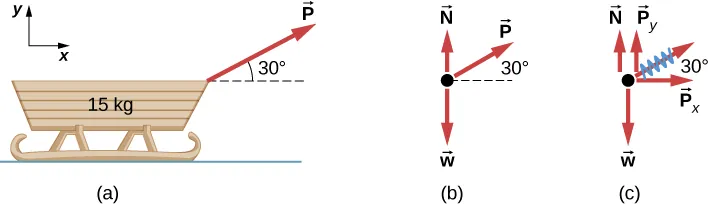
A free-body diagram is shown first with a single angled applied force, then redrawn with that force split into perpendicular components along the chosen axes. This illustrates the procedural step that turns a vector equation into two scalar equations, one per axis. The diagram also emphasizes that the choice of axes controls how much component-splitting is required. Source
Force equations become component equations
After choosing axes, write Newton’s second law separately along each axis.
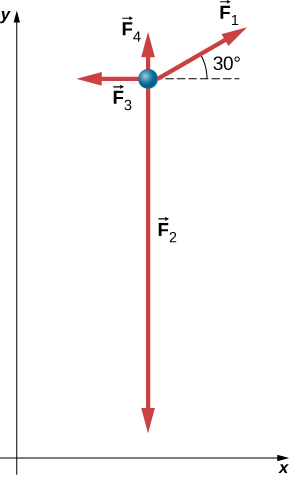
Several forces acting on a particle are drawn on an – coordinate system, including one force at a angle. This setup naturally leads to writing two independent component equations, and , by projecting each force onto the axes. The image helps students see how “angled forces” translate into separate x- and y-contributions in the algebra. Source
Insert example content here...EQUATION
= net force component along the -axis (N)
= mass of the object or system (kg)
= acceleration component along the -axis (m/s)
= net force component along the -axis (N)
= acceleration component along the -axis (m/s)
These equations are most powerful when your axis choice makes either or in one direction especially simple.
Choosing axes in common AP Physics 1 situations
Inclined surfaces (the classic “choose along the incline” move)
When an object moves or tends to move along an incline, choose:
parallel to the surface (often down/up the ramp)
perpendicular to the surface
This is exactly the syllabus point: choosing a coordinate system parallel to the acceleration, such as along an incline, simplifies writing algebraic equations.
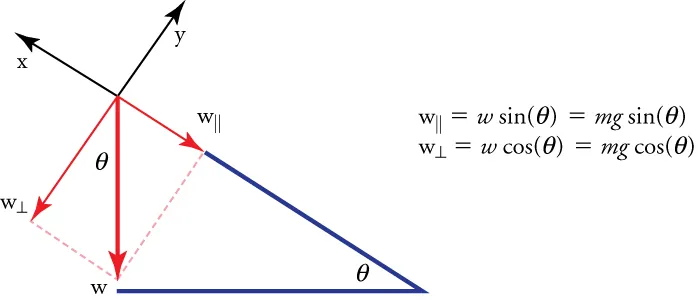
A block on an incline is analyzed using axes aligned with the plane, so the weight is resolved into components parallel and perpendicular to the surface. With this axis choice, the perpendicular component relates directly to the normal force, and the parallel component determines the downhill (or uphill) acceleration. The picture visually motivates the common results (along the plane) and (into the plane). Source
With this choice:
The normal force lies entirely along (no components needed).
The acceleration often lies entirely along (so if the object stays on the surface).
Only weight typically needs to be split into components.
Horizontal surfaces
If motion is horizontal, choose:
horizontal (direction of motion/acceleration)
vertical
This often makes , so the vertical force equation becomes a quick constraint equation rather than a “motion” equation.
Objects pulled at an angle
If a force is applied at an angle (like a rope pulling up-and-forward), you can choose axes either:
Standard horizontal/vertical (often easiest for gravity), or
One axis along the acceleration (if acceleration direction is known and fixed)
Pick the choice that minimises the number of angled forces you must resolve.
Sign conventions and consistency checks
Good axis choices still require consistent signs.
Choose a positive direction along each axis (state it mentally or in writing).
Components pointing opposite your positive axis are negative.
If your solved acceleration comes out negative, it usually means the object accelerates opposite your initial positive choice (not automatically that you made a mistake).
A quick check: if an object stays in contact with a surface, the axis perpendicular to the surface often has zero acceleration, so your equation in that direction should reflect balance of components in that direction.
Practice Questions
(2 marks) A block slides down a frictionless incline. State a convenient choice of axes and give one reason why this choice simplifies the equations.
1 mark: Axes chosen with one axis parallel to the incline and the other perpendicular to it.
1 mark: Reason linked to simpler components, e.g. and/or normal force lies entirely perpendicular so no need to resolve it, and only weight needs resolving.
(5 marks) A box is pushed up a ramp at constant speed. Explain how you would choose axes to write force equations efficiently, and state what each component equation represents. Do not calculate anything.
1 mark: Choose axes parallel and perpendicular to the ramp.
1 mark: State that motion/acceleration is along the ramp so the parallel equation controls speed change (here ).
1 mark: State perpendicular acceleration is zero () because the box remains on the surface.
1 mark: Explain that the normal force is entirely in the perpendicular direction with this axis choice.
1 mark: Identify that weight must be resolved into components parallel and perpendicular to the ramp (or equivalent statement about which forces need resolving).
FAQ
Use the dominant constraint first (e.g. along/perpendicular to a surface or along a taut string). If the motion could reverse, pick an axis direction anyway; a negative result later simply indicates the true direction is opposite.
Yes, if multiple angled forces exist and only one is aligned with the incline. If resolving several forces would require trig either way, it can be cleaner to use horizontal/vertical and resolve only one or two forces.
Draw the right triangle formed by the vector and its components along your axes. Use basic trig definitions: adjacent with $\cos$, opposite with $\sin$, always referencing the angle between the vector and the axis direction.
In AP Physics 1, you should keep axes perpendicular. Non-orthogonal axes complicate component addition and are not expected for algebra-based free-response solutions.
Write a small “+” arrow for each axis direction, then assign each force component a sign by whether it points with or against that arrow. If you change your axis direction mid-problem, rewrite the component signs rather than trying to ‘flip’ an existing equation.
