

AP Syllabus focus: ‘A free-body diagram shows each force exerted by the environment on one object or system.’
Free-body diagrams (FBDs) turn a physical situation into an organized force picture. If you can correctly isolate the object and represent only the external forces, the algebraic force equations become much easier to write and interpret.
What a Free-Body Diagram Represents
Core idea
An FBD is a simplified sketch of a single chosen object or system with all external forces acting on it drawn as vectors. Everything else (other objects, surfaces, fields) becomes the environment that exerts those forces.
Free-body diagram (FBD): A diagram of an isolated object or system showing every force exerted on it by the environment, drawn as vectors acting on that object or system.
A correct FBD is not “a picture of the scene.” It is a force inventory for one target.
External vs. internal forces (for systems)
When you choose a system (more than one object treated together), forces between objects inside the system are internal and are not drawn on the system’s FBD.
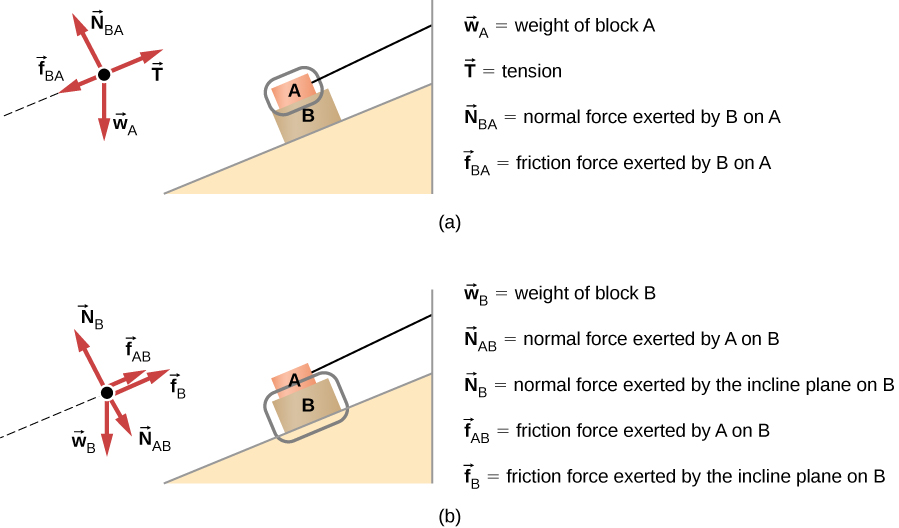
Two separate free-body diagrams for two objects on the same incline, with forces labeled by both type and agent (e.g., and ). This makes it explicit that the forces you draw depend on the chosen target: the interaction forces between A and B are external to each individual object, but would be internal (and omitted) if A and B were treated as one system. Source
Only forces exerted from outside the system count as external forces on that system.
How to Draw an FBD (Process)
Step-by-step method
Choose the target: Decide the exact object or the exact system boundary.
Sketch a simple shape: A dot or box is enough; do not draw extra details.
Identify interactions with the environment:
Contact with surfaces/strings/other objects
Long-range interactions (e.g., gravity)
Draw one force vector per interaction acting on the target.
Label each force clearly (preferably with both type and agent when helpful), e.g., “normal force from ramp on block.”
Choose axes (optional for the diagram itself): If you plan to resolve components, lightly indicate your coordinate directions next to the FBD.
Force-vector drawing rules
Vectors start on the object (commonly from its center for translational problems).
Arrow direction shows the force direction; arrow length can indicate relative magnitude when known.
Do not combine forces into one “net force arrow” on the FBD; keep forces separate so the algebra is transparent.
Reading an FBD (From Diagram to Equations)
Once forces are identified, the net force is the vector sum of all forces on the target.
= net external force on the chosen object/system, in newtons (N)
= each individual external force vector acting on the object/system, in newtons (N)
To “read” an FBD effectively:
Check completeness: Is every environment interaction represented by exactly one force?
Check exclusivity: Are there any forces that should not be there (internal forces, forces the object exerts on others)?
Relate directions to motion carefully: The direction of motion is not automatically the direction of net force; the FBD determines net force, not vice versa.
Common Forces You Must Recognise on FBDs
Include only forces that are actually exerted on the target by the environment:
Weight (gravitational force by Earth on the object): always points downward near Earth.
Normal force: exerted by a surface, perpendicular to the surface (not always upward).
Tension: exerted by a taut string/rope/cable, along the string away from the object.
Friction: exerted by a surface, parallel to the surface, opposing relative motion or attempted slipping.
Applied push/pull: an external contact force from a person/object, in the direction of the push/pull.
Frequent AP-Level Mistakes (and How to Avoid Them)
Including forces the object exerts on the environment: An FBD shows forces on the object, not forces by the object.
Double-counting interactions: For example, splitting one contact into multiple “applied forces” without a physical reason.
Assuming automatically: Normal force depends on the situation; draw it based on contact geometry, not a memorised equality.
Drawing motion arrows instead of force arrows: Velocity/acceleration can be shown separately, but they are not forces.
Forgetting the system choice: If you switch from “block only” to “block + rope,” the correct set of external forces changes.
Practice Questions
(2 marks) A book rests at rest on a horizontal table. Draw the free-body diagram for the book and label each force.
1 mark: Correctly shows weight acting downward on the book ().
1 mark: Correctly shows normal force from the table acting upward on the book ().
(5 marks) A crate is pulled across a rough horizontal floor by a rope at an angle above the horizontal. Draw the free-body diagram for the crate and label all forces. State the direction of friction and briefly justify it.
1 mark: Weight () vertically downward.
1 mark: Normal force () perpendicular to floor (upward).
1 mark: Tension/pull force along the rope at an upward angle.
1 mark: Friction force along the floor opposing the relative motion (opposite intended/actual sliding).
1 mark: Justification that friction opposes relative motion or tendency to slip, not necessarily the applied force direction.
FAQ
Use static friction if the surfaces are not slipping relative to each other (including “about to slip”). Use kinetic friction only when sliding is occurring.
Clues: phrases like “moves at constant speed” (kinetic) versus “does not move” (static).
On an FBD, it is usually best to draw the single original force vector first.
You may then add component arrows separately if it helps your equations, but don’t replace the original force unless your teacher/exam context explicitly expects components-only.
Write forces as “agent on object,” e.g., “floor on block” for the normal force.
This makes it harder to accidentally include the reaction force, which acts on the other object.
Draw the direction correctly and use a reasonable generic length; unknown magnitude does not prevent you from making a correct FBD.
If you know relative sizes (e.g., one force is larger), you can show that qualitatively.
Make a list of all environment interactions mentioned or implied (surface contact, string, gravity, hand, etc.), then confirm there is exactly one force for each interaction and no extras.
Re-read what object/system you isolated to ensure you didn’t include internal forces.
