

AP Syllabus focus: ‘Forces are vectors that describe interactions between objects or systems; an object cannot exert a net force on itself.’
Forces are not “things an object has.” In AP Physics 1, a force is an interaction between two objects (or systems) that can change motion and is described with both magnitude and direction.
What a force represents
A force is a model for how one object influences another through an interaction. Every force you write down should answer two questions: “On what object?” and “Exerted by what other object?”
Force — a vector quantity that represents an interaction between two objects (or systems) that can change an object’s motion and/or deform it.
Forces are measured in newtons (N), and the unit can be expressed in base SI units.
= one newton, the SI unit of force
= kilogram, unit of mass
= metres per second squared, unit of acceleration
Forces as interactions between objects (or systems)
The syllabus emphasis is that forces are vectors describing interactions. That has several practical consequences:
Each force has two “participants”
A single force always involves:
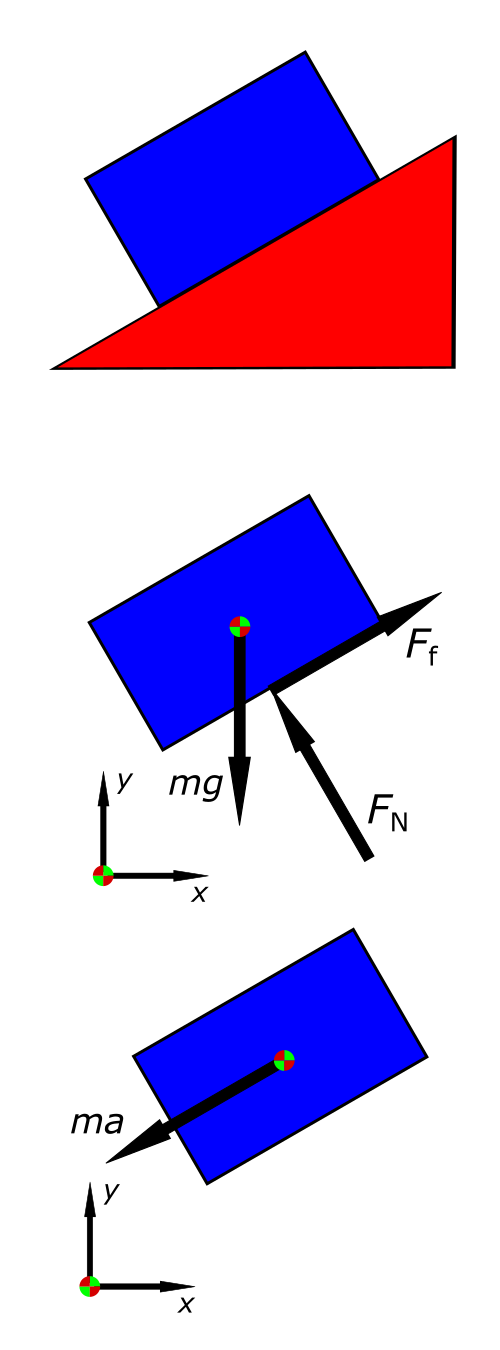
A free-body diagram isolates one object and shows all external forces acting on it as vectors. The labeled arrows (e.g., weight , normal force , and friction ) make the “on object/by object” idea concrete by showing which interactions the environment exerts on the object. This kind of diagram is the standard starting point for translating interactions into equations. Source
the object experiencing the force (the “on” object)
the object exerting the force (the “by” object)
A clear notation is: , meaning “the force exerted by A on B.” This helps prevent common errors such as listing a force without identifying its interaction partner.
Interaction forces come in pairs across the two objects
If object A exerts a force on object B, then object B exerts a force on object A at the same time.
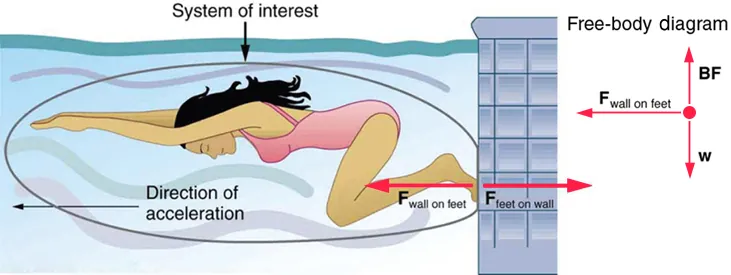
This figure shows an interaction where one object pushes on another and receives an equal-and-opposite force in return, exemplifying Newton’s third law. Because the two forces act on different objects, they are not combined as forces on a single system unless you intentionally choose the combined system. The diagram helps prevent the common mistake of pairing forces that do not act on the same free-body diagram. Source
These two forces:
are the same type of interaction (e.g., contact, gravitational)
have equal magnitude and opposite direction
act on different objects, so they do not “cancel” on a single object
(You do not add an interaction pair together unless you are analysing both objects at once.)
Why an object cannot exert a net force on itself
The specification statement “an object cannot exert a net force on itself” means you should never include a “self-force” in an analysis of one object. Any forces that parts of an object exert on other parts of the same object are internal to that object and cannot change the motion of the object as a whole without an external interaction.
Ways this idea shows up in reasoning:
Pulling on your own hands with a rope creates forces within the rope-hand system, but there is no external agent providing an unbalanced interaction on the system as a whole.
If you isolate a single object as your system, you only include forces exerted by the environment (other objects outside that system). The object itself is not an “outside object,” so it cannot contribute a net external force on itself.
This is a common conceptual checkpoint: if your force list includes “force of the object on itself,” you have misidentified the interacting objects.
Common interaction partners to look for
When you identify forces, think in terms of “What other object is touching it or influencing it?”
Typical interaction partners include:
Earth (gravitational interaction)
a surface (contact interaction)
a rope/cable (interaction through tension)
a spring (spring interaction)
a fluid like air or water (drag, buoyant interaction)
another moving or stationary object (push/pull contact interaction)
Vector nature: direction matters because interactions have direction
Because forces are vectors, the direction of the interaction is as important as its size.
Two equal forces applied in different directions are not equivalent, and multiple interactions combine according to vector addition. Keeping careful track of direction is part of correctly modelling the physical interactions present.
Practice Questions
(1–3 marks) A book rests on a table. State two forces acting on the book and, for each, name the object exerting that force.
Weight (gravitational force) on the book exerted by the Earth (1)
Contact/support force on the book exerted by the table (1)
(4–6 marks) A student pushes horizontally on a wall with her hand.
(a) Identify the force exerted by the student on the wall and the force exerted by the wall on the student, using clear “by/on” wording.
(b) Explain why these two forces do not cancel when analysing the motion of the student alone.
(c) State whether the student can exert a net force on herself, and justify briefly.
(a) Force exerted by student (hand) on wall (1)
(a) Force exerted by wall on student (hand) (1)
(a) Forces are equal in magnitude and opposite in direction (1)
(b) They act on different objects (student vs wall), so they are not added together for one object (1)
(c) Student cannot exert a net force on herself (1)
(c) Because forces are interactions with other objects; internal forces within the student do not provide a net external force (1)
FAQ
Yes. The interaction forces are equal in magnitude and opposite in direction.
Different masses can still accelerate differently because acceleration depends on mass as well as the force acting on each object.
Third-law pairs act on two different objects, so they cannot balance each other on a single object.
Balanced forces are multiple forces on the same object whose vector sum is zero.
It’s shorthand. More precise language is “a force acts on the object due to another object.”
Using “by/on” wording reduces confusion about where the force comes from.
Yes. Motion is not required for an interaction force to exist.
A stationary object can experience forces from other objects that are equal and opposite when combined.
Forces between objects inside the chosen system are internal interactions.
Only forces exerted by objects outside the system are external interactions you include when discussing the system’s overall motion.
