

AP Syllabus focus: ‘Internal forces between objects in a system do not affect the motion of the system�s center of mass.’
Understanding how internal forces cancel at the system level is essential for analyzing interactions like pushes, collisions, and explosions. This idea lets you predict center-of-mass motion without tracking every force between individual objects.

A two-body system with masses and and the center of mass marked between them. The placement illustrates how the center of mass depends on the mass distribution, giving a concrete reference point for applying system-level motion ideas. Source
Core Idea: Internal Forces Don’t Move the System’s Center of Mass
When you define a system that contains multiple interacting objects, forces can be split into:
Internal forces: forces objects in the system exert on each other
External forces: forces exerted on the system by the environment
The key claim in this subsubtopic is that internal forces may change how objects move relative to each other, but they do not change the motion of the center of mass of the entire system.
What “internal forces don’t affect center-of-mass motion” means
Internal forces can be large (e.g., tension, contact forces during a collision), but they come in Newton’s third law pairs within the system. Each pair is equal in magnitude and opposite in direction, so the vector sum of all internal forces is zero when considering the whole system.
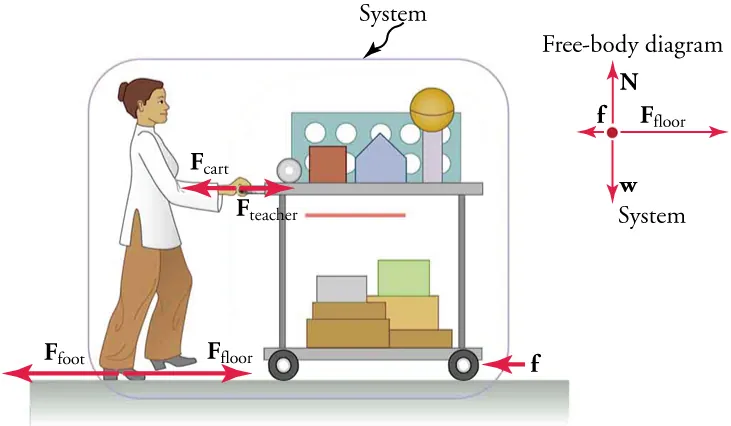
A system diagram and free-body diagram for a teacher pushing a cart, where internal contact forces within the chosen system are excluded from the system FBD. The remaining external forces (e.g., friction and the floor’s forward force) determine the system’s net external force and thus the center-of-mass acceleration. Source
Definitions You Must Use Precisely
Internal force: A force exerted by one object in a system on another object in the same system.
Internal forces can speed up one object and slow down another, but they cannot provide a net “push” on the system as a whole.
A separate label is needed for forces coming from outside the system boundary.
External force: A force exerted on a system by an object (or field source) that is not part of the system.
The System-Level Equation for Center-of-Mass Motion
For AP Physics 1, the motion of the center of mass is governed by the net external force on the system.
Internal forces do not appear in the final system equation because they cancel in pairs.
= net external force on the system, in N
= total mass of the system, in kg
= acceleration of the center of mass, in m/s
This equation is a powerful shortcut: once you choose the system, you only need external forces to determine how the center of mass accelerates.
How Internal Forces Cancel (Newton’s Third Law Inside a System)
If object A and object B are both inside the system, then the force of A on B and the force of B on A are:
the same type of interaction
equal in magnitude
opposite in direction
acting on different objects (but both still inside the system)
When summing forces over the entire system, these two forces add to zero. As a result:
internal forces can change the system’s internal energy and relative motion
internal forces cannot change the system’s total “external push,” so they cannot directly change
Practical Modelling Steps (AP-Algebra Workflow)
Step 1: Choose the system boundary
Common choices:
two colliding carts together as one system
two masses plus string as one system
fragments produced by an explosion as one system
Step 2: List forces and classify them
If the force comes from an object outside the boundary, it is external
If the force is between objects both inside, it is internal
Step 3: Predict center-of-mass motion using only external forces
If , then , so the center of mass moves with constant velocity (possibly zero).
If , the center of mass accelerates in the direction of .
Key Consequences You Should Be Able to State
In an isolated system (no net external force), internal forces may cause dramatic internal changes (separation, deformation, recoil), but the center of mass continues in a straight line at constant speed.
In collisions where external forces are small during the interaction time, the center-of-mass motion is approximately unchanged during the collision interval.
If an external force acts (like friction with the ground), then the center of mass can accelerate even if internal forces are present.
Common AP Pitfalls (Concept Checks)
A force pair from Newton’s third law does not cancel on a single-object free-body diagram; the cancellation happens only when both objects are included in the same system.
Do not include internal forces in when using the center-of-mass equation; doing so double-counts interactions that cancel at the system level.
The center of mass can move even while objects within the system move in complicated ways; internal forces determine the internal motions, not the system’s overall acceleration.
Practice Questions
Q1 (2 marks) Two skaters push off each other on frictionless ice. Treat both skaters as one system. State the net external horizontal force on the system and describe the motion of the system’s centre of mass.
Net external horizontal force is (1)
Centre of mass has constant velocity (straight-line; could be at rest) (1)
Q2 (5 marks) Two carts, A and B, are initially at rest on a level track. A spring between them is compressed and then released, pushing them apart. Consider the system to be both carts plus the spring. Neglect friction. (a) Identify two internal forces present during the release. (2 marks) (b) State and justify the acceleration of the centre of mass during the release. (3 marks)
(a)
Force of spring on cart A (1)
Force of spring on cart B (1) (b)
(b)
Net external force on the system is horizontally (1)
Internal forces cancel in the system force sum (Newton’s third law pairs within system) (1)
Therefore and the centre of mass velocity stays constant (here, remains zero) (1)
FAQ
Internal forces can do equal-and-opposite impulses on different parts.
One object gains momentum while another gains the opposite momentum, keeping the system’s total momentum (and centre-of-mass motion) unchanged when $\sum \vec F_{\text{ext}}=0$.
Yes, provided the forces are an interaction pair between the same two objects.
At each instant, the forces are equal and opposite; integrated over time, their impulses also cancel for the full system.
Forces are classified by whether both interacting objects are inside the boundary.
If you exclude one object (e.g., only cart A), the same interaction force becomes external to that smaller system.
Only if there is a nonzero net external force.
If $\sum \vec F_{\text{ext}}\neq 0$ (e.g., friction, a push from a wall), then $ \vec a_{\text{cm}}=\sum \vec F_{\text{ext}}/M$ regardless of internal activity.
Small external forces are often present:
rolling resistance or air drag
slight track tilt
external contact during the event
These make $\sum \vec F_{\text{ext}}$ nonzero, so the centre of mass can slowly accelerate.
