

AP Syllabus focus: ‘Newton’s third law describes interactions using paired forces that two objects exert on each other.’
Newton’s third law is a consistency rule for forces in interactions. It helps you identify which forces come in pairs, avoid common free-body diagram mistakes, and reason about motion in systems of multiple objects.
Core idea: forces come from interactions
A force is not something an object “has”; it is something that happens between two objects (or systems). When object A interacts with object B, each exerts a force on the other.
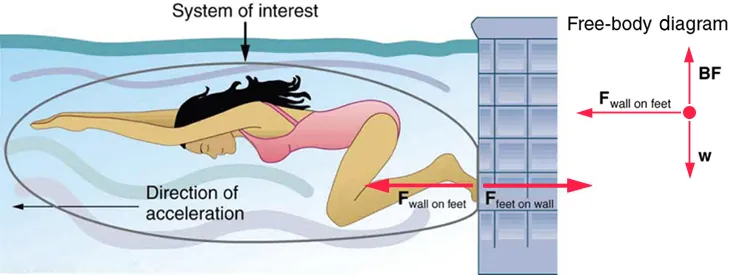
A swimmer pushes on a pool wall; the wall exerts an equal-magnitude force back on the swimmer in the opposite direction, illustrating an interaction force pair. The accompanying free-body diagram emphasizes that the diagram for one object includes only forces on that object, so the third-law partner force belongs on the other object’s diagram. Source
Newton’s Third Law (force-pair statement)
Newton’s third law force pair: Two forces from the same interaction, exerted on different objects, equal in magnitude and opposite in direction: “force of A on B” and “force of B on A.”
A third-law pair always involves:
Two objects (A and B)
One interaction (contact or noncontact)
Two forces (one on each object)
How to write and recognise a third-law pair
Use precise naming: “force on X by Y”. This prevents confusing which object the force acts on.
Action–reaction notation and algebraic form
= force exerted by A on B (newtons, N)
= force exerted by B on A (newtons, N)
This equation encodes two facts:
Equal magnitudes:
Opposite directions: the vectors point in opposite directions along the same interaction line
Checklist for identifying a true third-law pair
Are the forces on different objects? (They must be.)
Do the forces come from the same interaction? (One contact, or one gravitational interaction, etc.)
Are the forces opposite in direction and equal in magnitude?
Would both forces disappear if the interaction disappeared (objects separate / no longer attract)?
If any answer is “no,” you are not looking at a third-law pair.
Common misconceptions to avoid
“Third-law forces cancel, so nothing moves”
Third-law forces do not cancel each other for a single object, because they act on different objects. Motion depends on the net force on each object separately.
For example, if you push a cart:
Your hand exerts a force on the cart.
The cart exerts an equal and opposite force on your hand. The cart can still accelerate because the forces on the cart (push forward, friction backward, etc.) may not sum to zero.
“Normal force and weight are a third-law pair”
They are usually not a third-law pair because both can act on the same object (a block), while third-law pairs act on different objects.
Weight: gravitational force on block by Earth
Normal force: contact force on block by surface
The third-law partner of the block’s weight is the gravitational force on Earth by the block. The partner of the normal force on the block is the normal force on the surface by the block.
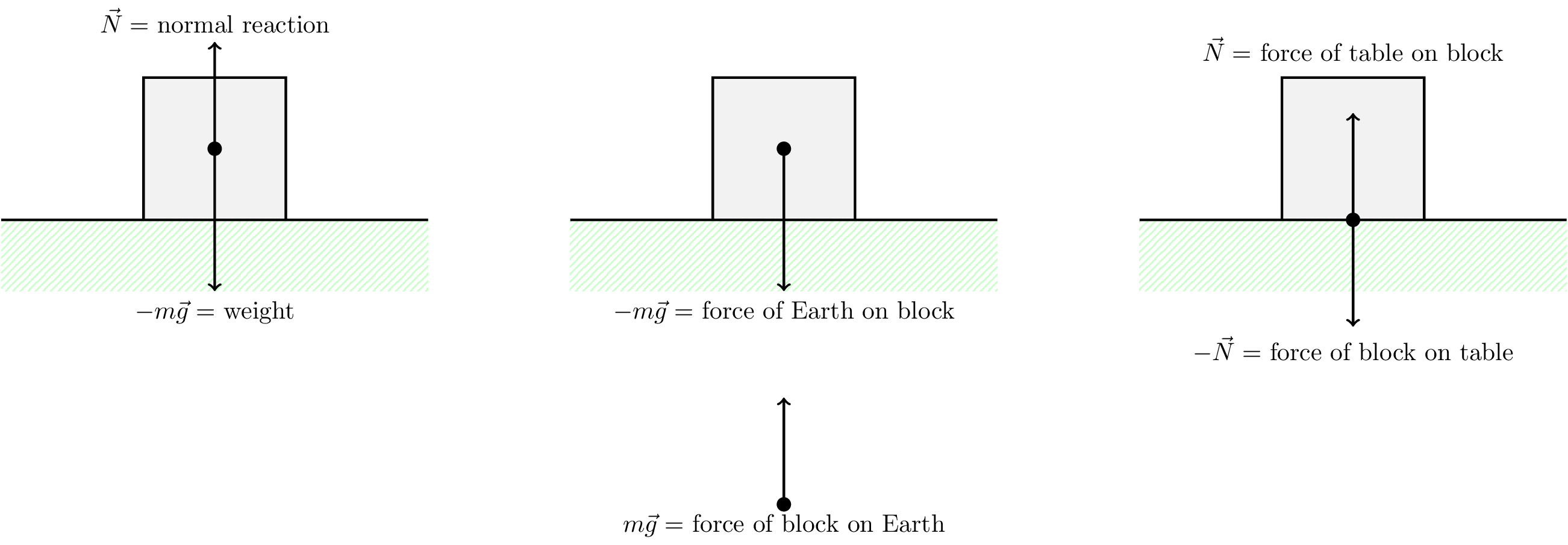
A block-on-table diagram showing the forces on the block ( upward and downward) and, separately, the correct Newton’s third-law pairs for gravity (Earth on block vs. block on Earth) and contact (table on block vs. block on table). It visually reinforces that equal-and-opposite forces on the same object (like and on the block) are not a third-law pair; third-law partners act on different objects. Source
“If masses differ, forces in the pair differ”
The forces in a third-law pair are always equal in magnitude, regardless of mass. Different masses lead to different accelerations because depends on , but the interaction forces match in magnitude.
How third-law pairs appear in free-body diagrams
A free-body diagram (FBD) includes only forces acting on one chosen object. Because third-law partners act on a different object, they usually appear on a different FBD.
Practical method for multi-object situations
Draw an FBD for object A.
For each force on A by B, immediately note (mentally or in words) the partner: force on B by A.
Then draw the FBD for object B, and include that partner force.
This method helps with:
Connected objects
Objects in contact (pushes, normal forces, friction)
Interactions involving Earth (weight pairs)
Interaction types relevant to third-law pairs
Contact interactions
Common contact forces form third-law pairs:
Normal forces: surface on object / object on surface
Friction: surface on object / object on surface (opposite directions)
Applied pushes/pulls: hand on object / object on hand
Directions depend on geometry and relative motion tendency, but the paired magnitudes match.
Gravitational interaction
For two objects attracting:
Earth pulls on the object (weight near Earth)
The object pulls on Earth with equal magnitude and opposite direction
Even if Earth’s acceleration is too small to notice, the force pair is still present.
Why Newton’s third law matters for systems
When analysing a system of multiple objects, third-law pairs often become internal forces. Internal forces can be crucial for individual objects, but they do not create a net external force on the entire system because internal force pairs sum to zero when you include all system objects.
This is why carefully identifying interaction pairs improves your choice of system and prevents double-counting forces.
Practice Questions
(2 marks) A student pushes a box to the right with a horizontal force. State the Newton’s third law force pair for the force “push on box by student,” using correct wording and direction.
1 mark: Identifies the partner as “force on student by box” (or “force on hand by box”) from the same interaction.
1 mark: States it is equal in magnitude and opposite in direction (to the left on the student/hand).
(6 marks) A book rests on a table. Forces on the book are its weight and the normal force from the table.
(a) (2 marks) Explain why the weight and the normal force are not a Newton’s third law pair.
(b) (4 marks) For each of the two forces on the book, state the correct Newton’s third law partner force, including which object the partner acts on and which object exerts it.
1 mark: States third-law pairs act on different objects.
1 mark: Notes weight and normal both act on the book (so cannot be a pair). (b)
2 marks: Partner of weight: gravitational force on Earth by book (equal magnitude, opposite direction).
2 marks: Partner of normal on book by table: normal force on table by book (equal magnitude, opposite direction).
FAQ
Ask what physical contact or long-range attraction creates each force.
If removing one contact (or one attracting object) would remove both forces, they are from the same interaction.
If one force is gravitational and the other is contact, they cannot be the same interaction.
Use labels like “on X by Y” to track the interaction unambiguously.
Yes. For a given interaction between two objects, the forces are collinear and opposite.
For contact, the interaction line is set by the contact geometry at the point/region of contact. For gravity, it lies along the line connecting centres of mass.
Friction on object A by surface B pairs with friction on surface B by object A.
They have equal magnitude and opposite directions, but their directions depend on the relative sliding (kinetic friction) or the tendency to slide (static friction).
Yes. Each separate interaction produces its own pair.
Example: a block on a table has a gravitational interaction with Earth and contact interactions with the table (normal, possibly friction). Each interaction generates a distinct third-law pair on different objects.
Because “net force” is defined for a chosen object (or chosen system).
For two separate objects, the equal-and-opposite forces act on different bodies, so each object can still have a nonzero net force. Only when you treat both objects together as one system do the internal third-law forces cancel within that system.
