

AP Syllabus focus: ‘In AP Physics 1, distance interactions are limited to gravitational forces.’
Action-at-a-distance forces are interactions that do not require physical contact. In AP Physics 1 Algebra, you will treat gravity as the only such interaction, which shapes how you model forces and identify interaction pairs.
What “action at a distance” means (in this course)
In everyday language, an “action at a distance” force seems to “reach across space.” In AP Physics 1, that idea is used in a limited, controlled way: only gravitational forces are treated as noncontact interactions.
Action-at-a-distance force: A force exerted on an object without direct physical contact between the interacting objects.
Gravity is therefore your only required example of a force that can act when objects are separated (for example, Earth pulling on a falling ball).
What does and does not count on the AP exam
Included as action at a distance: gravitational force between separated masses.
Not treated as action at a distance in AP Physics 1: electric and magnetic forces (they are outside the AP Physics 1 scope for distance interactions).
Forces such as normal force, friction, and tension are contact forces and require touching interactions through surfaces or connectors.
Gravitational interaction as a mutual force pair
A key idea is that forces arise from interactions between two objects. Even though gravity acts across space, it still comes from an interaction, so it appears as a Newton’s third law pair: each object pulls on the other.
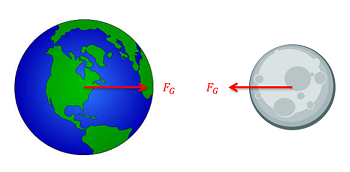
The figure depicts gravity as a mutual interaction between two bodies (e.g., Earth and Moon), emphasizing that each body experiences a force from the other. This makes the Newton’s third-law structure visually concrete: the forces are equal in magnitude, opposite in direction, and act on different objects. Source
When you describe the force on one object, be explicit about the source:
“Force of Earth on ball” (Earth exerts gravitational force on the ball)
“Force of ball on Earth” (ball exerts gravitational force on Earth)
These are different forces acting on different objects, not a single force “belonging” to one object.
= force exerted by object on object (newtons, N)
= force exerted by object on object (newtons, N)
This relationship is crucial for action-at-a-distance reasoning: although there is no contact, the interaction is still two-sided and forces come in matched pairs.
Common gravitational pairs you should recognise
Earth and an object near Earth
Earth pulls object downward
Object pulls Earth upward (usually negligible motion for Earth due to its huge mass)
Two astronomical bodies (conceptual level in AP Physics 1)
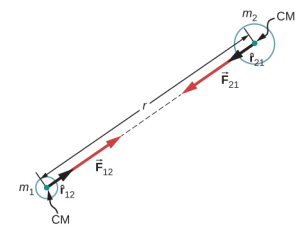
Two separated masses exert gravitational forces on each other along the line connecting their centers of mass. The diagram explicitly labels the mutual interaction as a third-law pair: points toward mass 2 while points toward mass 1, equal in magnitude and opposite in direction. Source
Each attracts the other along the line connecting their centers
How to represent action-at-a-distance forces correctly
When drawing or interpreting a force model for an object experiencing gravity:
Draw the gravitational force on the object of interest, not both forces in the pair on the same diagram.
Label forces with an “agent” to prevent confusion (for example, “Earth on cart”).
Direction: gravitational force points toward the other mass (toward Earth’s center for near-Earth situations).
Frequent student errors (and fixes)
Error: treating gravity as a property “owned” by the object (for example, “the object has a force downward”).
Fix: state the interaction: Earth exerts a force on the object.
Error: placing both third-law forces on the same free-body diagram.
Fix: a free-body diagram contains only forces acting on the chosen object/system.
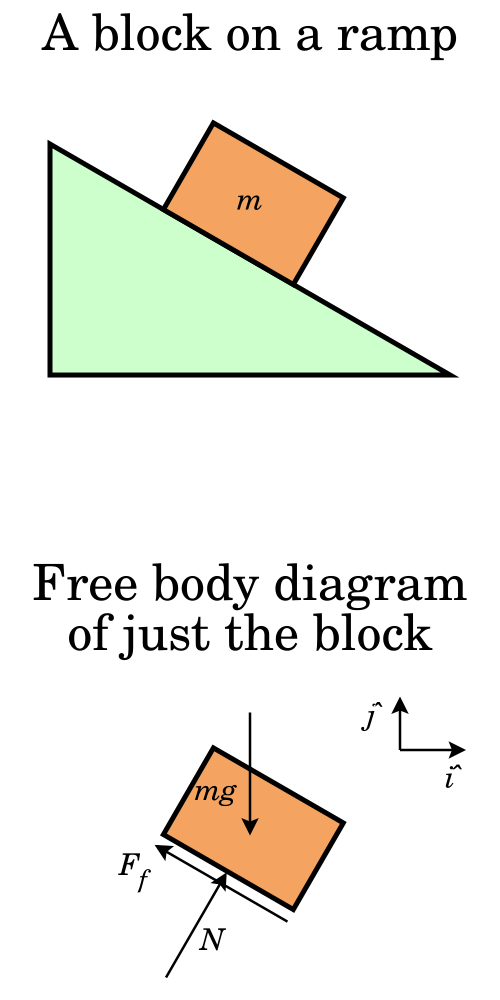
A free-body diagram isolates one object (or one system) and shows only the external forces acting on that chosen body. This visual convention helps prevent a common mistake in Newton’s third law reasoning: drawing both action–reaction forces on the same diagram, even though they act on different objects. Source
Error: pairing the gravitational force with the normal force as a third-law pair.
Fix: third-law pairs act on different objects; the normal force on the object pairs with the force the object exerts on the surface, not with gravity.
Why AP Physics 1 restricts distance interactions to gravity
Restricting action at a distance to gravity keeps the course focused on:
identifying interacting objects
applying Newton’s laws consistently
separating contact interactions from noncontact gravitational interaction
Within these limits, you should be able to decide whether a force requires contact, correctly name the interacting bodies, and identify the gravitational third-law pair even when objects are far apart.
Practice Questions
Q1 (1–3 marks) State the only type of action-at-a-distance interaction included in AP Physics 1, and name the two forces in the Newton’s third law pair for a falling ball near Earth.
Identifies gravity/gravitational force as the only action-at-a-distance interaction (1)
Names force of Earth on ball (1)
Names force of ball on Earth (1)
Q2 (4–6 marks) A spacecraft is far from planets and drifting. A small tool floats 2 m away from the astronaut. The astronaut throws the tool. Explain, using Newton’s third law and the AP Physics 1 treatment of action at a distance, which interaction forces must be considered during the throw and after the tool has left the astronaut’s hand.
States that in AP Physics 1 the only distance interaction is gravitational (1)
During the throw: identifies a contact interaction between astronaut and tool, producing a third-law pair (tool on astronaut and astronaut on tool) (2)
After release: states contact forces between them are zero; only gravitational forces (if any, from nearby masses) act at a distance (1)
Uses correct third-law language: forces equal in magnitude and opposite in direction, acting on different objects (1)
FAQ
AP Physics 1 restricts noncontact interactions to gravity by syllabus design. Electric and magnetic interactions require additional models and are assessed in other AP physics courses.
“Action at a distance” describes lack of contact, not lack of a partner. Gravity is still an interaction between two masses, producing two forces on two different objects.
Only if your “object” is a multi-object system that includes both bodies, which is rarely practical for Earth–object cases. Otherwise, each diagram shows forces on one chosen body.
AP Physics 1 does not require modelling propagation delays. You treat gravitational interactions as acting directly between objects without analysing signal travel time.
Draw a line connecting the centres of the two masses; the gravitational force on each mass points along that line toward the other mass.
