

AP Syllabus focus: ‘Tension is the net result of forces within a string; in an ideal string it is the same at all points.’
Tension problems are really Newton’s laws problems with careful system choices. Ideal strings and pulleys let you treat the force transmitted through a string as uniform, simplifying free-body diagrams and algebraic equations.
What “tension” means in AP Physics 1
Tension is a pulling interaction transmitted through a string, rope, or cable when it is taut (stretched straight, not slack).
Tension — the force a taut string exerts on an object it is attached to, directed along the string and away from the object.
A key syllabus idea is that tension is the net result of forces within a string: the string’s material is pulled by one object and pulls back on that object (and on any other attached object).
Ideal string and ideal pulley assumptions
In AP Physics 1, “ideal” means the model removes internal complications so tension relationships become simple.
Ideal string — a string with negligible mass that does not stretch, so it transmits force without storing significant energy or creating varying tension along its length.
Because the string is massless in the model, it cannot have a net force while still obeying ; that is the core reason tension becomes uniform.
Ideal pulley — a pulley that is massless and frictionless, so it only changes the direction of the string without changing the tension magnitude.
Uniform tension in an ideal string
The specification statement “in an ideal string it is the same at all points” is used operationally as:
Along one continuous ideal string, the tension magnitude is constant.
A frictionless, massless pulley does not change that magnitude; it only redirects the force.
So, if a single ideal string passes over an ideal pulley, you typically write the same tension value on both sides of the pulley (even though the directions differ).
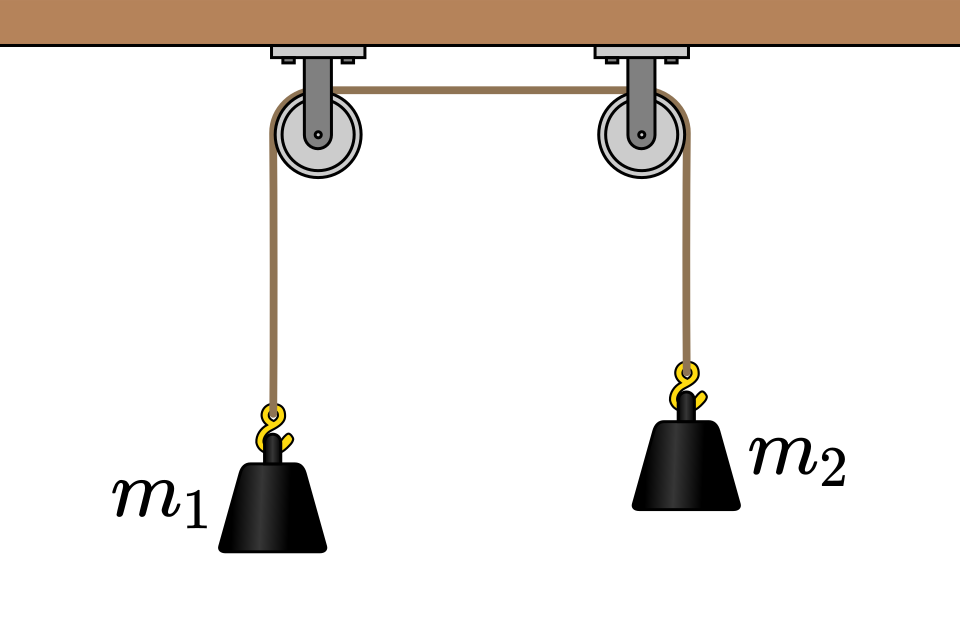
Atwood-machine schematic showing two masses connected by a single continuous string over pulleys. The diagram supports the AP idealization that the tension magnitude is uniform along the same massless string, so both sides share the same even though the forces point in opposite directions on the two masses. Source
Between using this idea and Newton’s second law, most AP tension questions reduce to writing one equation per mass.
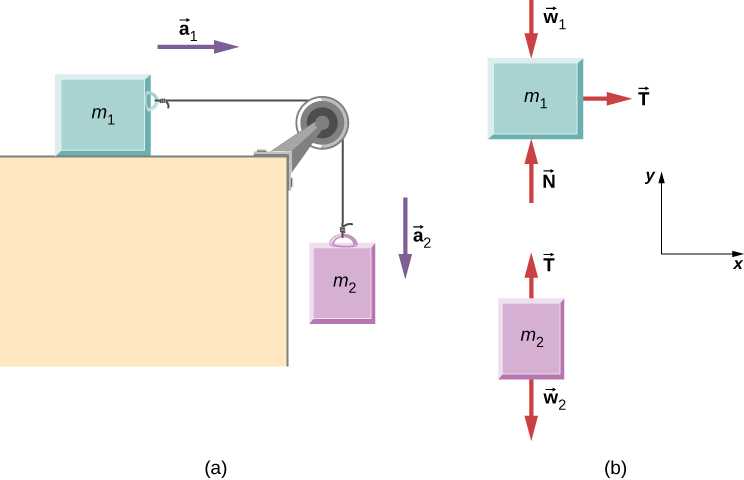
Two-block system with a string over an ideal pulley, shown alongside the free-body diagram for each mass. The FBDs make it explicit that tension acts on each object along the string direction, while weights and normal forces appear only where physically applicable—exactly the information needed to write for each mass. Source
How to use tension correctly on free-body diagrams
When you draw an FBD for an object attached to a string:
Draw tension on the object, not “in the string.”
The tension force points along the string.
The force points away from the object (a string pulls; it does not push).
If multiple string segments pull on the same object (e.g., an object supported by two vertical segments), you may have multiple tension forces, often equal in magnitude if they are parts of the same ideal string.
Tension forces on different objects are not a Newton’s third law pair with each other; each tension force is paired with an equal and opposite force the object exerts on the string at that contact.
Equations you actually use with ideal tension
You typically solve for tension by combining “same everywhere” with Newton’s second law for each connected mass.
= Net force component along a chosen axis (N)
= Mass of the object or system being modelled (kg)
= Acceleration component along that axis (m/s)
Choose axes along the direction of motion for each mass, then include with the correct sign based on direction.
In the ideal model, the tension equality is written as:
= Tension on one side/segment of the same ideal string (N)
= Tension on another side/segment of that same ideal string (N)
This equality applies only when the segments belong to the same continuous ideal string and pass over ideal pulleys.
Common modelling checkpoints (to avoid sign and setup errors)
String constraint: objects connected by a taut, inextensible ideal string share the same acceleration magnitude along the string (directions may be opposite).
Slack string: if the string goes slack, tension can drop to zero, and the “same acceleration” constraint may no longer apply.
Multiple pulleys/segments: if one object is supported by two segments of the same string, the object can experience a net upward force like (two separate pulls), while the string’s tension in each segment is still .
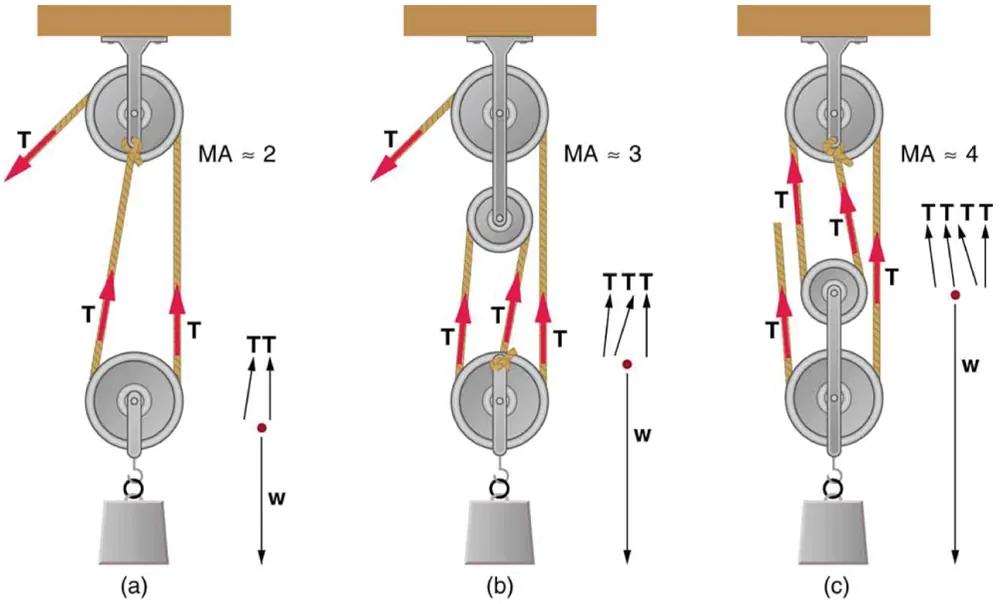
Pulley-system diagram illustrating that when a load is supported by two segments of the same rope, the load feels two upward tension forces that add to approximately . This is the core free-body-diagram reason a single movable pulley can provide mechanical advantage without changing the tension magnitude within each rope segment (in the ideal model). Source
Never assume unless the object is in equilibrium and tension is the only upward force balancing weight.
Practice Questions
Q1 (1–3 marks) A mass hangs at rest from a single vertical ideal string. State the direction of the tension on the mass, and state the relationship between and .
Tension acts upwards along the string / away from the mass (1)
Object at rest implies net force zero (1)
Therefore (1)
Q2 (4–6 marks) Two masses and are connected by a light inextensible string over an ideal pulley. The system accelerates with moving down and moving up. Write equations for each mass using Newton’s second law and show an expression for in terms of , , , and .
Uses same tension on both sides: is the same for both masses (1)
For (up positive): (2)
For (down positive): (2)
Rearranges to obtain or (1)
FAQ
If a segment of string has negligible mass, then for it to accelerate consistently without violating $F=ma$, the net force on that segment must be essentially zero, forcing equal pulls at its ends.
Yes. If the mass accelerates upward, Newton’s second law gives $T - mg = ma$, so $T = mg + ma$, which is greater than $mg$ for $a>0$.
The tensions on the two sides can differ: $T_1 \ne T_2$. The difference provides a torque to spin the pulley and/or overcome frictional torque.
Because the object is pulled upward by two separate tension forces (one from each segment). Each segment has tension $T$, so the total upward force from the string is $T+T=2T$.
Check whether the string is taut. If the geometry/motion implies slack (no stretching, no straight-line pull), the string cannot exert a pull, so the tension is taken as $0$ until it becomes taut again.
