

AP Syllabus focus: ‘In strings with noticeable mass, tension can vary, but AP Physics 1 treats these situations only qualitatively.’
Real strings are not perfectly massless or perfectly flexible. This page explains why tension can change from point to point in a real string and what AP Physics 1 expects you to do with that idea.
What “real string” means (and why it matters)
Tension as an internal interaction
Tension — the pulling force transmitted through a string, rope, or cable, acting along the string and exerted on objects attached to its ends.
Tension is an internal force within the string, but when you draw a free-body diagram (FBD) for an object attached to a string, tension is an external force on that object.
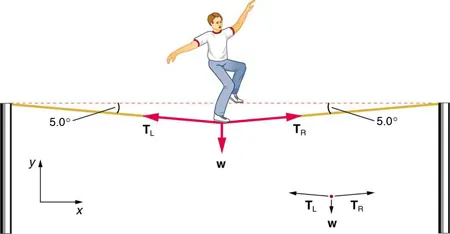
A free-body diagram for a tightrope walker showing two tension forces acting along the wire on either side of the person, plus weight downward. It emphasizes that tension forces are directed along the string and that their vector components can be analyzed to satisfy equilibrium conditions (e.g., and ). Source
Ideal vs real strings in AP Physics 1
In many AP problems, strings are treated as ideal: massless, inextensible, and with frictionless pulleys. That model makes tension uniform and simplifies Newton’s second law.
= tension at one point on the string, in newtons (N)
= tension at another point on the string, in newtons (N)
Real strings have noticeable mass (and sometimes stretch), so different parts of the string can require different net forces to accelerate, which implies different tensions.
Why tension can vary in a massive string (qualitative AP view)
Key idea: a string segment is an object
If a string has mass, then any small segment of the string is itself a physical object. For that segment to accelerate, it needs a nonzero net force. The only significant forces on a segment (in many setups) are the pulls from the neighbouring parts of the string at each end, which are tensions that can differ.
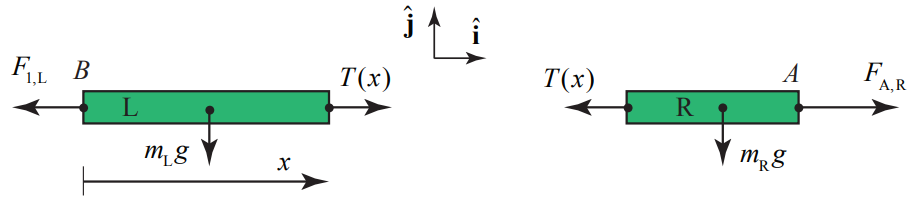
Force diagram for two sections of a rope when the rope’s mass is not negligible, with tension labeled at a point as . The figure supports the idea that adjacent rope segments can exert different pulls on each other, producing a nonzero net force on a segment when the rope is accelerating or when other forces (like friction/weight components) act on parts of the rope. Source
What “tension varies” looks like
If a massive string is accelerating, the “upstream” part of the string often must pull harder to accelerate:
the attached mass, and
some portion of the string’s own mass.
Therefore, the tension closer to the pulling agent can be larger than the tension near the load.
Even if the system moves at constant speed, tension can still vary if the string must support its own weight (for example, a hanging rope), because different points are responsible for holding up different amounts of string beneath them.
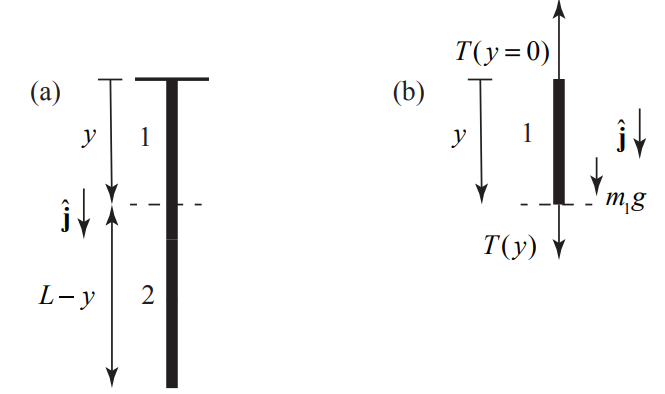
Free-body analysis of a vertically hanging massive rope using an “imaginary slice.” The diagram shows that the tension is larger nearer the support because higher points must hold up (and therefore balance the weight of) more rope below them. Source
Direction and magnitude considerations
Tension always pulls along the string, away from the object it acts on.
A real string can have:
different tension magnitudes at different locations, and
different tension directions if the string bends around objects. AP Physics 1 focuses on the magnitude variation due to mass, without requiring advanced modelling.
What AP Physics 1 expects you to do (the “AP limits”)
Treat massive-string effects qualitatively
You may be expected to:
state that “tension is not the same everywhere” if the string’s mass is not negligible,
explain the reason using Newton’s second law applied to a string segment (a segment needs net force, so end tensions can differ),
identify which side would have larger tension (typically the side responsible for accelerating/supporting more mass).
You are generally not expected to:
compute a full tension-as-a-function-of-position model,
use calculus or continuous mass distributions,
account quantitatively for wave effects, elasticity, or nonuniform density.
Practical modelling guidance
If the problem says ideal, assume uniform tension and proceed with standard FBDs.
If the problem draws attention to a heavy rope/string, use reasoning language:
“tension increases toward the support/pulling end,”
“tension differs on either side because part of the rope must accelerate.”
Practice Questions
(2 marks) A student replaces an ideal (massless) string with a noticeably massive rope in an Atwood machine setup. Qualitatively state how the rope’s tension compares at different points, and briefly why.
1 mark: States that tension is not the same everywhere in a massive rope (varies along its length).
1 mark: Explains that a segment of rope has mass and needs a net force to accelerate, so the tensions at its ends can differ.
(5 marks) In a system where a heavy rope pulls a crate along a frictionless floor, the rope is accelerating with the crate. Explain, without calculation, whether the tension at the pulling end of the rope is greater than, less than, or equal to the tension at the crate end. Justify using Newton’s laws and the idea of analysing a rope segment.
1 mark: Identifies that the rope has mass so tension can vary along it.
1 mark: Correctly states the pulling-end tension is greater than the crate-end tension.
1 mark: Uses a rope-segment argument (segment has two end tensions acting on it).
1 mark: Applies Newton’s second law qualitatively: segment must have a net forward force to accelerate, implying .
1 mark: Links the larger tension to “pulling end must accelerate both the crate and some/all of the rope’s mass” (clear physical reasoning).
FAQ
If the string’s mass is not negligible compared with the attached masses, or the prompt highlights a “heavy rope,” expect non-uniform tension.
A quick check is whether ignoring rope mass would clearly change the system’s inertia.
Yes, for example in a hanging rope at rest: higher points support the weight of more rope below, so tension increases upward.
AP usually expects this as a qualitative statement only.
Yes. On the object, you draw the tension at the point of contact between object and string.
The variation occurs along the string, not across the object-string boundary.
Stretch relates to elasticity and can cause changing tension during transients.
AP Physics 1 typically downplays elastic modelling unless a spring is explicitly involved.
Pulley friction or pulley rotational inertia can make the tensions on the two sides different.
In AP Physics 1, such effects are usually described qualitatively unless the pulley is explicitly idealised.
