

AP Syllabus focus: ‘If the net force on a system is zero, the system�s velocity remains constant.’
Constant-velocity motion is often misunderstood because everyday experiences include friction and drag. Newton�s first law clarifies what motion looks like when forces balance: objects do not naturally slow down or speed up without a nonzero net force.
Newton�s First Law and Constant Velocity
Newton�s first law connects net force to whether an object�s velocity changes. If all external forces on a chosen system cancel as vectors, there is no change in velocity: both speed and direction remain the same.
Key meaning of �constant velocity�
Constant velocity is motion with unchanging speed and unchanging direction (so the velocity vector is constant).
Because velocity is a vector, an object moving at constant speed in a circle does not have constant velocity (its direction changes). Constant velocity means a straight-line path (or being at rest).
Force condition for constant velocity
In AP Physics 1, you express the condition for constant velocity using the net external force.
= net external force on the system, in newtons (N)
= acceleration of the system, in m/s
= velocity of the system, in m/s
This is the mathematical statement of the syllabus idea: if the net force is zero, the system�s velocity remains constant.
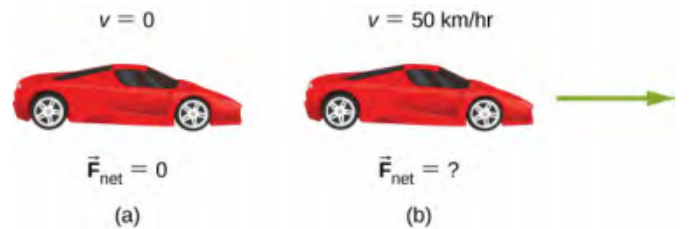
A conceptual diagram of a car at rest and a car moving at constant velocity, used to emphasize that constant velocity implies zero net force. In the moving case, the forward driving force must be balanced by resistive forces so that and . Source
How to Apply the Idea (Algebra-Based)
Interpreting �net force is zero�
Net force being zero means the force vectors add to zero, not that there are no forces.
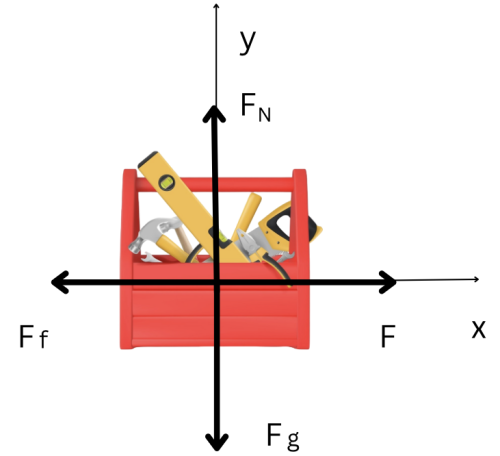
A free-body diagram of an object pulled horizontally with friction, showing the applied force balancing friction and the normal force balancing weight . When these pairs match in magnitude, and , so the object can move with constant velocity (zero acceleration). Source
A moving object can have several forces acting and still keep constant velocity.
Forces can cancel in each direction independently:
and implies no change in velocity components.
What constant velocity implies about motion
If velocity is constant, then:
The object�s speed does not increase or decrease.
The object�s direction does not change.
The object can be at rest as a special case (constant velocity of zero).
Common physical situations
Constant velocity requires no unbalanced force, but it may require forces to exist:
If resistive forces (like drag) act, a forward applied force may be needed to keep .
If resistive forces are negligible, an object already moving will continue without needing a continuing push.
Practical checklist for problems
Clearly choose the system (often a single object).
Identify all external forces on that system.
Write component conditions for constant velocity:
Solve for unknown forces using vector components and sign conventions.
Practice Questions
(2 marks) A puck glides across perfectly frictionless ice in a straight line at constant velocity. What is the net force on the puck? State your answer with direction.
Net force is (1)
Therefore no direction / net force vector is zero (1)
(5 marks) A crate is pulled across a level floor at constant velocity. The pulling force is at above the horizontal. Friction acts horizontally opposite the motion. Find (i) the friction force, and (ii) the size of the normal contact force if the crate�s weight is .
Uses constant velocity and (1)
Horizontal component of pull: (1)
(i) Friction equals that component: (1)
Vertical component of pull: upwards (1)
(ii) (1)
FAQ
No. It means the vector sum is zero.
Multiple forces can act and cancel in components, so motion can continue unchanged even with forces present.
Only if other forces would otherwise create a nonzero net force.
A force is required to change velocity, or to balance resistive forces so the net force stays zero.
On a velocity�time graph, constant velocity is a horizontal line.
On a position�time graph, constant velocity is a straight line with constant slope.
No, not in an inertial frame. If $\sum \vec{F}=0$, acceleration is zero, so speed cannot change.
If speed appears to change with zero net force, the frame or force model is inconsistent.
Not fully. The $x$-component of velocity is constant, but the $y$-component changes.
Overall velocity changes because at least one component changes.
