

AP Syllabus focus: ‘Forces can be balanced in one direction and unbalanced in another, changing velocity only where force is unbalanced.’
Motion in two dimensions is analysed by separating forces into perpendicular directions. A system can have zero net force along one axis (no acceleration there) while simultaneously accelerating along another axis.
Core Principle: Balance Can Be Direction-Specific
Forces add as vectors, so net force can be zero in one direction even if it is nonzero in another. The key payoff is that acceleration components depend only on the corresponding net force components.
Component Independence (What You’re Allowed to Conclude)
If an object’s forces are balanced in the -direction, then its -velocity does not change, even if there is a nonzero net force in the -direction. The object may still speed up, slow down, or change direction overall—just not due to acceleration in the balanced direction.
Direction-by-Direction “Balance” Language
Balanced in a direction — the net force component along that axis is zero, so the acceleration component along that axis is zero.
A common confusion is thinking “balanced” means “not moving.” Instead, balanced in one direction means constant velocity in that direction (which could be zero or nonzero).
Newton’s Second Law in Perpendicular Directions
When you split forces into components, you write a separate Newton’s second law equation for each axis.
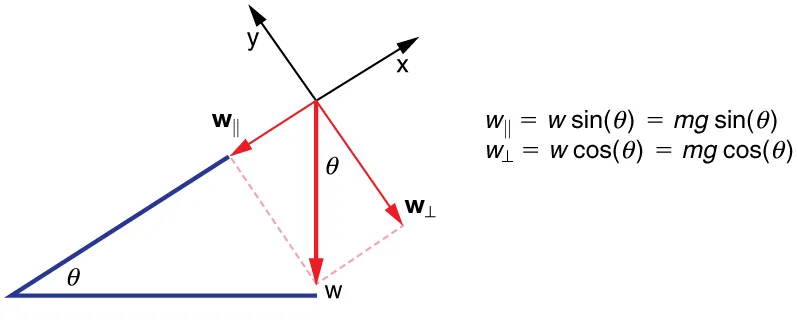
Free-body diagram on an incline with the weight resolved into components parallel and perpendicular to the surface. The diagram supports the idea that forces can cancel in one direction (often the perpendicular direction, giving ) while remaining unbalanced in another (parallel direction, giving nonzero acceleration). Source
This is the algebraic basis for “velocity changes only where force is unbalanced.”
= net external force component in the -direction (N)
= mass of the system (kg)
= acceleration component in the -direction (m/s)
= net external force component in the -direction (N)
= acceleration component in the -direction (m/s)
These equations are independent: setting forces , but it does not force .
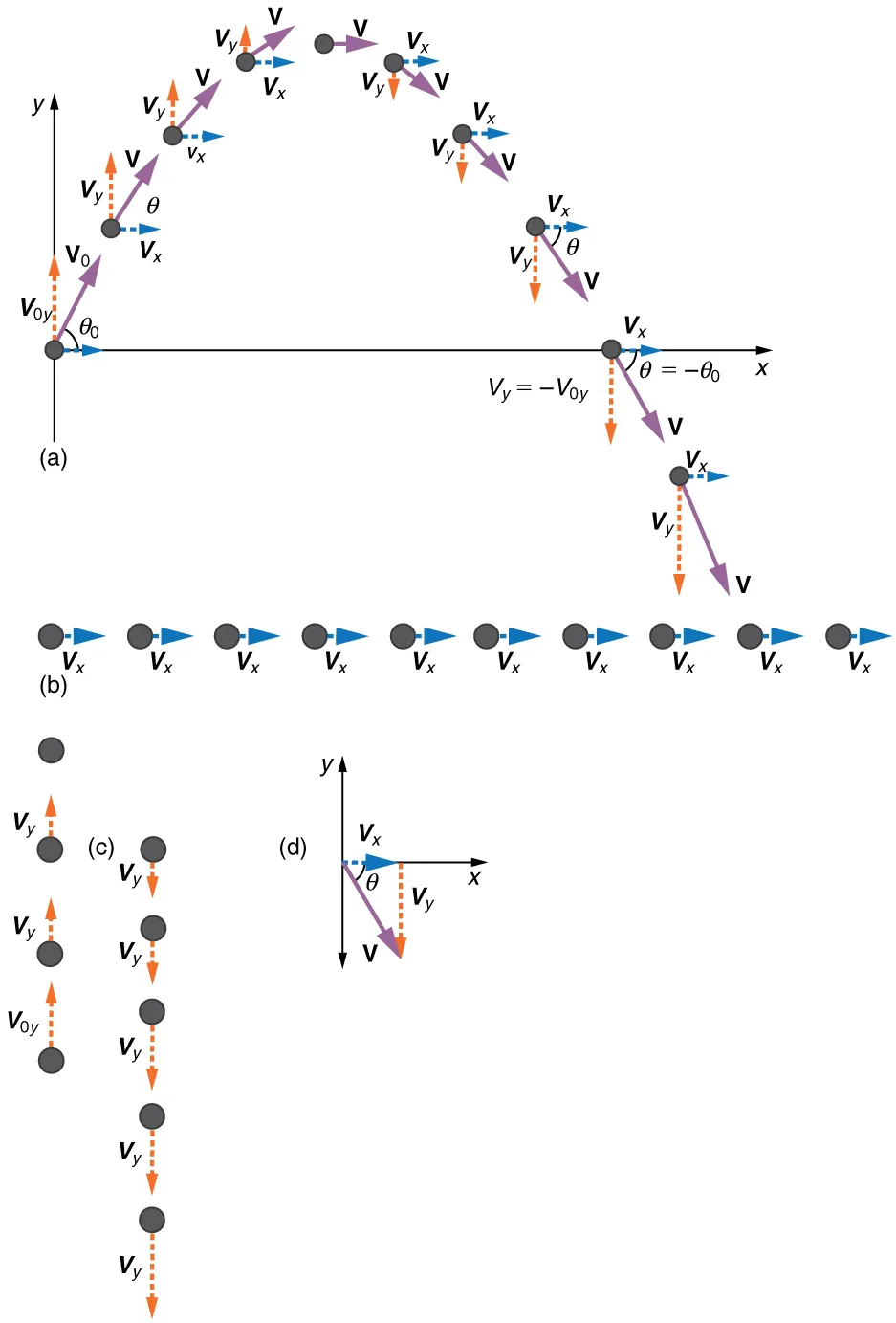
Projectile motion decomposed into independent horizontal and vertical motions: the horizontal component has so remains constant, while the vertical component has nonzero acceleration so changes. Recombining the components gives a changing velocity vector along a curved trajectory, even though one component can remain constant. Source
What Changes (and What Doesn’t) When One Direction Is Unbalanced
Balanced direction: velocity component is constant
If , then
Therefore is constant (could be or nonzero)
Position in still changes if , but it changes at a constant rate
Unbalanced direction: velocity component changes
If , then
Therefore changes over time
This can change the object’s overall speed and the direction of its velocity vector
Combined effect: path can curve even if one component is constant
An object can move with constant while its changes; the resulting trajectory is not required to be a straight line. The “only where force is unbalanced” statement is specifically about changes in velocity components, not about whether the object’s position changes.
Recognising Typical Force Patterns (Without Overgeneralising)
Many setups naturally produce balance in one axis:
Vertical balance: weight downward and a support force upward (normal force or tension) cancel, so while horizontal forces may be unbalanced.
Horizontal balance: leftward and rightward forces cancel, so while vertical forces may be unbalanced.
Be careful: a force “existing” in a direction does not imply imbalance. You must compare the sum of all components along that axis.
How to Apply This on Free-Body Diagrams and Equations
Workflow for “balanced in one direction” problems
Choose coordinate axes (often horizontal/vertical, unless given a tilted axis).
Draw a free-body diagram and label all external forces.
Resolve forces into and components if needed.
Add components to get and .
Use and separately.
Interpret:
If then and that velocity component is constant.
If then the velocity component changes in that direction.
Common reasoning checkpoints
“Constant speed” is not guaranteed by balance in one axis; only the component is fixed.
If one axis is balanced, you can often solve the other axis without needing details from the balanced one (except for shared quantities like mass).
Practice Questions
Q1 (1–3 marks) A puck slides on frictionless ice. The net force in the -direction is , and the net force in the -direction is upward. The mass is . State which velocity component(s) change, and find .
States does not change because so (1)
States changes because (1)
Calculates upward (1)
Q2 (4–6 marks) A cart moves on a level track. Vertically, the normal force and weight act. Horizontally, a constant pulling force acts to the right and a smaller constant resistive force acts to the left. The cart’s initial velocity is purely to the right. Explain, using Newton’s second law components, which acceleration components are zero/nonzero, and describe how the cart’s velocity changes over time.
Identifies vertical forces and states (1)
Concludes vertical forces balance () so and (1)
States therefore remains constant (and is zero if initially zero) (1)
Writes horizontal net force (1)
Concludes is nonzero to the right (1)
States increases over time (speed increases; direction stays right) because is to the right (1)
FAQ
Speed depends on the magnitude of the full velocity vector. If $v_x$ is constant but $v_y$ increases in magnitude, then $| \vec v |$ increases even though one component is unchanged.
Only if the only vertical forces are $N$ upward and $mg$ downward and the vertical acceleration is zero. Extra vertical forces (e.g., an angled pull) change the balance condition.
Yes. $\sum F_x=0$ implies $a_x=0$, not $v_x=0$. The object can have a nonzero constant $v_x$.
Curved motion occurs whenever acceleration is not parallel to velocity. If acceleration acts only in one axis while velocity has components in both axes, the velocity direction changes, producing a curved path.
Common issues include:
using the wrong angle for components
forgetting signs (positive/negative directions)
mixing axes (writing $y$-components in the $x$-equation)
assuming a force must equal another just because they “look opposite” on the diagram
