

AP Syllabus focus: ‘The net force on a system is the vector sum of all forces exerted on it.’
Net force is found by adding forces as vectors, not as plain numbers. This page focuses on how to combine multiple forces consistently using components, signs, and direction to represent the overall push or pull on a system.
Core idea: adding forces as vectors
Net force and what it represents
Net force — the single force vector equivalent to all external forces acting together on a system.
Because forces are vectors, the net force depends on both magnitude and direction. Two large forces can produce a small net force if they point mostly opposite each other, while smaller forces can produce a larger net force if they align.
A key modeling rule is that you only add forces exerted on the system (typically by the environment). Forces that the system exerts on other objects are not included in the system’s net-force sum.
Vector sum statement (what you are always doing)
= net force vector on the system (N)
= the th force vector exerted on the system (N)
= “add all force vectors” (vector addition)
This statement is not a shortcut; it is the definition of how net force is constructed: a vector sum.
How to perform a vector sum (algebra-friendly)
Step-by-step process (recommended)
Choose a coordinate system (often right, up) that you will use consistently.
For each force, identify its direction relative to your axes.
If a force is not along an axis, break it into perpendicular components.
Add force components separately along each axis.
Combine the summed components to describe the net-force vector.
Component form (why it simplifies everything)
In AP Physics 1 Algebra, component addition is the most reliable way to avoid direction mistakes, especially when there are forces at angles.
= net force component in the -direction (N)
= -component of the th force (N)
= net force component in the -direction (N)
= -component of the th force (N)
Once components are summed, the net force can be reported as:
A component pair , which fully specifies the vector in 2D, or
A magnitude-and-direction description (when requested), consistent with the chosen axes.
Interpreting signs, directions, and cancellations
Signs encode direction
A negative component does not mean “negative force” physically; it means the force component points in the negative direction of your chosen axis. Common sign errors come from switching sign conventions mid-problem.
Cancellations are vector-based
Forces “cancel” only when they are equal in magnitude and opposite in direction along the same line (or when their components cancel axis-by-axis). Typical patterns:
Opposite forces along one axis can cancel in that axis while leaving a nonzero net force along the perpendicular axis.
Multiple forces at angles can partially cancel, leaving a net force that points in a direction not matching any single force.
What must be included in the sum
Include all forces exerted on the system
Net force is the vector sum of all forces exerted on the system, meaning:
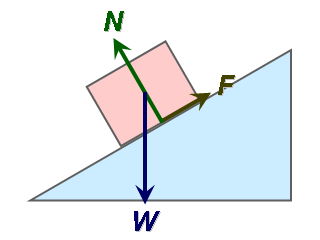
Free-body diagram of a block on an inclined plane, with the external forces labeled (weight, normal force, and friction). A diagram like this is the bookkeeping step that ensures every external interaction is included before you add components. Once each force is identified, you can project them onto chosen axes and sum the components. Source
Do not omit a force because it is “balanced” by another; balancing is a result you discover after summing.
Treat each distinct interaction as its own vector in the sum, even if two forces are the same type.
One system, one net force vector
If you model multiple objects as one system, you still compute a single for that system by adding all forces exerted on the system from outside it. The output is still one vector, even though many forces contributed.
Practice Questions
(2 marks) Two horizontal forces act on a trolley: to the east and to the west. State the net force (magnitude and direction).
(1)
to the east (1)
(5 marks) A particle experiences three forces: in the direction, in the direction, and at above the axis. Find and .
Resolve angled force: and (2)
(1)
(1)
Correct sign usage consistent with stated axes (1)
FAQ
State your axes first, then assign signs by direction relative to those axes.
If it points opposite your positive axis, its component is negative.
Only when all forces are collinear (all along the same line).
Then you can treat one direction as positive and the opposite as negative.
The physical net-force vector does not change.
Only the component values change, because components depend on your chosen coordinate system.
Compare approximate “dominant” directions before calculating.
If the largest contributions point mostly one way, your net force should point roughly that way too.
You include forces exerted on your chosen system only.
A force the system exerts on something else is not part of the system’s net-force sum, even though it has a third-law partner elsewhere.
