

AP Syllabus focus: 'Specific heat is an intrinsic material property that depends on atomic arrangement and interactions; AP Physics 2 models it as temperature-independent.'
Materials do not all warm up by the same amount when they absorb the same energy. That difference comes from a material property set by microscopic structure and particle interactions.
What specific heat means
Specific heat describes how much thermal energy must be transferred to change the temperature of a material.
Specific heat: The amount of energy required to raise the temperature of 1 kilogram of a substance by 1 kelvin or 1 degree Celsius.
A larger specific heat means a material needs more energy for the same temperature change. A smaller specific heat means the temperature changes more easily when energy is added or removed. This is why different substances respond differently to heating, even when their masses are equal. In AP Physics 2, specific heat is usually represented by the symbol .
Because specific heat is defined per unit mass, it does not automatically become larger when the sample becomes larger. A 1-kilogram sample of a material and a 10-kilogram sample of the same material have the same specific heat, even though the larger sample requires more total energy to produce the same temperature increase.
Material identity versus sample size
Physicists call specific heat an intrinsic property because it belongs to the material itself rather than to the amount of that material present.
Intrinsic property: A property that depends on the type and state of a material, not on how much of that material is present.
This is an important distinction. Properties such as mass and volume depend on sample size, so they are not intrinsic. Specific heat, however, depends on what the material is like microscopically. If two samples are made of the same substance and are in the same state, they are modeled as having the same specific heat even if one sample is much larger than the other. If the materials are different, their specific heats are generally different because their atoms are arranged differently and interact differently.
The state of the substance also matters. A substance in one phase can have a different specific heat than the same substance in another phase, because the atomic arrangement and interactions are no longer the same.
Why atomic arrangement and interactions matter
Specific heat is not arbitrary. It comes from how energy is stored at the particle level. When thermal energy is transferred into a substance, that energy is distributed among its atoms or molecules. The way this happens depends on the material’s internal structure.
In a solid, atoms are arranged in a relatively fixed pattern and can vibrate about equilibrium positions. In a liquid, particles remain close together but can move past one another. These different arrangements affect how added energy changes microscopic motion. The forces between particles also matter, because stronger or more complex interactions can allow transferred energy to be spread among more kinds of microscopic motion.
As a result, two materials can absorb the same amount of energy and experience different temperature changes. The material with the larger specific heat can absorb more energy before its temperature rises by the same amount. At the AP Physics 2 level, you do not need a detailed quantum model of the material. What matters is the qualitative idea that specific heat depends on atomic arrangement and interactions.
The relation used in calculations
The practical meaning of specific heat is captured by the standard heating equation.
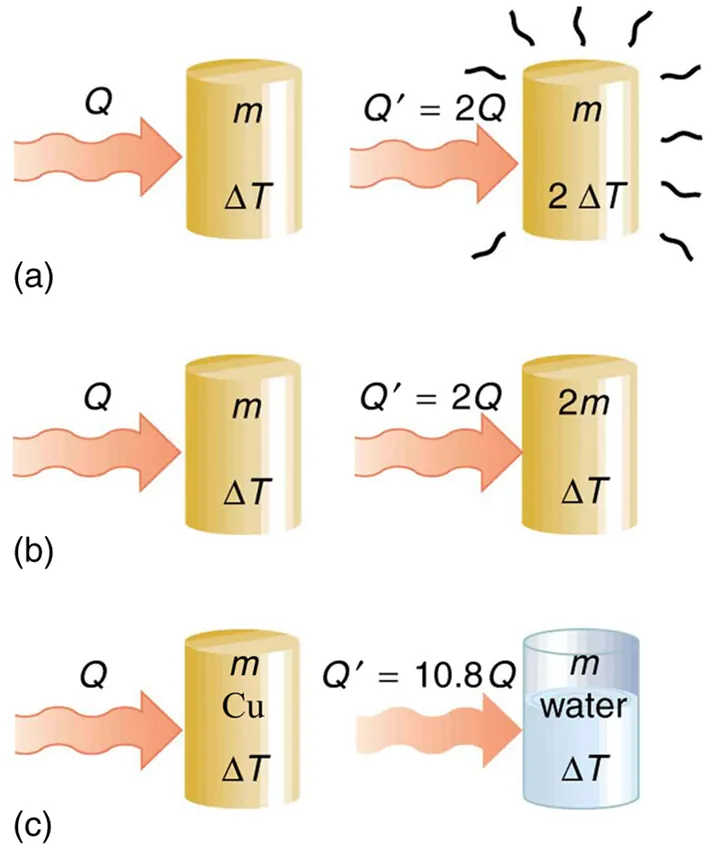
This figure illustrates how heat transfer scales linearly with temperature change and with mass , while also depending on the substance through its specific heat . The side-by-side comparison makes it clear why different materials can experience different temperature changes under the same energy input. Source
= thermal energy transferred, J
= mass of the substance, kg
= specific heat,
= temperature change, K or
This equation shows clearly why specific heat is intrinsic.
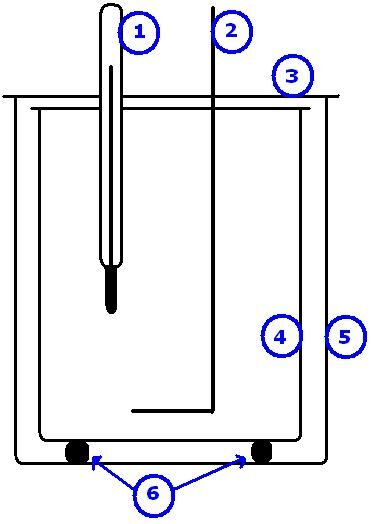
This diagram shows a typical calorimeter setup (insulation, thermometer, and stirrer) used to measure a temperature change during an energy transfer. It provides a physical context for applying by emphasizing controlled conditions where heat exchange with the environment is minimized. Source
The mass tells how much material is present, while tells how resistant that material is to temperature change. If and are fixed, a larger value of produces a smaller value of . If and are fixed, a larger value of means more energy must be transferred.
So, specific heat should be interpreted as a material constant for the situation being modeled, not as a measure of sample size. The sample size changes the total energy required, but not the specific heat itself.
The AP Physics 2 temperature-independent model
Real materials do not have perfectly constant specific heats under all conditions. In practice, specific heat can vary with temperature, and sometimes with phase or other conditions. However, AP Physics 2 treats specific heat as temperature-independent unless the problem explicitly indicates otherwise.
This modeling choice is useful because it lets you treat as a constant over the temperature range in the problem. That makes the equation straightforward to apply. For many classroom situations, this approximation is accurate enough to describe the behavior of the material without introducing unnecessary complexity.
When using this model, the key idea is that the listed value of specific heat is taken to represent the material throughout the process. You should not assume, though, that this is a universal truth for all temperatures in real life. It is a simplified but effective AP-level model.
Common reasoning patterns
If two samples are the same material and in the same state, they are modeled as having the same specific heat, even if their masses differ.
If two samples have the same mass and receive the same energy, the one with the larger specific heat undergoes the smaller temperature change.
If two materials show different temperature changes for the same mass and energy transfer, their specific heats are different.
Specific heat is tied to material identity and microscopic structure, not to the total amount of substance present.
In AP Physics 2, treat specific heat as constant over the problem’s temperature range unless told otherwise.
Practice Questions
A 0.50 kg block of copper and a 2.0 kg block of copper are both solid. State whether their specific heats are the same or different, and explain why.
1 mark: States that the specific heats are the same.
1 mark: Explains that specific heat is an intrinsic property, so it depends on the material and state, not on the amount of the material.
Two 1.0 kg samples, A and B, are each given of energy. Sample A increases in temperature by , while sample B increases in temperature by .
(a) Which sample has the greater specific heat?
(b) Use the equation to justify your answer.
(c) If the mass of sample A were doubled, would its specific heat change? Explain.
(d) State the assumption AP Physics 2 makes about specific heat when solving problems like this.
1 mark: (a) Sample B has the greater specific heat.
1 mark: (b) Recognizes that for the same and , a smaller means a larger .
1 mark: (b) Correctly links this to sample B because is less than .
1 mark: (c) States that doubling the mass would not change the specific heat.
1 mark: (d) States that AP Physics 2 models specific heat as temperature-independent, so is treated as constant over the process.
FAQ
Specific heat depends on particle arrangement and interactions, not just chemical formula.
In ice, water molecules are locked into a crystal structure. In liquid water, they move more freely while still interacting strongly. In steam, the molecules are much farther apart. Because the microscopic energy storage is different in each phase, the specific heat can also be different.
Metals often change temperature relatively quickly when energy is added, which means their specific heats are usually smaller.
Water’s molecular structure and intermolecular forces let added energy be distributed in ways that do not raise temperature as quickly. That is one reason water is effective in cooling systems, while metals are useful when rapid temperature response is wanted.
Yes. Changing composition can change the atomic arrangement and the interactions between particles.
That means an alloy may not have exactly the same specific heat as any one of its pure component metals. In careful measurements, even small composition changes can matter. In introductory physics, though, problems usually treat the material as uniform and use a single listed value.
Specific heat is an intrinsic property of a material. Heat capacity applies to a particular object.
Heat capacity tells how much energy is needed to raise the temperature of the whole object by 1 degree. Specific heat tells how much energy is needed per unit mass. For an object of mass $m$, heat capacity is related to specific heat by multiplying by the mass.
Density does not tell the full microscopic story. Two substances can have similar densities but very different particle interactions and internal structures.
Since specific heat depends on how energy is distributed at the atomic or molecular level, it is usually determined most reliably by experiment. Measured values capture the combined effects of bonding, structure, and state in a way that simple bulk properties cannot.
