

AP Syllabus focus: 'The rate of conductive energy transfer depends on thermal conductivity, material dimensions, and the temperature difference across the material.'
To analyze conduction in AP Physics 2, focus on what controls how quickly thermal energy passes through a material: the material itself, its size and shape, and the temperature difference.
What the conduction rate describes
Conduction is thermal energy transfer through a material because neighboring particles interact. In solids, this usually happens through collisions, vibrations, and, in some materials, mobile electrons. The key idea in this subtopic is not just that energy transfers, but how fast it transfers.
The rate of energy transfer tells how much thermal energy moves through a material each second. A larger rate means energy is being conducted more quickly. In physics, this rate is measured in watts, where .
A key quantity in this model is thermal conductivity.
Thermal conductivity: A material property that describes how easily thermal energy is transferred through a material by conduction.
A material with a larger thermal conductivity transfers thermal energy more readily under the same conditions. A material with a smaller thermal conductivity resists conductive energy transfer more strongly. This is why metals are often good conductors and insulating materials are usually poor conductors.
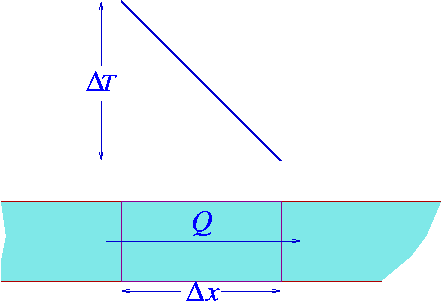
A plane slab separates a hotter side from a cooler side, establishing a temperature difference that drives heat flow through the material. The diagram highlights the conduction direction and the thickness (the same idea as in your equation), reinforcing why larger thickness reduces the transfer rate. Source
= rate of thermal energy transfer by conduction, in watts
= thermal conductivity of the material
= cross-sectional area perpendicular to the energy flow, in square meters
= temperature difference across the material, in kelvins or degrees Celsius
= thickness of the material measured in the direction of energy transfer, in meters
This equation shows exactly what the AP syllabus emphasizes: the rate depends on thermal conductivity, material dimensions, and the temperature difference across the material.
How the temperature difference affects conduction
Larger temperature difference means faster transfer
The rate of conduction is directly proportional to . If the temperature difference across the material increases, the conduction rate increases by the same factor, as long as the other quantities stay the same.
This makes physical sense. A bigger temperature difference means the hotter side and cooler side are farther apart in thermal condition, so energy is driven through the material more strongly.
Important points:
The temperature difference must be measured across the material, from one side to the other.
For a temperature difference, a change of is the same size as a change of , so either unit works for .
If the two sides become closer in temperature, the conduction rate decreases.
How material dimensions affect conduction
Cross-sectional area
The conduction rate is directly proportional to the cross-sectional area . A larger area gives thermal energy more pathways through the material, so more energy can pass each second.
If the area doubles while everything else remains constant, the rate of conductive energy transfer also doubles.
This is why a wide metal bar can transfer more thermal energy per second than a narrow bar of the same material and length.
Thickness
The conduction rate is inversely proportional to the material’s thickness . A thicker material slows the transfer because the energy must move through a greater distance.
If the thickness doubles while everything else remains constant, the conduction rate becomes half as large.
For insulation, increasing thickness is often very effective because it reduces the rate of thermal energy transfer even when the material itself does not change.
How thermal conductivity affects conduction
The role of the material itself
The factor tells how strongly the material supports conductive energy transfer. A larger means a larger conduction rate for the same area, thickness, and temperature difference.
This lets you compare materials directly:
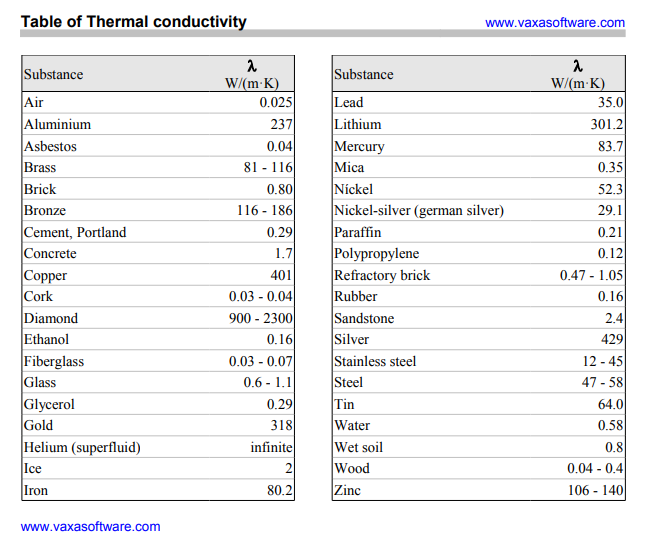
A reference table lists thermal conductivities for many common materials in . Seeing values for metals (high ) alongside materials like wood, glass, and air (low ) makes the “material itself” factor in the conduction-rate equation quantitatively tangible. Source
High : transfers energy quickly by conduction
Low : transfers energy slowly by conduction
In AP Physics 2, you should be able to reason qualitatively and quantitatively from this. If two objects have the same dimensions and the same temperature difference across them, the one with the larger will conduct energy faster.
Interpreting the equation physically
The conduction equation is most useful when the material is treated as:
uniform, so the same material extends throughout
flat or approximately one-dimensional, so energy mainly moves from one side to the other
under conditions where the temperatures at the two sides are known
The equation combines three common-sense ideas:
better conducting materials transfer energy faster
bigger exposed area increases transfer
greater thickness reduces transfer
It is also helpful to think of the rate as a balance between factors that help conduction and factors that oppose it:
help: large , large , large
oppose: large
Because the equation is algebraic, it is especially useful for comparing situations.
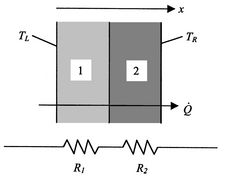
A composite wall (two layers) is shown with the same heat-flow rate passing through both layers, while each layer contributes its own thermal resistance. This reinforces the idea that conduction can be analyzed like a series circuit, where increasing or decreasing increases resistance and lowers the overall heat-transfer rate. Source
You can often predict what happens without calculating a full numerical answer.
Common AP reasoning patterns
For this subtopic, be ready to make statements such as:
“The conduction rate increases because the temperature difference increases.”
“The conduction rate decreases because the material is thicker.”
“The conduction rate is larger for the material with greater thermal conductivity.”
“A larger cross-sectional area allows more thermal energy to pass each second.”
You should also recognize proportional reasoning:
doubling doubles
doubling doubles
doubling doubles
doubling halves
On AP-style questions, the most important skill is connecting the physical change in the system to the correct factor in the conduction-rate equation, then explaining whether the rate increases, decreases, or stays the same.
Practice Questions
A ceramic slab and an aluminum slab have the same thickness, the same cross-sectional area, and the same temperature difference across them. Which slab transfers thermal energy at a greater rate by conduction? Explain briefly. [2 marks]
States that the aluminum slab transfers thermal energy at the greater rate. [1]
Explains that aluminum has a larger thermal conductivity , so with the same , , and , the equation gives a larger rate. [1]
A wall panel has area , thickness , thermal conductivity , and a temperature difference of across it.
(a) Write an equation for the rate of thermal energy transfer by conduction. [1]
(b) Calculate the rate of thermal energy transfer through the panel. [2]
(c) Without changing the material, state one change to the panel’s dimensions that would reduce the rate of thermal energy transfer to one-half its original value, and explain why. [2]
(a)
Writes a correct equation such as . [1]
(b)
Correct substitution: . [1]
Correct answer: . [1]
(c)
States a valid dimensional change, such as doubling the thickness or halving the area. [1]
Correct explanation using proportional reasoning: is inversely proportional to and directly proportional to , so doubling or halving reduces the rate to one-half. [1]
FAQ
Only the temperature difference matters in the conduction equation, not the absolute temperature.
A change of $1\ K$ is the same size as a change of $1\ ^\circ C$, so a difference of $15\ K$ is also a difference of $15\ ^\circ C$. That is why either unit works for $\Delta T$.
Air has a relatively low thermal conductivity compared with metals and many solids, so it transfers energy slowly by conduction.
Insulating materials often trap air in small pockets. That creates many regions with low $k$, which helps reduce the overall rate of conductive energy transfer.
If the air were free to move a lot, other types of thermal transfer could become important, so trapping it is useful.
Two solid surfaces that look flat are usually rough on a microscopic scale. They touch only at small points, with tiny gaps in between.
Those gaps reduce how easily thermal energy passes from one object into the other. This is called contact resistance.
In practical systems, tightening the contact or adding thermal paste can increase the actual conduction rate between the surfaces.
When thermal energy passes through multiple layers, each layer resists the transfer somewhat differently.
A layer with:
larger thickness
smaller area
smaller thermal conductivity
will reduce the transfer rate more strongly.
In steady conditions, the same energy per second must pass through each layer, so adding layers usually lowers the overall rate compared with a single layer.
The metal and the wood can be at the same temperature, but your skin responds strongly to how fast energy leaves your hand.
Because metal usually has a much larger thermal conductivity, it conducts energy away from your skin more quickly. That larger rate of energy transfer makes the metal feel colder.
Wood removes energy more slowly, so it feels warmer even when both objects start at the same temperature.

