

AP Syllabus focus: 'Thermal conductivity is an intrinsic material property that depends on the arrangement and interactions of the atoms in the material.'
Thermal conductivity helps explain why some materials quickly pass along thermal energy while others act as insulators. In AP Physics 2, the key idea is that this property belongs to the material itself.
Thermal conductivity belongs to the material
An intrinsic property depends on the nature of a material rather than on how much of the material is present.
Intrinsic property: A property that is determined by the material itself, not by the object's size, shape, or amount.
If two samples are made of the same material under the same conditions, they have the same intrinsic properties even if one sample is larger, thicker, or heavier. Properties such as mass and volume are different because they change when the amount of material changes.
The property that describes how well a material transfers thermal energy by conduction is thermal conductivity, usually represented by .
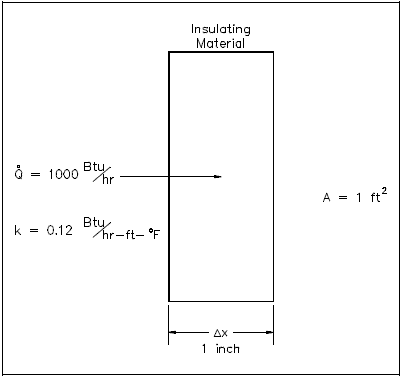
A standard “conduction through a slab” diagram showing heat flowing through an insulating block. The labels highlight the key variables in Fourier’s law—material property , cross-sectional area , and thickness —which helps separate “what the material is” from “how the object is shaped.” Source
Thermal conductivity: A material property that indicates how readily thermal energy is conducted through a substance.
Thermal conductivity is therefore not a description of one particular object alone. It is a statement about the material making up that object. A copper block, a copper wire, and a thin copper sheet can have very different shapes, but the material copper is still characterized by the same thermal conductivity when conditions are comparable.
Why atomic structure matters
The syllabus emphasizes that thermal conductivity depends on the arrangement of atoms and the interactions between them. This connects the microscopic model of matter to the macroscopic observation of conduction.
Arrangement of atoms
In a solid, atoms are not free to travel from place to place, but they do vibrate around equilibrium positions. When one region is warmer, its atoms have greater average kinetic energy and vibrate more strongly.
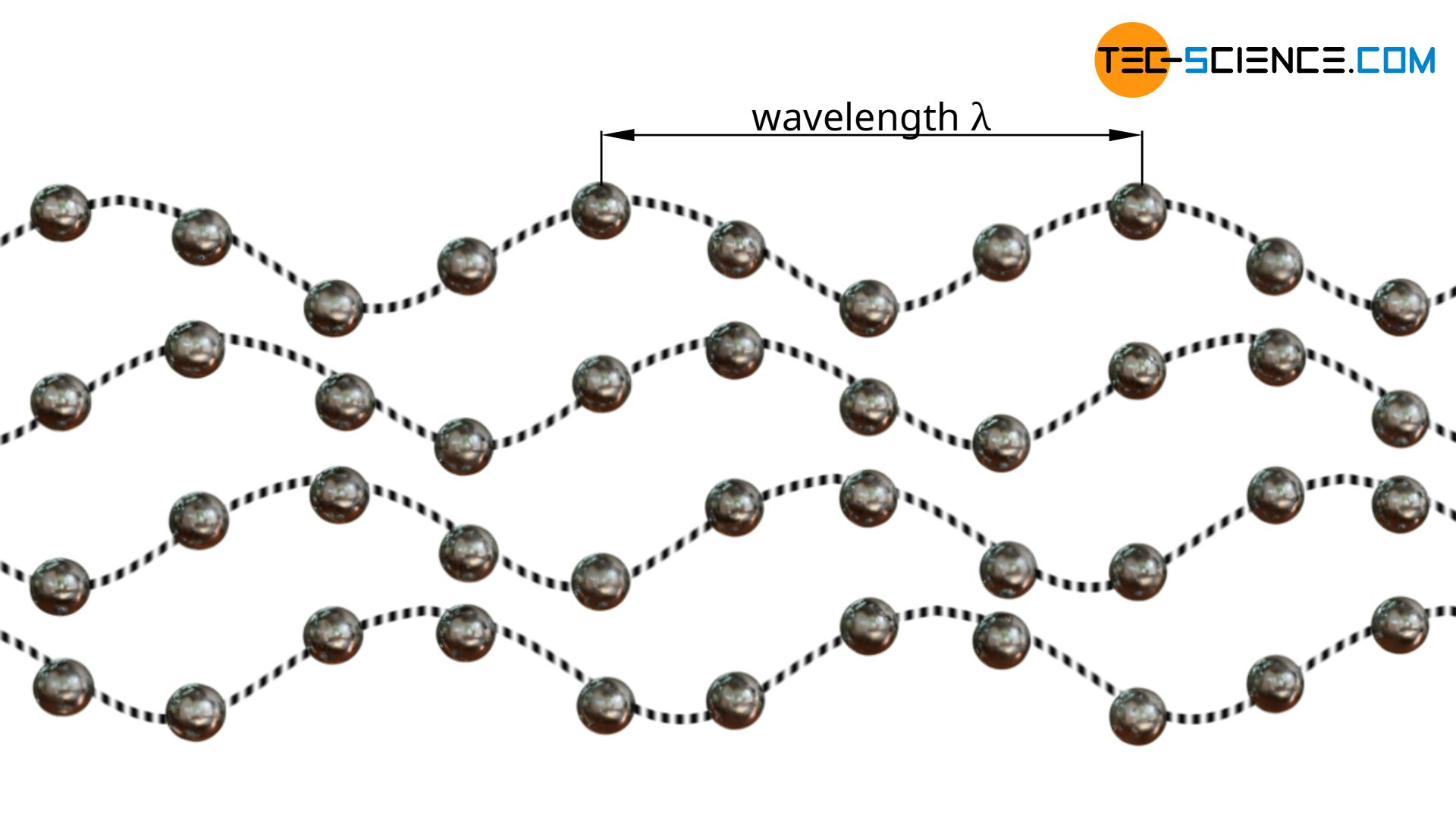
A lattice-vibration (phonon) schematic showing how a vibrational disturbance can propagate through a solid. This connects the macroscopic idea of conduction to the microscopic picture: energy moves through coupled atomic vibrations, and the effectiveness depends on how strongly neighboring atoms interact. Source
That disturbance can be passed to neighboring atoms.
How effectively the disturbance spreads depends partly on how the atoms are arranged.
In materials with a more connected internal structure, energy can pass from atom to atom more effectively.
In materials with gaps, pores, or a less effective internal pathway, conduction is reduced.
Different internal structures can lead to different thermal conductivities even when materials may appear similar on a large scale.
This is why thermal conductivity is not just about chemical identity in a simple sense. The internal structure of the material matters because it determines the pathways available for energy transfer.
Interactions between atoms
Atomic interactions include the forces that act between neighboring atoms. These forces determine how readily one atom’s motion influences another’s motion.
If neighboring atoms interact in a way that allows energy to be passed along efficiently, the material tends to have a larger thermal conductivity. If the interactions are less effective at transmitting vibrational energy, the thermal conductivity tends to be smaller.
A strong AP-style explanation links these ideas clearly:
warmer atoms have more kinetic energy
they collide with or influence nearby atoms
the effectiveness of that transfer depends on the material’s atomic arrangement and interactions
the overall result is a material-specific thermal conductivity
Large and small thermal conductivity
A material with a large thermal conductivity transfers thermal energy readily by conduction. A material with a small thermal conductivity resists conduction and is often useful for insulation.
This does not mean that the amount of thermal energy transferred is set only by the material. The actual transfer in a real situation also depends on the physical setup. However, the material’s thermal conductivity tells you how favorable the material itself is for conduction.
For exam reasoning, it is important to separate these ideas:

Fourier’s law in differential form, relating heat-flux vector to the temperature gradient via thermal conductivity. This equation summarizes how acts as the proportionality constant that turns a temperature gradient into a material-dependent heat flow response. Source
Thermal conductivity describes the material.
Energy transfer rate describes what happens in a specific situation.
A larger sample of an insulating material is still made of a low-conductivity material. A thinner sample of a conducting material is still made of a high-conductivity material. Changing the object’s dimensions can change how much energy is transferred, but it does not automatically change the material property. That distinction is central whenever you compare different samples of the same material.
Distinguishing material from object
Students often confuse the material property with features of a particular object. A helpful test is to ask, “Would this value stay the same if I changed the amount of the material but not the material itself?”
If the answer is yes, the property is intrinsic. Thermal conductivity passes this test.
Cutting a block into two smaller pieces does not create a new thermal conductivity.
Simply reshaping the same material without changing its internal structure does not change its thermal conductivity.
Replacing the material with a different one can change thermal conductivity because the atomic arrangement and interactions are different.
This idea is especially important when comparing conductors and insulators. The reason one material conducts better than another is not that it is bigger or smaller. The reason is that the microscopic structure of the material allows energy to move through it more or less effectively.
Using this idea in explanations
On AP Physics 2 questions, you may be asked to justify why one material conducts thermal energy better than another. A strong response should connect the observable behavior to the microscopic model.
A clear explanation usually does three things:
identifies which material has the larger or smaller thermal conductivity
states that thermal conductivity is an intrinsic property of the material
connects that property to the arrangement and interactions of the atoms in the material
That kind of reasoning shows that thermal conductivity is not just a memorized label. It is a physical property that comes from how matter is built at the atomic level.
Practice Questions
Two rods have the same length and cross-sectional area. One rod is copper and the other is glass. When each rod is placed between the same hot and cold surfaces, the copper rod transfers thermal energy faster.
State which rod has the larger thermal conductivity and explain why thermal conductivity is an intrinsic property. [2 marks]
1 mark: States that the copper rod has the larger thermal conductivity.
1 mark: Explains that thermal conductivity depends on the material itself, or on the arrangement and interactions of its atoms, not on the rod’s size or shape.
A student compares three slabs used for insulation.
Slab A and Slab B are both made of brick, but Slab A is thicker than Slab B.
Slab C has the same thickness as Slab B but is made of foam.
All three slabs have the same cross-sectional area and are placed separately between the same warm and cool environments.
(a) Compare the thermal conductivity of Slab A and Slab B. Explain your answer. [2 marks]
(b) Compare the rate of thermal energy transfer through Slab A and Slab B. Explain why this comparison does or does not determine their thermal conductivity. [2 marks]
(c) Foam contains many trapped air spaces. Using atomic arrangement and interactions, explain why Slab C can have a smaller thermal conductivity than Slab B. [2 marks]
[Total: 6 marks]
(a) 1 mark: States that Slab A and Slab B have the same thermal conductivity.
(a) 1 mark: Explains that thermal conductivity is intrinsic, so it depends on the material, not the thickness of the sample.
(b) 1 mark: States that Slab B has a greater rate of thermal energy transfer than Slab A because it is thinner.
(b) 1 mark: Explains that transfer rate depends on the setup, while thermal conductivity is a property of the material itself.
(c) 1 mark: States that the trapped air spaces interrupt or reduce effective pathways for energy transfer.
(c) 1 mark: Explains that the atomic arrangement and interactions in foam make it less effective at passing energy from atom to atom, so its thermal conductivity is smaller.
FAQ
Yes. In real materials, thermal conductivity often changes as temperature changes.
For many AP Physics 2 situations, thermal conductivity is treated as a given property for the stated conditions. If a problem does not mention temperature dependence, you should usually treat $k$ as constant over the range involved.
In more advanced courses, temperature dependence becomes important because atomic motion and interactions can change significantly as the material gets hotter or colder.
Yes. If the atoms are arranged differently, the thermal conductivity can be different even when the chemical element is the same.
That happens because thermal conductivity depends on internal structure, not just on chemical symbol. Different crystal structures or bonding patterns can create very different pathways for transferring energy.
So “same element” does not automatically mean “same $k$.”
A pure material has its own intrinsic thermal conductivity. A composite or layered object is different because it contains more than one material.
In that case, the whole object may be described by an effective thermal conductivity, but that value depends on:
which materials are present
how much of each material is present
how they are arranged
So the intrinsic property belongs to each material component, while the overall object may behave according to a combined or effective value.
In gases, atoms or molecules are much farther apart than in most solids. Because of that spacing, energy is not passed along as efficiently from particle to particle.
In solids, neighboring atoms are close together, so vibrational energy can move through the structure more effectively. In gases, collisions are less well connected into a continuous pathway.
That is why many gases have relatively small thermal conductivity compared with common solids.
Yes. Some solids are anisotropic, meaning their properties depend on direction.
If the atomic arrangement is different along different directions, energy may move more easily one way than another. That means the same solid can have one value of thermal conductivity in one direction and a different value in another direction.
AP Physics 2 usually uses simpler models, but this idea is a direct consequence of thermal conductivity depending on atomic arrangement and interactions.
