

AP Syllabus focus: 'The energy needed to change a material’s temperature is related to its mass, specific heat, and temperature change.'
When a material is heated or cooled without changing phase, the amount of energy transferred depends on how much material is present, what it is made of, and how much its temperature changes.
The Core Relationship
A temperature change occurs when energy is transferred into or out of a material. If two samples are made of the same substance, the larger sample needs more energy for the same temperature increase. If two samples have the same mass, the material with the greater resistance to temperature change needs more energy. That resistance is described by specific heat.
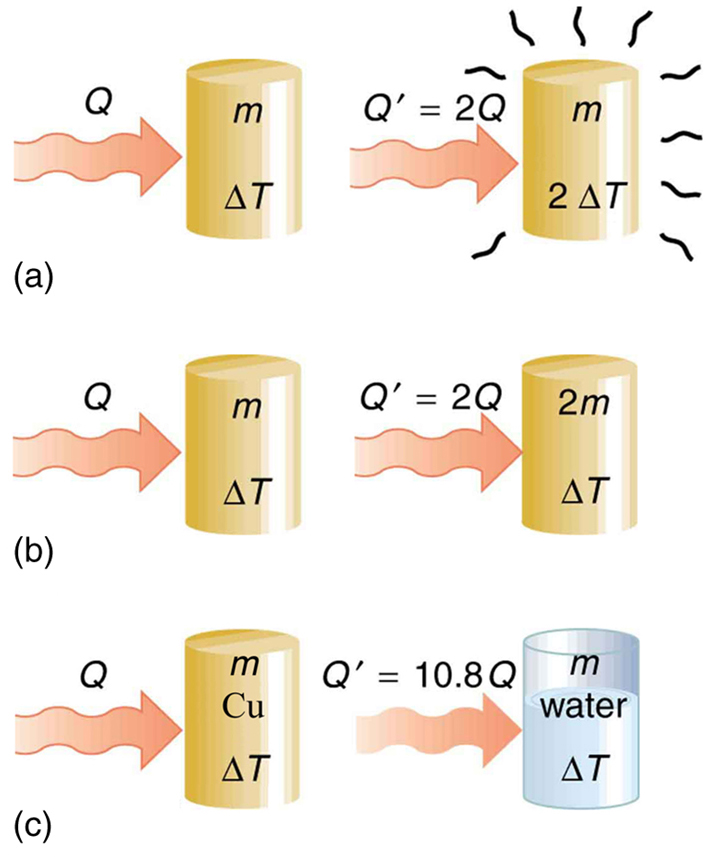
This diagram illustrates the three core proportionalities in : heat added scales linearly with temperature change, with mass, and with the material (specific heat). It also emphasizes that two equal-mass samples can require very different energy inputs to achieve the same when their specific heats differ. Source
Term: Specific heat is the amount of energy required to raise the temperature of of a material by or .
In AP Physics 2 Algebra, specific heat links the energy transferred during heating or cooling to the observed temperature change.
= energy transferred to or from the material, in joules
= mass of the material, in kilograms
= specific heat, in
= temperature change, in or
This equation applies while the material remains in the same phase and while the specific heat can be treated as constant over the temperature interval.
Interpreting the Variables
Mass
The energy required is directly proportional to mass.
If the mass doubles, the required energy doubles for the same material and the same temperature change.
A small sample can warm quickly with little energy transfer.
A large sample requires much more energy to reach the same temperature increase.
This makes sense physically: more matter means more particles whose average energy must change.
Specific Heat
The value of specific heat tells how much energy a material requires per kilogram per degree of temperature change.
A large specific heat means the material needs a lot of energy for a small temperature change.
A small specific heat means the material’s temperature changes more easily.
For this reason, equal masses of different materials can respond very differently to the same energy transfer. In problems, the specific heat is usually given, so the main task is to use it correctly in the equation.
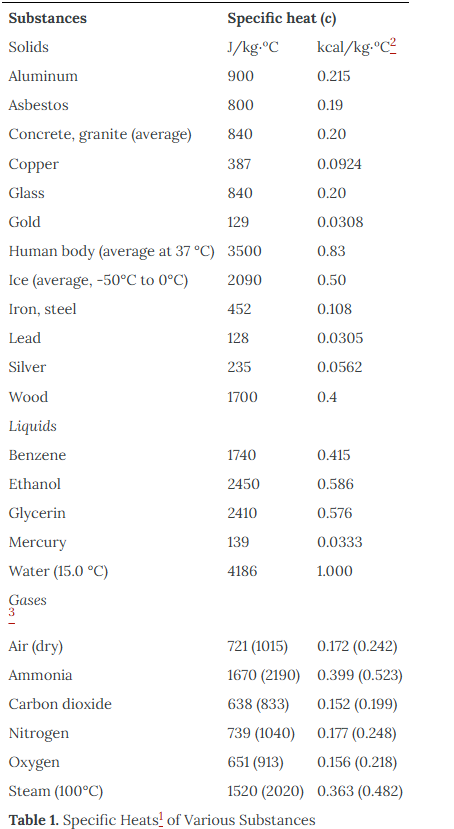
A reference table of specific heats makes the constant in concrete by showing typical values for solids, liquids, and gases. Comparing entries (for example, water versus metals) helps explain why equal masses can experience very different temperature changes under the same energy transfer. Source
Temperature Change
The quantity means final temperature minus initial temperature. It is not the starting temperature by itself.
A bigger temperature change requires more energy if mass and specific heat stay the same.
A smaller temperature change requires less energy.
Only the change matters in this equation. A sample heated from to has the same as one heated from to .
Heating and Cooling
The equation works for both warming and cooling, but the sign of the energy transfer matters.
If the material is heated, its temperature increases, so is positive and is positive.
If the material is cooled, its temperature decreases, so is negative and is negative.

A cooling curve shows temperature decreasing over time toward the surrounding temperature, making the idea of a negative visually intuitive. In energy-transfer language, cooling corresponds to energy leaving the object (negative ) as the object’s temperature falls. Source
A positive value of means energy was transferred into the material. A negative value means energy was transferred out of the material. On AP problems, keeping the sign consistent helps show whether the material gained or lost energy.
This relationship does not describe a process in which temperature stays constant while energy is still being transferred. For this subtopic, focus only on situations where energy transfer actually produces a temperature change.
Units and Useful Conventions
Correct units are essential.
Mass should be in kilograms, not grams, unless you convert first.
Energy is measured in joules.
Specific heat is commonly given in .
Temperature change may be written in kelvins or degrees Celsius.
For temperature differences, a change of is the same size as a change of . That is why either unit works for . However, you must calculate the change carefully by subtracting initial temperature from final temperature.
A common error is mixing the absolute temperature with the temperature change. The equation uses , not just .
Reasoning with
Many AP Physics 2 Algebra questions can be solved with proportional reasoning before doing any arithmetic.
If increases while and stay fixed, the needed energy increases in the same proportion.
If doubles, the needed energy doubles.
If is cut in half, the needed energy is cut in half.
You can also rearrange the equation if the question asks for a different variable:
To find temperature change, divide energy by .
To find mass, divide energy by .
To find specific heat, divide energy by .
In a multistep problem, first identify the material, then read the mass, then compute the temperature change with the correct sign. After that, choose whether the answer should represent energy added or energy removed. Clear variable identification is often as important as substitution.
This relationship is one of the main tools for connecting thermal energy transfer to measurable changes in temperature in real materials.
Practice Questions
A copper sample has a specific heat of . How much energy must be transferred to raise its temperature by ?
1 mark for using
1 mark for a correct answer of or
Two solid blocks each receive of energy.
Block A has mass and specific heat .
Block B has mass and specific heat .
(a) Calculate the temperature change of each block.
(b) Which block has the greater temperature change? Explain using physics reasoning.
(c) Block B is later cooled by the same magnitude of temperature change you found in part (a). State the sign of for this cooling process and explain why.
(a)
1 mark for using for Block A
1 mark for or
1 mark for or
(b)
1 mark for identifying Block B as having the greater temperature change
1 mark for explaining that with the same , a smaller value of gives a larger
(c)
1 mark for stating that is negative because energy is transferred out of Block B during cooling
FAQ
Real experiments often lose energy to the surroundings, the container, or measuring devices.
Other causes include:
inaccurate mass measurements
temperature sensors that lag behind the material
impurities in the sample
assuming $c$ stays constant over a temperature range where it actually changes
Because of these effects, the measured value is often an approximation rather than a perfect match to a reference value.
Water has an unusually large specific heat because added energy is not used only to increase particle motion quickly.
A significant amount of energy also goes into changing the ways water molecules interact with one another. As a result, water’s temperature rises more slowly than that of many metals for the same energy input.
This is why oceans, lakes, and even the human body can resist rapid temperature changes.
Then the simple form $Q=mc\Delta T$ becomes only an approximation over a wide temperature range.
In more advanced physics, the temperature range is broken into smaller intervals, or calculus is used, so that the changing value of $c$ can be accounted for more accurately.
In AP Physics 2 Algebra, specific heat is typically treated as constant unless the problem clearly says otherwise.
Calorimetry uses measured temperature changes to determine unknown energy transfers or unknown specific heats.
A typical approach is:
place materials in thermal contact
measure initial temperatures
wait for a final equilibrium temperature
use $Q=mc\Delta T$ for each part of the system
By combining those expressions with conservation of energy, an unknown quantity can be found. This is one of the most common practical uses of the temperature-change equation.
Yes. A substance can have different specific heats as a solid, liquid, or gas.
That happens because the particles are arranged differently and store energy in different ways in each phase. So a material may require one amount of energy per degree when solid and a different amount when liquid.
That is why you must use the specific heat value that matches the phase named in the problem.

