

AP Syllabus focus: 'Charge is a fundamental property of matter and is described as positive or negative. Electrons have charge -e, protons have charge +e, and neutrons have no electric charge.'
Understanding electric charge begins with recognizing it as an intrinsic feature of matter. At this level, the essential task is to identify which basic particles are positive, negative, or uncharged.
What It Means for Charge to Be Fundamental
In physics, electric charge is one of the basic properties used to describe matter. Calling charge fundamental means it is not added on later or caused by some outside condition. It is built into the particle itself.
Electric charge: An intrinsic property of matter that can be positive, negative, or zero.
A particle does not become an electron because it happens to be negative at one moment. Rather, being negatively charged is part of what an electron is. In the same way, a proton carries positive charge as part of its identity, and a neutron has no electric charge as part of its identity. In this topic, charge is treated as a basic characteristic of matter, not as a temporary label.
This idea is important because it tells you how to describe particles precisely. If you know the particle type, you should know the sign of its charge. That link between particle identity and charge is a core fact for AP Physics 2.
Positive and Negative Charge
The meaning of the signs
The words positive and negative label two opposite kinds of charge.
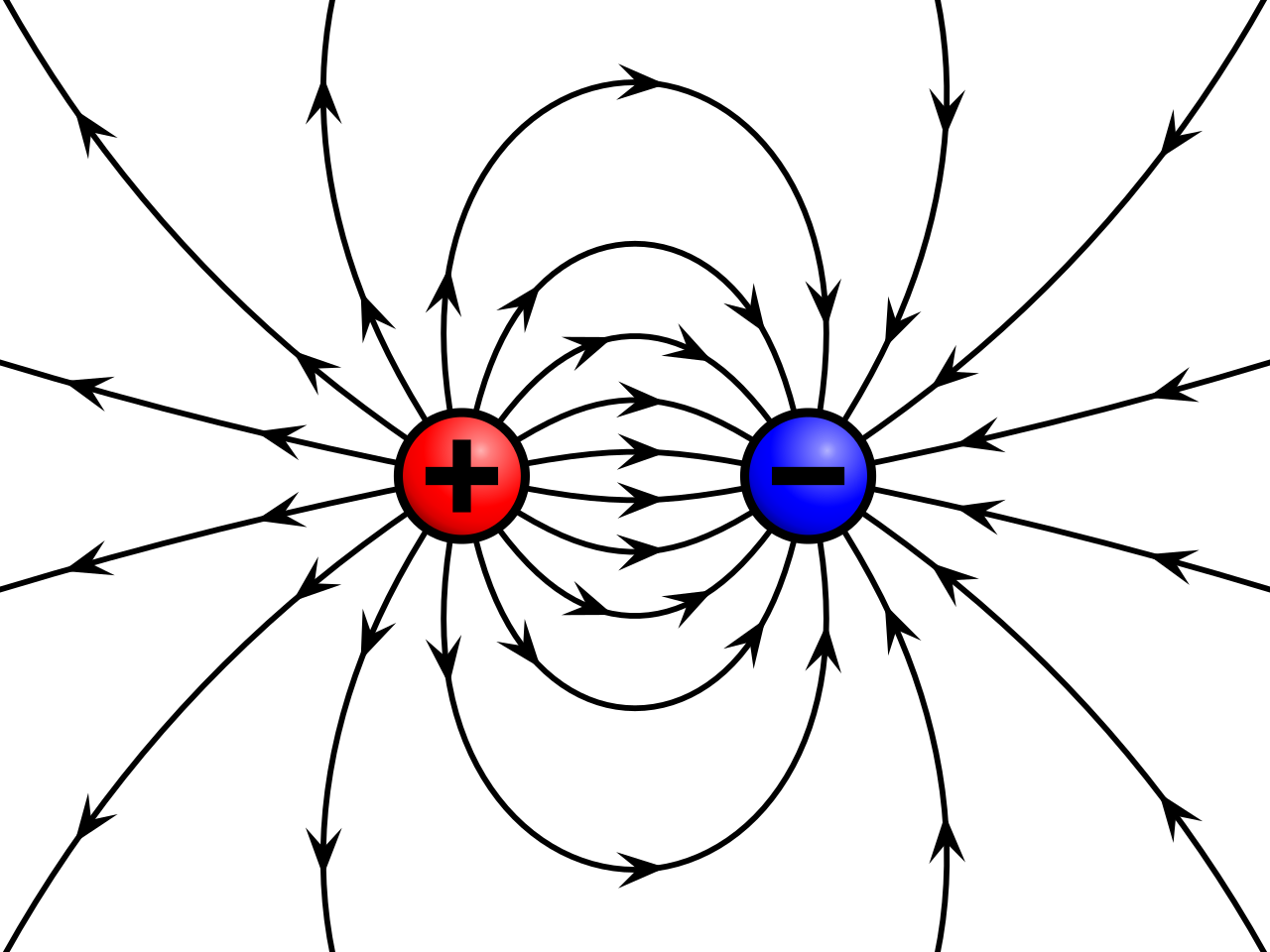
Electric field-line diagram for a positive and a negative point charge, illustrating the standard sign convention used in physics. Field lines are drawn as leaving positive charge and ending on negative charge, visually encoding how opposite signs are paired and distinguished. Source
They do not mean good and bad, and they do not mean one particle has “more” charge just because its sign is positive. The sign tells you the category of charge a particle belongs to.
In AP Physics 2, the sign must be stated correctly whenever you describe a charged particle. Saying that a proton has charge is incomplete, because the sign is part of the physical description. A proton has , while an electron has . The different signs are essential and cannot be omitted.
The role of the symbol
The notation used in this topic highlights an important pattern. The electron is written as and the proton as . The shared symbol shows that these two particles are described using the same charge magnitude, while the sign distinguishes the type of charge. The neutron is different because it has no electric charge.
You do not need an equation to use this idea. Instead, you need to recognize what the notation is telling you: electrons and protons are opposite in sign, while neutrons are uncharged.
Charges of the Basic Particles
At this level, three particles appear repeatedly in descriptions of matter:
Electron: charge
Proton: charge
Neutron: no electric charge, often represented as
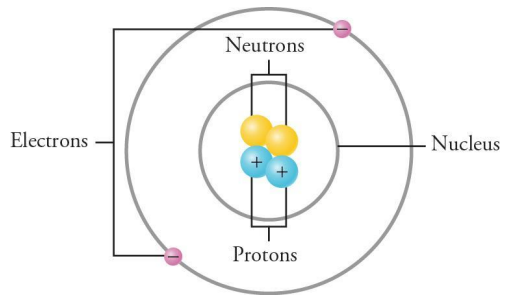
Simplified atomic model showing negatively charged electrons surrounding a nucleus that contains positively charged protons and neutral neutrons. The diagram reinforces that charge is tied to particle type: electron (), proton (), and neutron (). Source
These statements should be memorized exactly. They are foundational facts, not results you derive from another relationship. When a problem, diagram, or written description refers to one of these particles, you should immediately connect the particle name to its charge.
It is also important to distinguish between negative and uncharged. An electron is negative. A neutron is not negative; it has no electric charge. Those are different descriptions and should never be used interchangeably.
Interpreting Matter at the Particle Level
Because charge is a property of matter, descriptions of matter often depend on which particles are present. When reading a particle model, identify each particle by its charge before doing any further reasoning. Electrons contribute negative charge, protons contribute positive charge, and neutrons do not contribute electric charge.
This is a particle-level idea. It means you should think about charge as belonging to the matter itself, not as a vague label attached afterward. If a question mentions an electron, that immediately tells you the charge is negative. If it mentions a proton, the charge is positive. If it mentions a neutron, there is no electric charge to assign.
The phrase fundamental property also means that charge does not depend on location. An electron remains negatively charged wherever it is. A proton remains positively charged. A neutron remains uncharged. The surroundings may matter in later physics topics, but they do not change the charge assigned to the particle itself.
Language That Must Stay Precise
A large number of mistakes come from careless wording rather than difficult physics. Precision matters here because the topic is built from a few exact statements.
Do not say a neutron is “kind of neutral” or “slightly charged.” The correct statement is that a neutron has no electric charge.
Do not drop the sign when naming the charge of an electron or proton.
Do not use positive, negative, and uncharged as if they mean the same thing.
Do not treat charge as temporary. For these particles, charge is part of the particle’s identity.
When writing free-response answers, short accurate statements are often best. Examples of correct language include: “The electron has charge ,” “the proton has charge ,” and “the neutron has no electric charge.” Those are the exact facts this subsubtopic expects you to know and use.
Practice Questions
State the electric charge of:
an electron
a proton
a neutron
Electron has charge . (1)
Proton has charge . (1)
Neutron has no electric charge, or . (1)
A student writes the following statements:
“An electron has charge .”
“A proton has charge .”
“A neutron is negatively charged because it is a particle in matter.”
“Charge is a fundamental property, so it is part of a particle’s identity.”
Identify which statements are correct. For any incorrect statement, rewrite it correctly. Then explain what is meant by saying charge is a fundamental property of matter.
Identifies statement 1 as correct. (1)
Identifies statement 2 as correct. (1)
Identifies statement 3 as incorrect and corrects it to: a neutron has no electric charge, or . (1)
Identifies statement 4 as correct. (1)
Explains that fundamental means charge is intrinsic to the particle itself and is not assigned by location, motion, or surroundings. (1)
FAQ
The names come from historical convention, established before modern particle physics was developed. Scientists needed two opposite labels and chose positive and negative.
The choice was arbitrary. If the labels had been reversed, the physics would still work as long as everyone used the same convention consistently.
Experiments show that the proton and electron have equal charge magnitude to extremely high precision, with opposite signs.
That equality is important because ordinary matter can be electrically neutral when equal numbers of protons and electrons are present. If their charge magnitudes were different, neutral matter would be much harder to explain.
In a deeper particle model, a neutron is made of smaller particles called quarks, and quarks do carry charge.
However, the charges inside the neutron add to zero overall. That is why the neutron’s total electric charge is $0$, even though its internal structure is more complicated than the AP Physics 2 model.
The symbol $e$ is a compact way to represent the common charge magnitude associated with electrons and protons.
Using $-e$ and $+e$ makes the sign difference easy to see without writing a long numerical value every time. It helps emphasize that the two particles have opposite charge types.
Antimatter particles follow the same charge categories as ordinary matter, but the corresponding particle has the opposite sign of charge.
For example:
a positron has charge $+e$
an antiproton has charge $-e$
an antineutron has charge $0$
This reinforces the idea that charge is part of a particle’s identity.
