

AP Syllabus focus: 'A test charge is small enough that it does not significantly affect the nearby electric field. Electric fields point away from isolated positive charges and toward isolated negative charges.'
This page focuses on how physicists define electric field direction and why an ideal probe charge must be small enough to reveal, rather than disturb, the field.
Understanding the idea of a test charge
A test charge is an ideal probe used to check the direction of an electric field at a particular location. The key idea is that the field already exists because of some source charge, and the test charge is only used to detect that field.
Test charge: A very small charged object used to determine the direction of an electric field without significantly changing the existing field.
The phrase small enough is essential. A test charge cannot be so large that its own charge noticeably changes the field in the region being studied. In physics, this is an idealization: we imagine a charge that is present just long enough, and is weak enough, to indicate direction without becoming an important part of the situation.
Why “small enough” matters
If the test charge were too large, it would no longer be a passive probe. Instead, it would become another important source of electric influence. That would make the observed field less trustworthy, because the direction would no longer be due only to the original charged object.
In practice, “small enough” means the test charge should have a negligible effect on the surroundings compared with the source charge being investigated. This matters because the purpose of a test charge is to measure, not to alter.
A good mental checklist is:
the test charge should not significantly change the nearby field
the test charge should be much less important than the source charge
the direction found should represent the original field, not a new field created by the probe itself
This idea is common in physics: the best measuring device interferes as little as possible with the system it measures.
Field direction around isolated charges
To describe direction clearly, the syllabus refers to isolated charges. This means the field pattern is being considered for a single charged object on its own, without nearby charges changing the basic inward or outward pattern.
Isolated charge: A charge treated as if nearby charges do not significantly alter the electric field pattern being described.
For an isolated charge, the field direction depends only on whether the source charge is positive or negative. The sign of the source determines whether the electric field points outward from the charge or inward toward it.
Positive source charges
An isolated positive charge produces an electric field that points away from the charge in all directions. If you imagine placing a small positive test charge nearby, the field direction is the outward direction from the source.
This outward pattern is often described as radial, meaning it extends straight outward from the center of the charge.
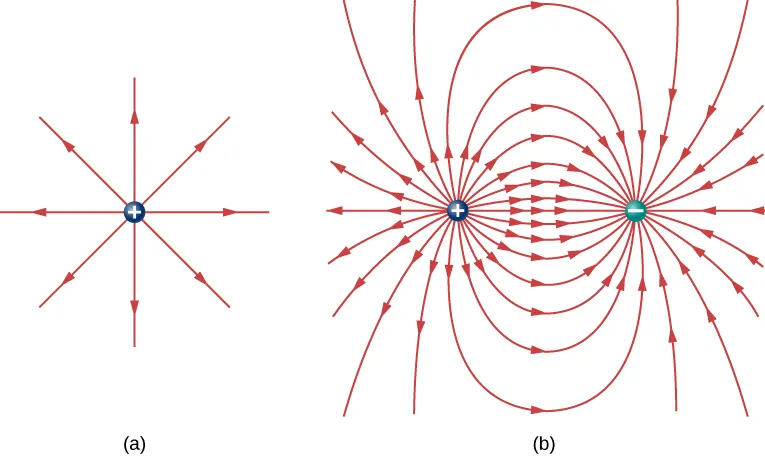
Field lines for a positive point charge point radially outward, and the arrowheads give the local direction of . This representation helps connect the verbal rule (“away from positive”) to the standard field-line diagram used in problem solving. Source
At every point around the charge, the electric field direction is the direction moving away from the positive source.
Negative source charges
An isolated negative charge produces an electric field that points toward the charge in all directions. A small positive test charge placed nearby would indicate a direction aimed inward, toward the source charge.
This is also a radial pattern, but the arrows point inward rather than outward. So the sign of the source charge completely changes the direction of the field:
positive source charge field points away
negative source charge field points toward
How to interpret field direction correctly
A common point of confusion is that the electric field direction is a property of the space around the source charge, not a property chosen separately for each object that enters the field.
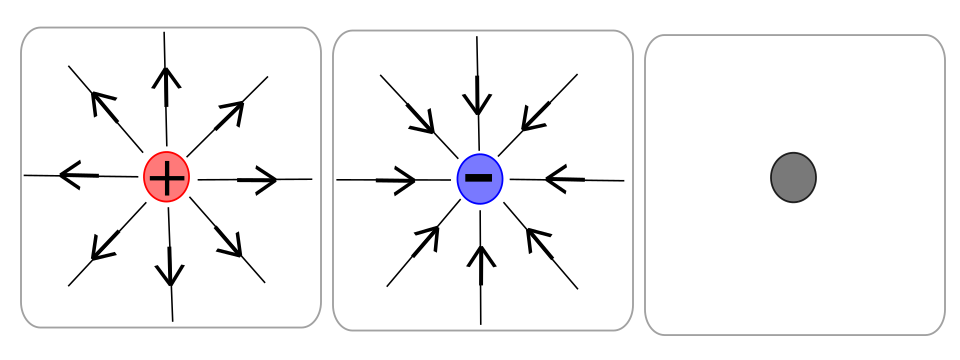
Electric field lines visualize the direction a positive test charge would be pushed at each location in space. The diagram contrasts a positive source charge (field lines radiate outward) with a negative source charge (field lines terminate inward), reinforcing that direction is set by the source charge’s sign. Source
Once the source charge is known, the field direction at a point is fixed.
The use of a positive test charge is a convention that makes direction consistent. Because of that convention:
outward arrows indicate a positive source charge
inward arrows indicate a negative source charge
the field direction is not redefined just because a different charge is later placed there
This means you should think of field direction as part of the environment created by the source charge. The test charge only reveals that direction.
Another important point is that the direction is local. When we say “the field points away” or “toward,” we mean the direction at a specific location around the charge. Around an isolated charge, those local directions form the familiar inward or outward pattern centered on the charge.
Common mistakes to avoid
Students often make a few predictable errors with this topic.
One mistake is thinking that a test charge can be any convenient charged object. It cannot. If it significantly affects the nearby electric field, then it is not functioning as an ideal test charge.
Another mistake is mixing up the source charge and the test charge. The source charge creates the field. The test charge is only used to identify the field’s direction.
A third mistake is reversing the field directions for isolated charges. Remember the rule exactly:
electric fields point away from isolated positive charges
electric fields point toward isolated negative charges
Finally, do not interpret “small enough” as meaning “zero charge.” A test charge must still be charged so that field direction can be identified. The important requirement is not zero charge, but negligible disturbance.
Practice Questions
A small positive test charge is placed near an isolated negative charge.
(a) In which direction does the electric field point? (1 mark)
(b) Why must the test charge be very small? (1 mark)
(a) 1 mark for stating that the electric field points toward the negative charge.
(b) 1 mark for stating that the test charge must not significantly affect or change the nearby electric field.
A student maps the electric field around an isolated charged object. At every point shown, the field arrows point directly inward toward the object.
(a) Identify the sign of the charged object and explain your answer. (2 marks)
(b) The student then tries to use a much larger positively charged sphere as the test charge. Explain why this is a poor choice of test charge. Give two reasons. (2 marks)
(c) If a negative particle were placed at one of the mapped points, would it move in the same direction as the field arrows or the opposite direction? (1 mark)
(a)
1 mark for identifying the object as negative.
1 mark for explaining that electric fields point toward isolated negative charges.
(b)
1 mark for stating that the larger probe would significantly affect or disturb the nearby field.
1 mark for explaining that a large probe is not a good ideal test charge because its own charge cannot be neglected.
(c)
1 mark for stating that the negative particle would move opposite to the field direction.
FAQ
Using a positive test charge creates a single, consistent convention for everyone.
If physicists allowed the sign of the probe to change the definition, field directions would become ambiguous. With the positive-test-charge convention, the electric field has one agreed direction at each point, regardless of which particle is later placed there.
There is no universal numerical cutoff. It depends on the situation.
A test charge is small enough when its presence does not noticeably change the original field pattern. In practice, physicists compare the probe’s effect with the effect of the source charge and make sure the probe’s influence is negligible.
No. A test charge must actually have charge.
A neutral object does not provide a direct standard for electric field direction in the way required by the definition. The idea of a test charge is tied to a charged probe, specifically one small enough not to disturb the field significantly.
In practice, “isolated” means other nearby influences are small enough to ignore for the model being used.
It does not mean absolutely nothing else exists. It means the charge being studied is the only one that significantly determines the field direction in the region of interest.
Those diagrams represent an idealized model.
They assume:
a single isolated source charge
a symmetric situation
no nearby objects changing the pattern
Real setups can be more complicated, but the ideal picture is useful because it shows the core rule clearly: away from positive, toward negative.
