

AP Syllabus focus: 'In electrostatic equilibrium, excess charge on a solid conductor is on the surface, the electric field inside is zero, and the surface field is perpendicular.'
Charged conductors settle into a stable arrangement because mobile charges respond to electric forces. Understanding that stable arrangement lets you predict where charge sits and how the electric field behaves.
Electrostatic Equilibrium
In this topic, a conductor allows charge to move through the material.
Conductor: A material in which electric charge can move relatively easily.
When extra charge is placed on a solid conductor, the charges do not usually remain where they were first deposited. They move because electric forces act on them. That motion continues until the charge distribution becomes stable.
When that rearrangement stops, the conductor is in electrostatic equilibrium.
Electrostatic equilibrium: The state in which charges in a conductor are no longer moving from place to place, so the electric field arrangement is stable.
Because charges are free to move, a conductor cannot stay in equilibrium if electric forces still push those charges through the material.
Excess Charge Is on the Surface
Excess charge means any net charge added to the conductor beyond its neutral state. In a solid conductor at equilibrium, this excess charge is found on the surface, not trapped in the interior. If some of it were left inside the material, it would create electric forces on other mobile charges in the conductor. Those charges would continue to move until the interior arrangement changed.
A useful way to think about this is repulsion between like charges. Charges with the same sign spread out as much as possible. For a solid conducting object, the greatest separation is obtained when the extra charge moves to the outer surface. Once the excess charge has reached the surface and the internal field has been canceled, the conductor can remain at rest.
This is why diagrams of a charged conductor show charges on the boundary of the object rather than scattered through the material.
The Electric Field Inside the Conductor Is Zero
In electrostatic equilibrium, the electric field inside the conducting material is zero.
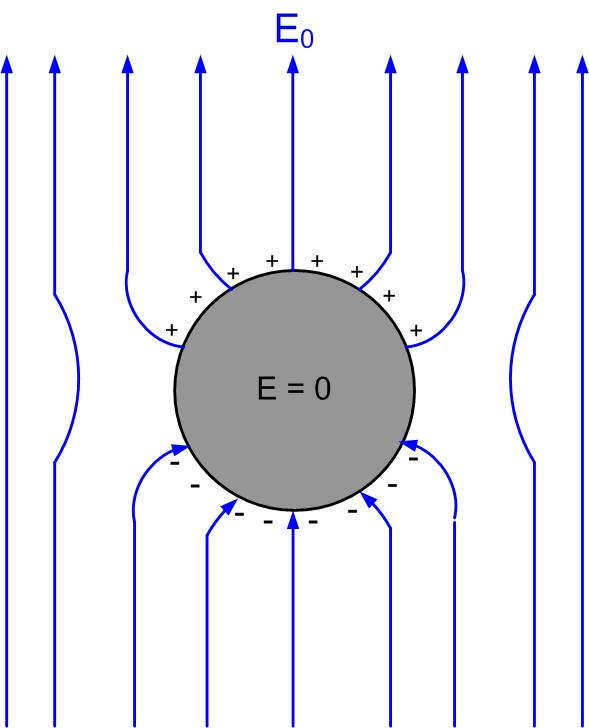
A conducting sphere placed in an external electric field polarizes: induced surface charge appears with opposite signs on opposite sides, while the field inside the metal remains . The curved field lines outside illustrate how the conductor’s surface charges rearrange until the internal field cancels. Source
This statement is essential. If there were any nonzero field inside, even a very small one, the mobile charges in the conductor would feel a force and drift through the material. Because equilibrium means no further charge motion, the field inside cannot remain nonzero.
This result is about the conductor itself, not about the space far away from it. Charges outside the conductor can influence how the surface charge is arranged, but once equilibrium is established, their effects are balanced so that the net field within the conducting material is zero.
For AP Physics 2, this idea supports an important reasoning pattern:
moving charges imply the conductor has not yet reached equilibrium
a nonzero internal electric field would keep charges moving
therefore a conductor in electrostatic equilibrium must have zero electric field inside
The Surface Field Is Perpendicular
At the surface of a charged conductor, the electric field is perpendicular to the surface.
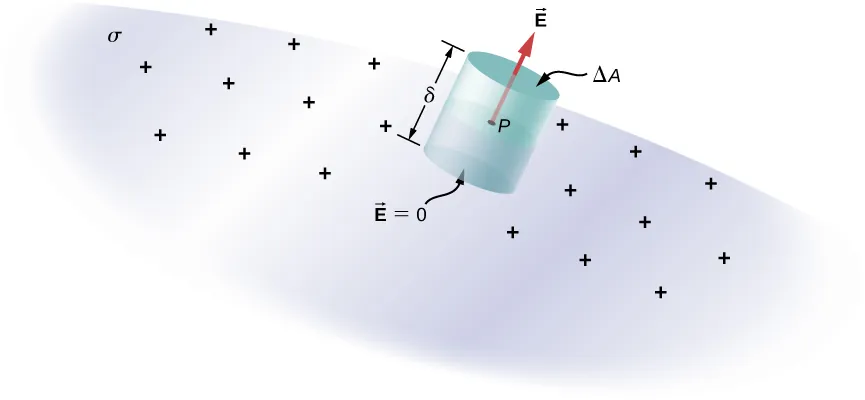
An infinitesimal cylindrical (pillbox) Gaussian surface straddles a conductor’s boundary: inside the metal, while the external field points normal to the surface. This diagram supports the equilibrium argument that any tangential component would drive surface charges to move, so only the perpendicular component can remain. Source
In field diagrams, the field lines meet the surface at right angles.
Why must this be true? Suppose the surface field had a component parallel to the surface. Charges on the surface would feel a force along the surface and would slide sideways. That motion would change the charge distribution, so the conductor would not be in equilibrium. Therefore the parallel, or tangential, component of the electric field must be zero at equilibrium. Only the perpendicular component can remain.
For that reason, the field just outside the surface points directly away from a positively charged conductor and directly toward a negatively charged conductor. It does not skim along the conductor.
What to Look for in Representations
When interpreting a diagram of a charged solid conductor in electrostatic equilibrium, look for these features:
all excess charge is drawn on the outer surface
no electric field vectors are shown inside the conducting material
field lines cross the surface at
any picture showing field lines running along the surface represents a nonequilibrium situation
Connecting the Three Facts
These three properties are not separate rules to memorize. They follow from one another. Because charges in a conductor are free to move, any internal electric field causes motion. Charge shifts until that internal field is eliminated. The stable final arrangement places excess charge on the surface, and the remaining field at the surface can only point perpendicular to it.
Common Misconceptions to Avoid
A conductor can contain charges overall, but in electrostatic equilibrium the excess charge is on the surface. The interior is not filled with extra stationary charge.
Zero electric field inside the conductor does not mean there is no charge on the conductor. It means the charges have arranged themselves so their fields cancel within the material.
Perpendicular surface field does not mean the field is the same everywhere around the conductor. The direction is perpendicular locally at each point on the surface, even if the field strength changes from one location to another.
Practice Questions
A solid metal sphere is given a net positive charge and then left undisturbed until electrostatic equilibrium is reached. State: (a) where the excess charge is located (b) the electric field inside the metal
1 mark: States that the excess charge is on the surface of the conductor.
1 mark: States that the electric field inside the metal is zero.
A student claims that a charged solid conductor could have some excess charge inside it and electric field lines that run along its surface while still being in electrostatic equilibrium. Explain why this claim is incorrect.
1 mark: Recognizes that charges in a conductor are free to move.
2 marks: Explains that if excess charge were inside the conductor, electric forces would cause charges to move until the excess charge reached the surface.
2 marks: Explains that if the electric field inside were nonzero, charges would continue moving, so the field inside must be zero in electrostatic equilibrium.
1 mark: Explains that a field line along the surface would mean a tangential electric field component, which would move surface charges, so the surface field must be perpendicular.
FAQ
Surface charge tends to crowd more strongly where the conductor has a small radius of curvature, such as at a sharp tip or edge.
Because the field must be perpendicular to the surface, that crowded charge produces a larger field just outside those regions. This is why sharp points can more easily ionize nearby air and cause effects such as corona discharge.
No. Zero electric field inside a conductor means the electric potential does not change from one point to another inside the conducting material.
That constant potential could be zero, positive, or negative depending on the chosen reference point. What matters in electrostatic equilibrium is that the conductor’s interior is at one constant potential, not that the value must be zero.
For a hollow conductor in electrostatic equilibrium, the conducting material still has zero electric field inside it, and excess charge still resides on surfaces.
If there is no charge inside the cavity, the cavity can be shielded from external static electric fields. If a charge is placed inside the cavity, charges redistribute on the inner and outer surfaces so the conducting material itself still remains in electrostatic equilibrium.
In ordinary physics problems, the rearrangement happens extremely quickly because mobile electrons respond almost immediately to electric forces.
In AP Physics 2, this process is usually treated as effectively instantaneous unless the problem specifically discusses a changing situation. The key idea is that the conductor reaches a stable charge distribution long before you analyze the equilibrium state.
It means the electric field is perpendicular to the surface at each individual point. The correct direction is the local outward or inward normal direction there.
So the field direction can change from place to place on a curved conductor. What cannot exist in electrostatic equilibrium is a sideways, surface-parallel component that would push charges along the surface.
