

AP Syllabus focus: 'The electric force exerted on a positive test charge by an electric field is in the same direction as the electric field at that point.'
This subtopic explains how an electric field determines the push or pull on a charged object. The most important idea is that field direction tells you the force direction for a positive charge.
Force Direction in an Electric Field
An electric field describes how a charged object would interact with charge placed at a particular location. For AP Physics 2, the key directional rule is simple: if the charge placed in the field is positive, the electric force points in the same direction as the electric field.
When you see an electric field arrow at a point in space, that arrow does not show motion by itself.
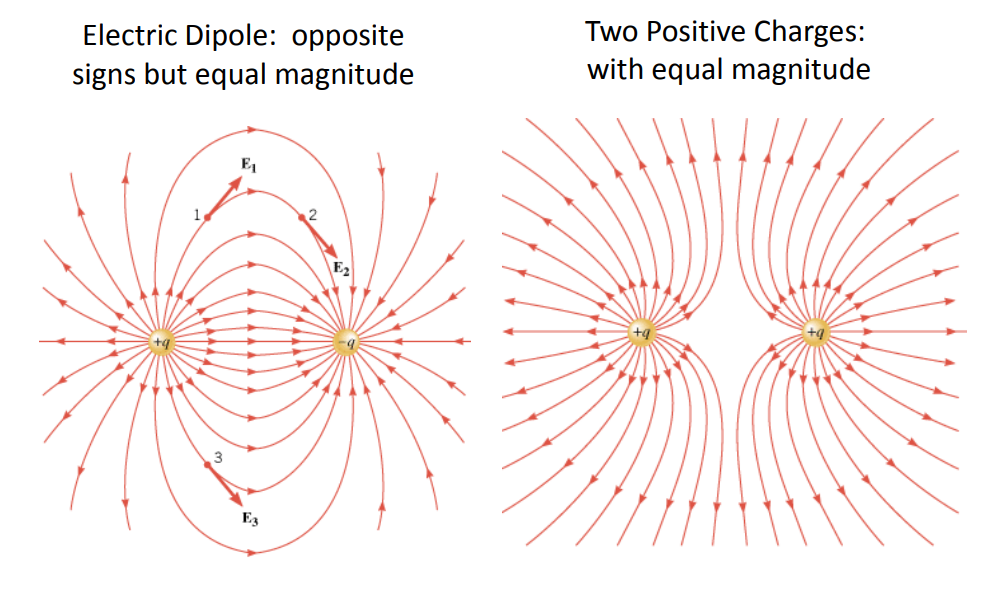
Electric field line diagrams for a dipole (equal and opposite charges) and for two equal positive charges. The arrows on the field lines indicate the direction a positive test charge would be pushed at each location (tangent to the field line). The changing line directions emphasize that force direction depends on position in the field, not just on the presence of charges. Source
It shows the direction of the electric force that would act on a positive charge placed there.
Electric force: The force a charged object experiences because of an electric field at its location.
This rule is local. The phrase “at that point” matters because the field may be different at different positions. A charge can experience one force at one location and a different force at another if the field changes from place to place.
Relating Force and Field
The relationship between charge and electric force is expressed with a vector equation. The sign of the charge is built into the equation, so direction comes out naturally.
= electric force on the charge, N
= charge of the object, C
= electric field at the location of the charge, N/C
This equation shows two major ideas at once:
The magnitude of the force depends on both the amount of charge and the field strength.
The direction of the force depends on the sign of the charge.
If is positive, the force vector points in the same direction as . If is negative, the force vector points in the opposite direction.
How the Sign of Charge Affects Force
Positive charge
A positive charge placed in an electric field feels a force in the same direction as the field.
If the field points to the right, the force on a positive charge is to the right.
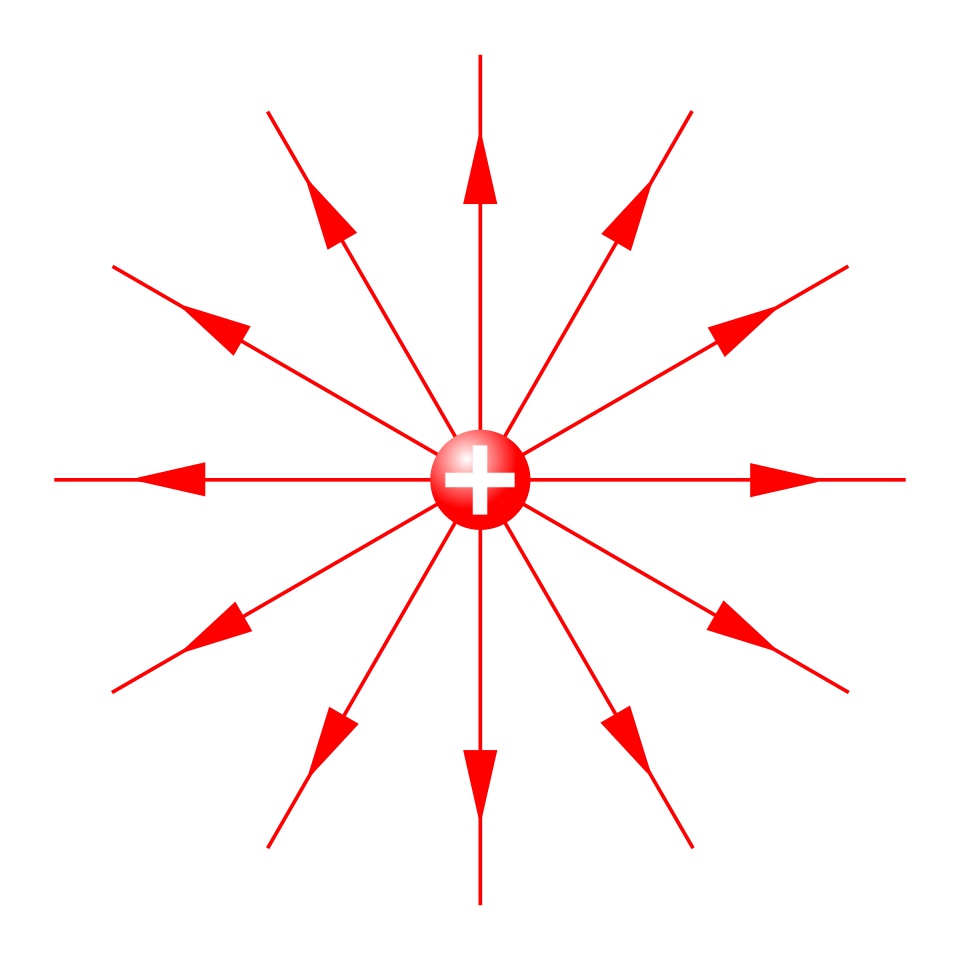
Electric field of a positive point charge shown with arrows pointing radially outward. At any location, the electric field vector is tangent to the arrow direction, so a positive test charge placed there would experience a force outward from the source charge. This provides a concrete reference for interpreting “field direction” as a local, point-by-point direction cue. Source
If the field points upward, the force on a positive charge is upward.
Negative charge
A negative charge placed in the same field feels a force in the opposite direction.
This is one of the most common places students make mistakes. The field direction is still defined using a positive charge. A negative charge does not change the field arrow; instead, it experiences a force opposite that arrow.
Zero charge
If an object has zero net charge, then the electric force from the field is zero because in .
Force Is a Vector Quantity
Because electric force is a vector, you must consider direction as carefully as magnitude. In many problems, the field direction is given with arrows or compass directions. The correct force direction follows from combining that field direction with the sign of the charge.
A useful way to think about this is:
Field direction answers: “Which way would a positive charge be pushed?”
Force direction on an actual charge depends on whether the actual charge is positive or negative.
This means you should never decide force direction by guessing from the source of the field alone. If the field at the location is already known, use that field direction directly.
Force and Motion Are Not the Same
Students often confuse force direction with motion direction. These are not always the same.
A charge may already be moving in some direction when it enters a field.
The electric force tells you the direction of the charge’s acceleration, not necessarily the direction of its instantaneous velocity. A positive charge released from rest begins accelerating with the field. A negative charge released from rest begins accelerating opposite the field. But if either charge already has velocity, its motion may not match the force direction immediately.
For this subtopic, the central point is still the force rule: positive charge → same direction as the field.
What “At That Point” Tells You
The electric field is evaluated at the position of the charge. That phrase is important in nonuniform situations.
If the field is stronger at one location than another, the force magnitude changes.
If the field points in a different direction at a new location, the force direction changes.
The same charge can therefore experience different forces as it moves through different parts of space.
So the force is not just a property of the charge alone. It depends on the charge-field interaction at a specific location.
Common Reasoning Mistakes
Mistake 1: Treating the field direction as the force direction for every charge
That is only true for a positive charge.
Mistake 2: Ignoring the sign of the charge
The sign determines whether the force matches or opposes the field direction.
Mistake 3: Confusing force with velocity
A particle can move one way while the electric force points another way.
Mistake 4: Forgetting that the field is local
The force must be determined from the field at the charge’s actual position.
Mistake 5: Focusing only on size
A complete force description needs both magnitude and direction.
Practice Questions
A uniform electric field points to the left. A small positive charge is placed in the field.
State the direction of the electric force on the charge and explain your answer.
1 mark: States that the force is to the left.
1 mark: Explains that the electric force on a positive charge is in the same direction as the electric field.
A particle with charge is placed in a uniform electric field of magnitude directed upward.
(a) Calculate the magnitude of the electric force on the particle. (2 marks)
(b) State the direction of the electric force. (1 mark)
(c) A second particle with charge is placed at the same point in the same field. Compare the magnitude and direction of the electric force on the second particle with that on the first particle. (2 marks)
(a) 1 mark: Uses or .
(a) 1 mark: Correct answer .
(b) 1 mark: States downward, because the charge is negative and the force is opposite the field.
(c) 1 mark: States the second particle experiences twice the magnitude of force, .
(c) 1 mark: States the second particle’s force is upward, because it is positive and the force is in the same direction as the field.
FAQ
This is a historical and mathematical convention that makes field diagrams consistent.
If field direction were based on a negative charge, every direction rule would flip. Using a positive charge gives one standard reference:
positive charge: force along the field
negative charge: force opposite the field
The convention does not change the physics. It just keeps communication clear.
Yes.
Force determines acceleration, not instantaneous velocity. A particle can already have a velocity in one direction when it enters a region where the electric force points another way.
In that case, the force changes the particle’s motion over time. The velocity does not have to match the force direction at every instant.
They can have the same force direction but different motion because motion also depends on other factors.
Important differences include:
different mass
different initial velocity
different initial position in a nonuniform field
So the field determines force direction for both, but it does not guarantee identical paths.
It means the field must be taken at the exact location of the charge.
In a nonuniform field:
the direction may vary from place to place
the strength may also vary
As a result, a moving charge may experience a changing force as it travels. The phrase emphasizes that electric force is determined locally, not from some average over a whole region.
The sign of the field component already includes direction relative to the chosen axis.
Then the sign of $q$ affects the force through $F = qE$. For example:
if $E$ is negative and $q$ is positive, then $F$ is negative
if $E$ is negative and $q$ is negative, then $F$ is positive
So coordinate signs and charge signs must both be handled carefully.
