

AP Syllabus focus: 'The total entropy of an isolated system can never decrease and is constant only for reversible processes.'
The second law of thermodynamics gives a direction to physical change. It identifies which processes can occur naturally in an isolated system and distinguishes ideal reversible changes from real irreversible ones.
The core idea of the second law
The second law of thermodynamics is not just about whether energy is conserved. Energy can be conserved in many different changes, but the second law tells us whether a change is allowed to occur spontaneously. It does this through the idea of entropy.
Entropy: A thermodynamic quantity, symbolized by , used to determine the direction of natural processes.
The law applies to the entropy of the entire system being considered, not just one object or one region inside it.
Isolated system: A system that does not exchange energy or matter with anything outside the system.
For an isolated system, there is no outside source of energy and no outside place for energy or matter to go. Because of that, the second law places a strict limit on what can happen: the total entropy of that isolated system cannot go down. A spontaneous process may leave the total entropy unchanged only in a special ideal case, but in ordinary real processes the total entropy increases.
= change in the total entropy of an isolated system, in
= reversible process
= irreversible process
This compact statement is the mathematical form of the syllabus statement. It gives a simple test: if a proposed change in an isolated system would make total entropy decrease, that change cannot occur spontaneously.
Interpreting “can never decrease”
The phrase “can never decrease” is the most important part of the law. It means that when an isolated system changes on its own, the total entropy must either stay the same or become larger. There are only three logical possibilities for total entropy change:
: impossible for an isolated system
: possible only for a reversible process
: expected for an irreversible process
A common mistake is to focus on one part of the system and forget the word total. One part of an isolated system may become more ordered or may lose entropy, but if that happens, another part must gain enough entropy so that the sum for the whole isolated system does not decrease. The second law is about the total result for the full isolated system.
The law also explains why natural processes have a preferred direction. A process that would lower total entropy does not occur spontaneously, even if it would still satisfy conservation of energy. This is why the second law adds new information beyond the first law.
Reversible and irreversible processes
A reversible process is the special case named directly in the syllabus statement.

Temperature–entropy (–) diagram comparing a reversible path and an irreversible path between thermodynamic states. It emphasizes that irreversibility is associated with entropy production, so the irreversible path has a larger total entropy increase than the reversible idealization connecting the same endpoints. This supports the rule that only the reversible limit can keep total entropy constant for an isolated system. Source
Reversible process: An ideal process that can be reversed by an infinitesimally small change and does not increase the total entropy of an isolated system.
In a reversible process, the system changes in such a controlled way that there is no net entropy production in the isolated system.
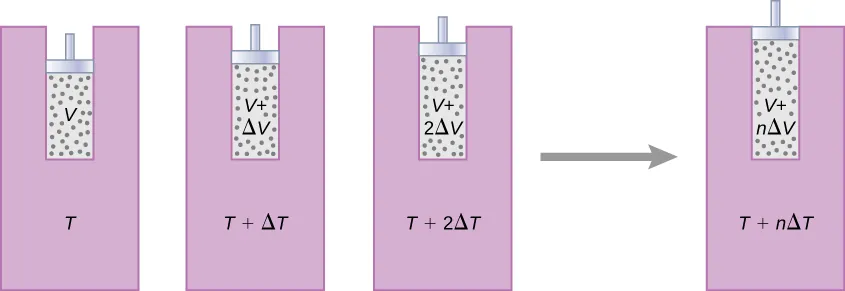
Diagram of a reversible heating/expansion carried out in many small steps using a sequence of heat reservoirs at slightly different temperatures. The figure illustrates the core reversible-process idea: infinitesimal temperature differences drive heat transfer, avoiding the entropy production associated with finite gradients. It connects the qualitative definition of reversibility to a concrete experimental-style model. Source
This is an ideal limit, not the typical behavior of real systems. Reversible processes are useful because they set the boundary between what is thermodynamically possible in principle and what actually happens in practice.
Most real processes are irreversible. In an irreversible process, the total entropy of an isolated system increases. Real changes usually involve effects that cannot be undone without producing additional changes elsewhere. Once such effects occur, the process cannot simply be reversed to restore the original state with no overall entropy increase.
Irreversibility is associated with situations such as:
friction or internal resistance
sudden, uncontrolled changes
finite differences that drive the process strongly rather than infinitesimally
Because real processes are irreversible, entropy increase is the usual outcome for spontaneous change in an isolated system.
Using the second law in reasoning
On AP Physics 2 Algebra questions, the second law is often used qualitatively. You are usually not expected to perform advanced entropy calculations. Instead, you should decide whether the entropy of an isolated system decreases, stays constant, or increases, and then connect that result to whether the process is impossible, reversible, or irreversible.
A strong reasoning pattern is:
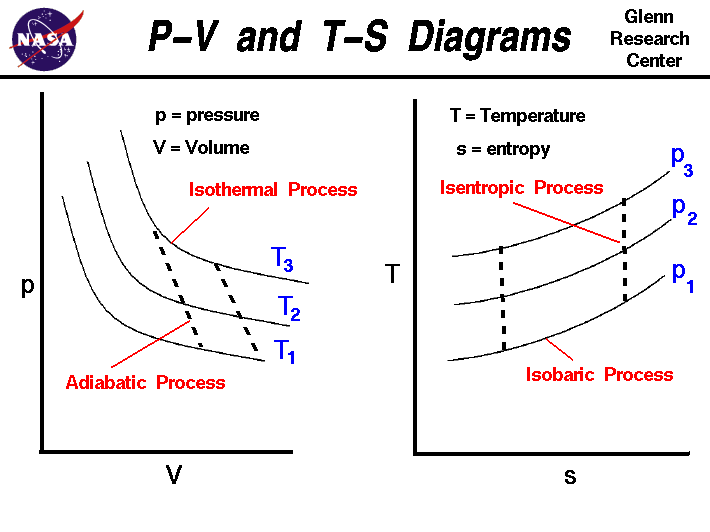
Side-by-side p–V and – diagrams illustrating how thermodynamic processes are represented on common state-variable plots. The – diagram highlights that an isentropic (reversible, adiabatic) process appears as a vertical line, reinforcing how reversibility connects to entropy behavior. This helps students translate qualitative second-law reasoning into a visual check on process direction and entropy change. Source
identify the system boundary
determine whether the system is isolated
apply the rule for total entropy change
If the system is isolated and the proposed change gives a total entropy decrease, the proposal must be rejected. If the total entropy remains constant, the change is only possible in the reversible ideal case. If the total entropy increases, the process is consistent with the second law and can occur spontaneously.
The second law therefore provides a clear thermodynamic direction: for isolated systems, allowed processes are those for which total entropy stays the same or increases, and only the reversible limit keeps it constant.
Practice Questions
State the second law of thermodynamics for an isolated system. What is the value of for a reversible process?
1 mark: States that the total entropy of an isolated system can never decrease.
1 mark: States that for a reversible process, .
A sealed, perfectly insulated container holds two objects initially at different temperatures. The objects are placed in thermal contact and eventually reach the same final temperature.
(a) Explain why the container can be treated as an isolated system. (1 mark)
(b) According to the second law of thermodynamics, what must be true about for the entire container during this real process? (1 mark)
(c) One student says, “If one object loses entropy, the second law is violated.” Explain why this statement is incorrect. (3 marks)
(a)
1 mark: States that no energy or matter is exchanged with the surroundings, so the container is isolated.
(b)
1 mark: States that for this real spontaneous process.
(c)
1 mark: Explains that the second law applies to the total entropy of the isolated system, not just one object.
1 mark: States that one part of the system may decrease in entropy.
1 mark: States that any decrease in one part must be balanced by a larger increase elsewhere so that total entropy does not decrease.
FAQ
Reversible processes are important because they define the thermodynamic limit of zero total entropy production in an isolated system.
They give physicists a reference point for comparing real processes. If a real process is made slower, smoother, and less dissipative, it can become more nearly reversible, even if it never becomes perfectly reversible.
“Disorder” is only a rough shortcut and can be misleading.
In physics, the important idea is not a vague sense of messiness but the formal rule that the total entropy of an isolated system cannot decrease. That statement is more precise and should be preferred on exams.
On extremely small scales, short-lived statistical fluctuations can occur, and a temporary decrease in entropy for a tiny part of a system is possible.
For macroscopic systems in ordinary thermodynamics, those effects are negligible. AP Physics 2 treats the second law as a reliable rule for large-scale physical systems.
A reversed video often shows a process that would require the total entropy of an isolated system to decrease.
That is why the motion looks wrong even if the same objects and forces are present. The second law gives macroscopic processes a preferred direction in time.
They try to reduce entropy production by minimizing dissipative effects and avoiding large imbalances.
Common strategies include:
reducing friction
making changes very slowly
using very small temperature or pressure differences
avoiding turbulence and sudden expansions
These steps do not create a perfectly reversible process, but they can make a real process closer to the reversible limit.

