

AP Syllabus focus: 'Outside an isolated sphere with spherically symmetric charge distribution, the electric field is the same as that of a point charge at the sphere's center.'
A charged spherical conductor is especially important in electrostatics because, for all outside points, it behaves exactly like a single point charge located at its center.
Core idea
A charged spherical object can often be modeled much more simply than an irregularly shaped one. If the sphere is isolated and its charge distribution is spherically symmetric, then every point outside the sphere experiences the same electric field that would be produced by a single point charge placed at the center. This is an exact equivalence for the outside region.
Spherically symmetric charge distribution: A charge distribution for which the amount of charge depends only on distance from the center, not on direction.
This idea is powerful because it replaces an extended charged object with a much simpler model. Instead of considering how many different parts of the sphere contribute to the field, you can use one total charge value and one distance measured from the center.
Conditions that must be satisfied
The object must be a sphere.
The charge distribution must have spherical symmetry.
The sphere must be isolated, so the symmetry is not disturbed.
The point where the field is evaluated must be outside the sphere.
If any of these conditions are not satisfied, the point-charge result is not guaranteed.
Electric field outside the sphere
For a point outside the sphere, the electric field depends only on:
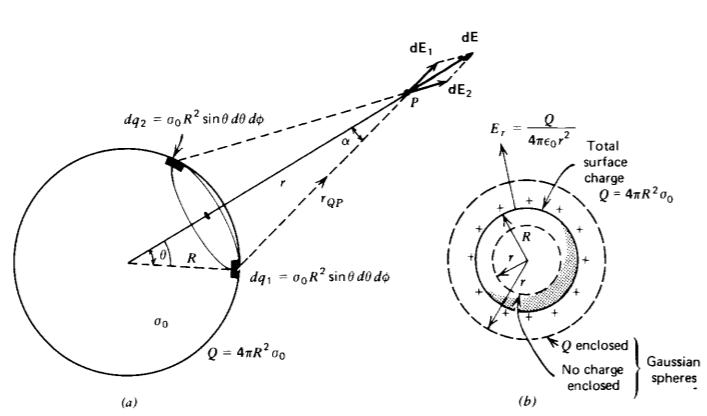
A concentric spherical Gaussian surface (radius ) is used to exploit spherical symmetry: the field is radial and has the same magnitude everywhere on the Gaussian sphere. This diagram helps justify why the outside field depends only on and , not on angle or the sphere’s orientation. Source
the total charge on the sphere,
the distance from the center,
It does not depend on the sphere’s detailed size or on the exact arrangement of charge, as long as the distribution remains spherically symmetric.
= electric field magnitude,
= Coulomb constant,
= total charge on the sphere,
= distance from the sphere’s center to the point of interest,
This is the same expression used for a point charge. The direction is also the same:
for , the field points radially outward
for , the field points radially inward
The word radially means along the line connecting the center of the sphere to the point where the field is measured.
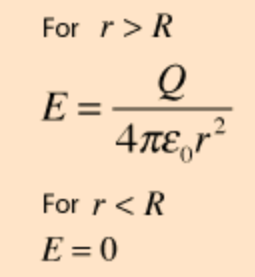
Diagram for a charged conducting sphere showing a radial electric field outside the sphere, identical in form to the field of a point charge located at the center. The outward/inward radial direction follows directly from the sign of , while the magnitude depends only on center-to-point distance. Source
Because of this symmetry, all points at the same distance from the center have the same field magnitude.
Why the distance is measured from the center
A very common mistake is to measure distance from the sphere’s surface. In this model, the correct distance is always from the center of the sphere to the point of interest. That is because the equivalent point charge is located at the center, not on the surface.
Why the center is the equivalent location
The center is the only location consistent with spherical symmetry. A spherically symmetric charge distribution has no preferred direction. If the equivalent charge were placed anywhere other than the center, the field would no longer be the same in all directions at the same radius. That would contradict the symmetry of the sphere.
You can think of the charges on the sphere as combining so that, outside the sphere, their total effect has the same radial pattern and the same inverse-square dependence as one centered point charge.
What the equivalence means in practice
When a problem gives you an isolated spherical conductor, the main idea is that the whole object can be treated as one charge located at its center for outside points. This allows you to:
use the total charge directly
compare field strengths at different outside locations
predict how the field changes with distance
For example, if the distance from the center doubles, the electric field becomes one-fourth as large because of the relationship.
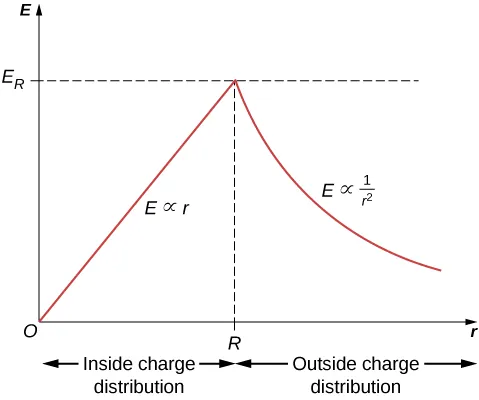
Plot of electric-field magnitude versus radial distance from the center for a spherically symmetric charge distribution. The outside region shows the inverse-square behavior , matching the field of a point charge with total charge placed at the center. Source
If the distance triples, the field becomes one-ninth as large.
Comparing different outside locations
Because the field depends only on center-to-point distance, the sphere’s orientation does not matter. Two points at the same distance from the center have the same electric field magnitude, even if they are on opposite sides of the sphere.
What changes from place to place is the direction of the field. At every outside point, the field points along the local radial line, either away from or toward the center depending on the sign of the charge.
Scope of the statement
The syllabus statement is specifically about the electric field outside the sphere. It tells you how to model the external field and where the equivalent point charge is located. It does not justify treating every charged object this way, and it does not apply automatically to nonspherical objects.
This is why symmetry matters so much. The sphere is special because its geometry is the same in every direction from the center.
Why this matters for problem solving
Many AP Physics 2 questions show a charged sphere with several labeled points around it. The key skill is recognizing that the entire outside field can be handled with one expression. You do not need to break the sphere into many smaller charge pieces if spherical symmetry is maintained.
AP-style reasoning tips
When solving problems on this subsubtopic:
identify the total charge
confirm that the point is outside the sphere
measure the distance from the center
use the point-charge model
determine direction from the sign of the charge
Common mistakes
measuring distance from the surface instead of the center
applying the rule to objects that are not spherical
forgetting that the statement applies only to the outside region
assuming visible size alone determines the outside field
giving only magnitude and ignoring field direction
Practice Questions
An isolated spherical conductor has net charge . Point is outside the sphere at distance from the center. State the magnitude and direction of the electric field at .
States the magnitude as or equivalent use of charge magnitude. (1)
States the direction is radially inward, toward the center of the sphere. (1)
Sphere A and Sphere B are isolated spherical conductors. Sphere A has radius . Sphere B has radius . Each sphere carries charge .
a) Compare the electric field magnitude at points located from the center of each sphere.
b) Compare the electric field magnitude at the surface of each sphere.
c) Explain why the answers to parts a and b are different.
a) States the fields are the same. (1)
a) Uses with the same and the same for both spheres. (1)
b) States or calculates . (1)
b) States or calculates , so Sphere A has four times the surface field of Sphere B. (1)
c) Explains that outside a spherical conductor the field is the same as that of a point charge at the center, so equal center distances give equal fields, but the surface points are at different center distances. (1)
FAQ
For outside points, a hollow spherical conductor and a solid spherical conductor can produce the same electric field pattern if they are isolated and have the same total charge.
What matters for the outside field is the spherical symmetry and total charge, not whether the sphere is hollow or filled in.
Yes. The key requirement is spherical symmetry, not whether the material is a conductor.
If the charge in an insulating sphere is distributed symmetrically about the center, then the outside electric field can still match that of a point charge at the center.
Nearby charged objects, conductors, or strong external electric fields can disturb the sphere’s charge distribution.
If that disturbance breaks spherical symmetry, then the external field no longer matches the exact field of a point charge at the center, even if the total charge remains the same.
You could measure the electric field at several points outside a charged sphere while keeping the sphere isolated.
Evidence for the model would include:
the field depending only on distance from the center
the field magnitude following an inverse-square trend
the field direction always being radial
A real object with small bumps or slight shape errors may not produce a perfectly point-charge-like field.
However, if the sphere is very close to spherical, the model is often still a good approximation, especially at points far from the sphere where small irregularities matter less.
