

AP Syllabus focus: 'Scalars are described by magnitude only, while vectors are described by both magnitude and direction.'
In mechanics, identifying whether a quantity is scalar or vector is the first step in describing motion correctly, because the mathematics and physical meaning depend on what information the quantity carries.
The Essential Distinction
Physics quantities do not all behave the same way. Some can be fully described by a single number and unit. Others require a number, unit, and directional information. This distinction is foundational in AP Physics C Mechanics because it determines how a quantity is interpreted and how it will later be combined, compared, and represented in physical models.
Scalar: A physical quantity completely specified by magnitude alone.
A scalar gives size but not orientation. If you know the value of a scalar quantity, you know everything needed for that quantity at the level of this topic. No extra directional statement is required to complete the description.
Magnitude in Physics
Magnitude means the amount or numerical size of a quantity, together with its unit. For a scalar, magnitude is the entire physical description. The key idea is not what the quantity measures, but whether changing direction would change the quantity itself. For a true scalar, direction is irrelevant.
This is why scalars are often easier to state and compare. If two scalar quantities have the same value and the same unit, they represent the same physical amount. Nothing else has to be added.
When Direction Matters
Many quantities in mechanics are not complete unless an orientation is included. Knowing only “how much” is not enough; you must also know “which way.” That extra requirement makes the quantity a vector.
Vector: A physical quantity completely specified by both magnitude and direction.
A vector cannot be specified by magnitude alone.
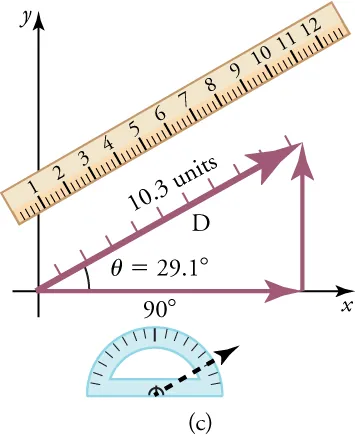
Two perpendicular displacement vectors are added head-to-tail, and the resultant is drawn from the original tail to the final head. The diagram emphasizes that vector addition depends on direction and geometry, not just on combining magnitudes. Source
If two vectors have the same magnitude but point in different directions, they represent different physical quantities. In mechanics, this matters because an object or interaction may be fundamentally different when its direction changes, even if its size does not.
What Physicists Mean by Direction
Direction can be described in several equivalent ways, depending on the problem. It might be given as left or right, upward or downward, toward a particular angle, or relative to coordinate axes. The exact wording is less important than the idea: a vector includes orientation in space.
A complete vector description therefore has two parts:
a magnitude
a direction
If either part is missing, the vector has not been fully specified. This is why vectors often require more careful interpretation than scalars.
Comparing Scalar and Vector Quantities
The difference between scalars and vectors is not about difficulty or importance. Both types of quantities are essential in mechanics. The distinction is about what information the quantity carries.
A scalar is fully described by magnitude only.
A vector is fully described by magnitude and direction.
Two scalars are equal if they have the same value and unit.
Two vectors are equal only if they have the same magnitude and the same direction.
Units alone do not tell you whether a quantity is scalar or vector.
That last point is especially important. Having units does not make a quantity a vector. Both scalars and vectors can have units, so classification depends on physical meaning, not on the presence of units.
Equality and Physical Description
When deciding whether a quantity is scalar or vector, ask what information must be included to describe the quantity completely. If a statement such as “5 meters” is enough, the quantity is scalar. If “5 meters” is incomplete and must be followed by something like “to the east” or “upward,” the quantity is vector.
This also explains why vector quantities are more sensitive to changes in direction. A vector can change even when its magnitude stays the same, because direction is part of the quantity itself. By contrast, a scalar changes only when its magnitude changes.
A useful special case is zero. A scalar can have a value of zero without any complication. A vector can also have zero magnitude, called the zero vector, but then directional information no longer distinguishes it from other zero vectors. In practice, the important idea is that nonzero vectors require direction.
Common Pitfalls
Students often recognize the words scalar and vector but still mix up the underlying ideas. Watch for these common errors:
Thinking that any quantity with units must be a vector.
Thinking that a large value automatically implies a vector.
Treating direction as optional for a vector.
Assuming that two vectors with equal magnitudes are automatically equal.
Confusing a vector with its magnitude. The magnitude of a vector is a scalar, even though the original quantity is a vector.
How to Identify the Type of Quantity
A quick classification method can prevent mistakes later in a problem.
Ask whether the quantity has an inherent orientation.
Ask whether reversing direction would create a physically different quantity.
Ask whether magnitude alone completely specifies the quantity.
If direction is required for a complete description, classify it as a vector.
These questions are especially useful in mechanics, where many important quantities are introduced early and then used repeatedly. Correctly identifying scalar and vector quantities is the foundation for clear reasoning throughout the rest of kinematics and mechanics.
FAQ
Time has order, but that is not the same as spatial direction. To specify a time interval, you only need its size and unit. You do not need an angle or an axis direction.
In AP Physics C Mechanics, that makes time a scalar. The fact that events progress from past to future does not make time a vector quantity.
Yes. A scalar can change when you change the orientation of the system, even though the scalar itself has no direction.
For example, a scalar result might depend on the angle of a device or on the direction of a vector quantity elsewhere in the problem. That does not turn the scalar into a vector; it only means the scalar depends on directional variables.
Both are notation conventions. An arrow over a symbol and boldface both tell you to interpret the symbol as a vector.
In handwritten work, arrows are often clearer. In printed work, boldface is common because it is easier to use consistently. The physics does not change; only the notation does.
The physical vector does not change, but its description can. Rotating the axes changes the components used to express the vector.
Its magnitude and physical meaning stay the same, provided the new axes are defined consistently. This is one reason vectors are so useful: they represent quantities that exist independently of any one coordinate choice.
For AP Physics C Mechanics, ordinary area and volume are treated as scalars. They describe how much surface or space there is, not a direction.
In more advanced physics, an oriented area vector can be introduced for specific applications, but that is beyond the usual AP treatment. For this course, area and volume should be regarded as scalar quantities unless a problem explicitly defines something different.
Practice Questions
A student says, “If a physical quantity has a magnitude, it must be a vector.” Is the student correct? Explain.
1 mark: States that the student is not correct.
1 mark: Explains that both scalars and vectors have magnitude, but only vectors also require direction.
Force A has magnitude 6 N east. Force B has magnitude 6 N west. A block also has mass 6 kg, and a second block has mass 6 kg.
(a) State whether force is a scalar or a vector quantity. (1 mark)
(b) Explain why Force A and Force B are not equal. (2 marks)
(c) Explain why the two masses can be equal without any directional information. (2 marks)
(a) 1 mark: Identifies force as a vector.
(b) 1 mark: States that equal magnitude alone is not enough for vectors to be equal.
(b) 1 mark: States that the directions are opposite, so the forces are different vectors.
(c) 1 mark: Identifies mass as a scalar.
(c) 1 mark: Explains that a scalar is fully described by magnitude only, so equal masses need only the same value and unit.
