

AP Syllabus focus: 'Distance and speed are scalar quantities, while position, displacement, velocity, and acceleration are vector quantities.'
In mechanics, classifying quantities correctly determines how motion should be described and interpreted. Scalars give size alone, while vectors carry directional information, so mixing them up changes the physical meaning of a result.
Why These Examples Matter
Mechanics uses several related quantities that seem similar at first glance. Distance and displacement both describe change in location, and speed and velocity both describe how fast something moves. The important distinction is whether direction is part of the quantity itself. If direction is essential, the quantity is a vector. If only an amount is needed, it is a scalar.
This distinction affects how you interpret motion. A scalar can tell you how much, but a vector tells you both how much and which way. In AP Physics C Mechanics, two quantities can share an SI unit yet represent different physical information.
Scalar Quantities in Mechanics
Distance
Distance is a scalar because it measures the total length of the path traveled without attaching any direction to that motion. If an object moves forward and then returns, the distance keeps accumulating because it depends only on how much ground was covered.
Distance is always associated with an amount of motion along a path. Because it is scalar, it does not distinguish between opposite directions. A trip of 3 m east and a trip of 3 m west both correspond to a distance of 3 m.
Distance is useful when the question concerns total travel, such as how far a particle moved along its path, but it does not by itself describe where the object ended up relative to where it started.
Speed
Speed is also a scalar. It describes how fast an object moves, but not the direction of motion. A car speedometer tells only the rate of motion, not whether the car is moving north or south.
Because speed is scalar, opposite directions do not create different speeds. An object moving at 5 m/s to the right and another moving at 5 m/s to the left have the same speed, even though their motions are not identical.
This is why speed cannot fully describe motion in more than a limited sense. It gives the magnitude of motion, but not its directional character.
Vector Quantities in Mechanics
Position
Position is a vector quantity because it identifies an object's location relative to a chosen origin and includes directional information. In one dimension, position indicates where the object is relative to the reference point. In higher dimensions, position must specify components in different directions.
Position is not just a distance from the origin. Two objects can be the same distance from the origin but on opposite sides of it, so the direction associated with position matters.
Displacement
Displacement is a vector because it describes the change in position from an initial location to a final location. It depends only on the starting and ending positions, not on the path taken between them.
This makes displacement fundamentally different from distance.
An object can travel a large distance and still have a small displacement, or even zero displacement, if it returns to its starting point. The vector nature of displacement means that the direction from start to finish is part of the quantity itself.
When comparing motions, displacement is often more informative than distance because it captures the net change in position rather than the total path length.
Velocity
Velocity is a vector quantity. It describes how position changes and includes both the rate of motion and the direction of motion. Two objects with the same speed can have different velocities if they move in different directions.
Velocity therefore carries more information than speed.
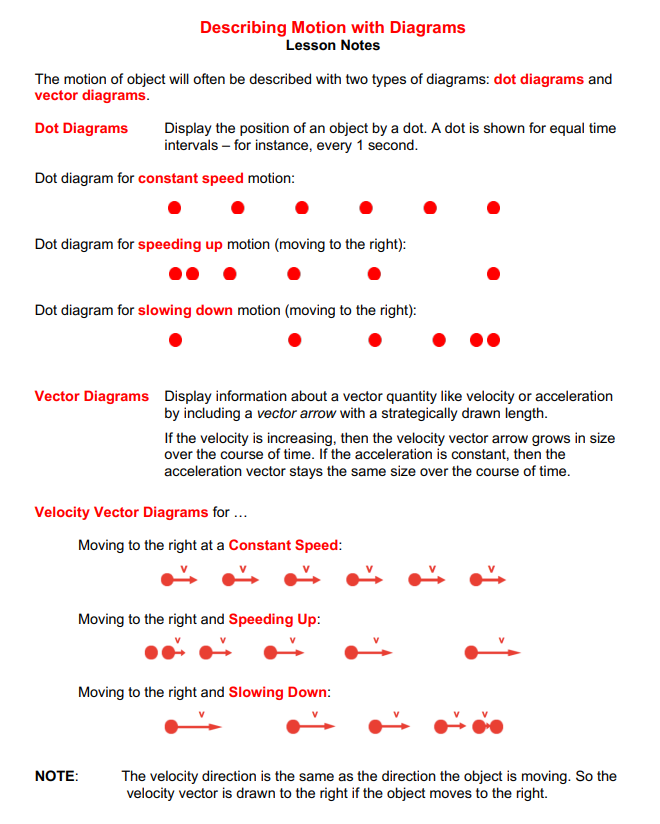
Dot diagrams show positions at equal time intervals, while velocity vector diagrams add arrows that encode both direction and magnitude. The side-by-side layouts make it visually clear why two motions can share the same speed but differ in velocity if their directions differ. Source
In mechanics, direction is often crucial because later analyses depend on how motion is oriented in space. Treating velocity as if it were a scalar removes information that the physics requires.
This is one of the most common student errors: using speed and velocity interchangeably. They are related, but they are not the same physical quantity.
Acceleration
Acceleration is also a vector. It describes how velocity changes, so its direction matters just as much as its size. Since velocity already contains direction, any change to velocity must be treated vectorially.
Acceleration can correspond to an increase in speed, a decrease in speed, or a change in the direction of motion. For that reason, acceleration cannot be understood correctly as a scalar amount of speeding up. It is a directed quantity that tells how the velocity is being altered.
Key Comparisons to Keep Straight
Several pairs of quantities are easy to confuse because they have similar units or are used in similar contexts.
Distance and displacement both use meters, but distance is scalar and displacement is vector.
Speed and velocity both describe motion rates, but speed is scalar and velocity is vector.
Position, displacement, velocity, and acceleration all require direction to be fully specified.
A quantity being measured in meters or meters per second does not automatically tell you whether it is scalar or vector.
A good test is to ask: Would changing the direction change the meaning of the quantity?
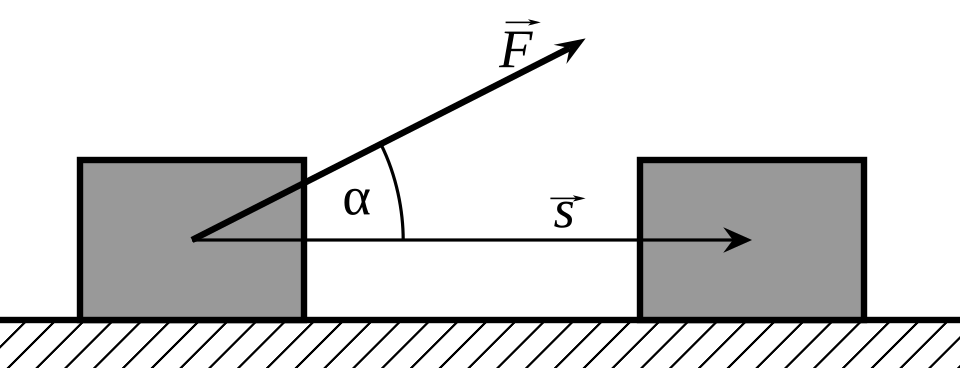
A force vector applied at an angle relative to a displacement vector illustrates how direction changes physical meaning even when magnitudes stay the same. The diagram highlights that vectors are defined not just by size, but by their orientation in space (here captured by the angle). Source
If the answer is yes, the quantity is a vector. If direction is irrelevant and only the amount matters, the quantity is scalar.
FAQ
Speed is the magnitude of velocity. If an object is moving in a particular direction at one instant, the number attached to its speed matches the size of its velocity.
The quantities are still different. Velocity keeps directional information, so the same speed can correspond to many different velocities.
Speed can stay constant while direction changes. When that happens, the velocity changes even though the size of the velocity does not.
Acceleration tracks changes in velocity, not just changes in speed. That is why turning motion can involve non-zero acceleration at constant speed.
In one-dimensional motion, the sign shows direction relative to the positive axis you chose at the start.
A negative value does not mean the magnitude is negative. It means the vector points opposite to the chosen positive direction.
Yes. A common case is an object thrown upwards. At its highest point, the instantaneous velocity is zero.
The acceleration is still downward because gravity continues to change the velocity. Zero velocity at one instant does not imply zero acceleration.
Any unambiguous method is acceptable. Common choices include:
a plus or minus sign in one dimension
a compass direction, such as east
an angle measured from an axis
component values along perpendicular axes
The best format is the one that matches the coordinate system of the problem or experiment.
Practice Questions
State whether each quantity is a scalar or a vector.
(a) speed
(b) acceleration
1 mark: speed is a scalar.
1 mark: acceleration is a vector.
A particle starts at the origin, moves 8 m east, and then 3 m west.
(a) Classify each of the following as scalar or vector: distance, displacement, speed, velocity. (4 marks)
(b) Explain why the particle's distance traveled is not equal to the magnitude of its displacement. (2 marks)
(a)
1 mark: distance is a scalar.
1 mark: displacement is a vector.
1 mark: speed is a scalar.
1 mark: velocity is a vector.
(b)
1 mark: distance depends on the total path length traveled.
1 mark: displacement depends only on initial and final position and includes direction; here the particle ends 5 m east of the start, so the net change in position differs from the total path length.
