

AP Syllabus focus: 'Vectors can be written in unit vector notation as x-, y-, and z-components, and position vectors may be expressed using r and the unit vector r-hat.'
In AP Physics C Mechanics, unit vector notation makes multidimensional vectors concise and exact. It lets you represent direction algebraically and describe an object's location relative to the origin with standard symbols.
Unit Vector Notation
In three dimensions, a vector can be split into perpendicular components along the coordinate axes.
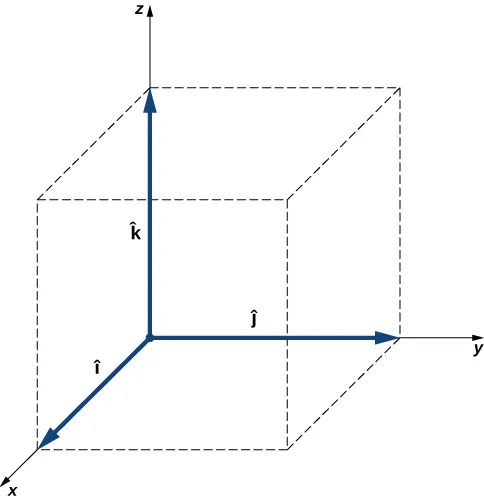
A right-handed –– coordinate system with the standard unit vectors , , and . This visual anchors unit vector notation by showing each unit vector as a direction-only arrow of length 1 along its axis. Source
Unit vector notation labels each component with a direction so the full vector can be written in one compact expression.
Unit vector notation: A way of writing a vector as the sum of its components along coordinate axes, each multiplied by a unit vector of magnitude 1.
Because the axes are perpendicular, each component can be handled independently. The numbers multiplying the unit vectors are scalar components, and their signs show whether the vector points in the positive or negative axis direction.
= vector quantity
= scalar components along the coordinate axes; same unit as
= unit vectors in the positive , , and directions; no unit
This notation separates magnitude information from direction information. The component values tell you how much of the vector lies along each axis, while the unit vectors identify which axis each component belongs to.
A negative component does not mean a negative magnitude for the entire vector. It means that particular part of the vector points opposite the positive axis direction. For example, a negative -component points in the direction.
Interpreting Components
When reading a vector written in unit vector form, focus on each component one axis at a time.
measures the part of the vector along the -axis.
measures the part along the -axis.
measures the part along the -axis.
The full vector is the combination of all three perpendicular pieces.
In two-dimensional situations, the -component is often zero, so only and appear.
The unit vectors themselves do not change size. Each has magnitude 1. Their role is purely directional, which is why they are essential in mechanics notation: they let a vector be manipulated algebraically without losing information about direction.
Position Vectors
One especially important vector is the position vector. It specifies where an object is located relative to the origin of the chosen coordinate system.
Position vector: A vector drawn from the origin to the location of an object.
For a position vector, the scalar components are the object's coordinates. That is why position written as a vector looks closely related to coordinate notation, but the arrow on the symbol shows that the quantity has both magnitude and direction.
= position vector from the origin to the object, in meters
= Cartesian coordinates of the object, in meters
= unit vectors along the coordinate axes; no unit
A position vector always begins at the origin and ends at the object. This matters physically and mathematically. If the origin is changed, the position vector changes even when the object itself stays in the same place. The notation therefore always depends on the chosen coordinate system.
Using and
The same position vector can also be written in a radial form that separates its length from its direction.
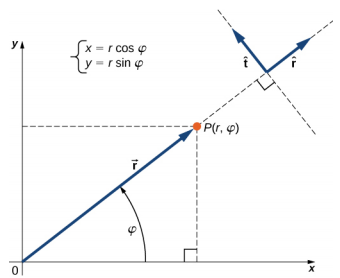
A polar-coordinate diagram showing the position vector from the origin to a point and the corresponding unit radial direction . It makes the separation in explicit: sets the distance, while sets the direction. Source
This is the meaning of expressing position with and r-hat.
= position vector from the origin to the object, in meters
= magnitude of the position vector, in meters
= unit vector pointing from the origin toward the object; no unit
Here, is a scalar distance, while gives direction only. The vector and the unit vector point the same way, but they do not have the same magnitude. The magnitude of is always 1, while the magnitude of is .
This distinction is central to correct notation. Writing means a full vector. Writing means only its size. Writing means only its direction. On AP Physics C problems, mixing these symbols can turn a correct physical idea into an incorrect mathematical statement.
Relating Cartesian and Radial Descriptions
A single physical location can therefore be described in two consistent ways. In Cartesian form, the position is built from fixed axis directions , , and . In radial form, the same position is built from a distance and a direction .
These are not different positions. They are two notational descriptions of the same vector. A strong AP Physics C student should be able to recognize whether a problem is emphasizing fixed coordinate components or direction from the origin, and then interpret appropriately.
Common Notation Points
Do not confuse with .
Do not attach units to , , , or .
Coordinates such as , , and are scalars, not vectors by themselves.
A missing hat changes a unit vector into something else entirely.
A missing arrow changes a full vector into a scalar symbol or component.
Careful notation is part of correct physics communication, not just formatting.
FAQ
They mean the same thing: unit vectors along the coordinate axes.
The difference is mostly stylistic. Physics and engineering texts often use $\hat{i}$, $\hat{j}$, and $\hat{k}$, while some maths-based texts prefer $\hat{x}$, $\hat{y}$, and $\hat{z}$ because they match the axis labels more directly.
The important point is consistency within one solution.
Not quite.
The ordered triple $(x,y,z)$ labels a location in a coordinate system. The expression $x\hat{i}+y\hat{j}+z\hat{k}$ is a vector from the origin to that location.
In introductory physics, they are closely linked because the origin is fixed and the position vector is usually what matters. In more formal language, a point and a vector are different kinds of objects.
Because its magnitude is 1, not because each component is 1.
For example, a direction halfway between the positive $x$- and $y$-axes has a unit vector with components $\frac{1}{\sqrt{2}}$ and $\frac{1}{\sqrt{2}}$. Neither component equals 1, but the vector’s overall length is 1.
So “unit” refers to total length, not to each coordinate entry.
The physical vector stays the same, but its components usually change.
That happens because the basis vectors themselves have changed direction. A vector that was mostly along $\hat{i}$ in one coordinate system might have substantial components along both new axes after rotation.
So unit vector notation is always tied to a particular set of axes. Change the axes, and you change the component description.
It is especially useful when the physics depends mainly on distance from a central point and the direction away from that point.
Common situations include:
motion around a central body
forces directed towards or away from an origin
any geometry with radial symmetry
In those cases, $r$ and $\hat{r}$ can make the structure of the problem clearer than separate Cartesian components.
Practice Questions
A particle has position vector m.
State the -component and the -component of the vector.
-component = m (1 mark)
-component = m (1 mark)
An object is located at coordinates m relative to the origin.
(a) Write the position vector in unit vector notation. (2 marks)
(b) Calculate the magnitude of the position vector. (2 marks)
(c) Write the unit vector in the direction of the position vector. (1 mark)
(a)
Correct components identified: , , and (1 mark)
Correct vector notation: m, or equivalently m (1 mark)
(b)
Uses (1 mark)
Correct answer: m (1 mark)
(c)
, or (1 mark)
