

AP Syllabus focus: 'A resultant vector is the sum of component vectors, and opposite directions in one dimension are represented by opposite signs.'
In one-dimensional mechanics, vectors all lie on a single line, so direction is handled with signs. Success depends on choosing a positive direction, assigning signs consistently, and interpreting the resulting algebra correctly.
One-Dimensional Vector Addition
When a vector quantity is restricted to one axis, every vector can point in only one of two directions along that line. Because the geometry is simple, one-dimensional vector addition does not usually require diagrams or trigonometry.

A number-line diagram of one-dimensional (collinear) vector addition using the head-to-tail method. The figure labels a positive vector and a negative vector on the same axis and shows the resultant as the single arrow from the initial tail to the final tip, matching the algebraic idea that signs encode direction. Source
Instead, direction is encoded by a plus or minus sign.
The single vector formed by combining several vectors along the same line is called the resultant vector.
Resultant vector: The one-dimensional vector equal to the sum of all contributing vectors along the chosen axis.
In this setting, the vectors being combined are often called component vectors or individual vectors. Each one contributes positively or negatively depending on its direction relative to the axis you have chosen.
Choosing a Sign Convention
Before any addition is done, choose which way on the line will count as positive.
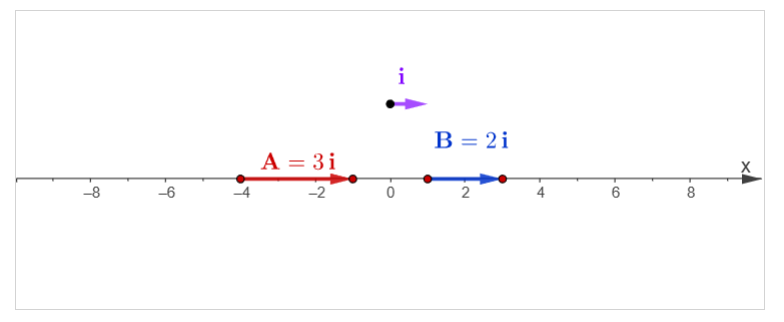
A labeled one-dimensional axis (line of action) used to define a sign convention for vectors. The diagram emphasizes that vectors pointing toward the chosen positive end are assigned positive values, while vectors pointing the other way are assigned negative values, so the sign of the computed resultant communicates direction. Source
The opposite way is then negative. This is the sign convention for the problem.
The choice is arbitrary. You may choose right as positive, or left as positive. You may choose up as positive, or down as positive. Physics does not change when the convention changes; only the signs attached to the vectors change.
What does matter is consistency. Once a positive direction has been chosen, every vector must be described using that same convention. If one quantity is assigned using one convention and another quantity is assigned using the opposite convention, the algebra mixes two different coordinate choices and the resultant becomes meaningless.
A negative sign does not mean the vector is unphysical or that its magnitude is “less than zero.” The sign only indicates direction. The magnitude of a signed vector value is its absolute value. For example, a vector written as has magnitude and points opposite the positive direction.
Algebraic Form of the Resultant
Once each vector has a sign, the resultant is found by ordinary algebraic addition. This is the key simplification of one-dimensional vectors: direction and magnitude are combined into a single signed number.
= resultant one-dimensional vector
= contributing one-dimensional vectors, each written with its sign
This equation shows why opposite directions in one dimension are represented by opposite signs. If two vectors point in opposite directions, they enter the sum with opposite signs, so the algebra automatically accounts for their opposition. You do not need a separate rule for “subtracting opposite vectors”; signed addition already does that.
If all contributing vectors point the same way, their magnitudes add because they all have the same sign. If some point one way and some point the other way, the resultant depends on which signed total is larger. The sign of the final answer tells you which direction wins.
Reading the Final Sign
The signed result carries directional information:
means the resultant points in the chosen positive direction
means the resultant points in the opposite direction
means the vectors exactly balance along that line
It is useful to separate signed value from magnitude. If , then the magnitude is , while the negative sign communicates direction. A student who reports only has given the size but not the full vector result.
Why Signed Addition Works
A one-dimensional axis has only two possible directions. That is why a single sign is enough to represent orientation. Positive and negative are not extra arithmetic decorations; they are the mathematical representation of direction on a line.
This makes the resultant especially easy to interpret. A large positive total means the combined effect points strongly in the positive direction. A large negative total means the combined effect points strongly in the opposite direction. A small total, whether positive or negative, means there has been substantial cancellation between vectors pointing opposite ways.
Because the method is purely algebraic, it is also easy to check. If the final sign surprises you, first verify that each original vector was assigned the correct sign under the stated convention. Most one-dimensional vector mistakes come from sign choices, not from difficult arithmetic.
Common Mistakes
Several recurring errors can hide a correct physical idea behind incorrect notation:
Adding magnitudes only. A vector sum must include direction, not just size.
Forgetting to state the positive direction. Without that choice, a negative answer has no clear meaning.
Dropping the sign in the final answer. The sign is part of the vector result.
Switching conventions midway. Consistency matters more than which direction was called positive.
Treating the resultant as a simple total of sizes. In one dimension, opposite directions must cancel through signed addition.
FAQ
Writing subtraction as addition of a negative vector keeps the method consistent: every resultant is found by one rule, namely signed addition.
It also reduces sign errors. You can focus on the direction of each vector first, assign its sign, and then add all terms in a single algebraic expression.
“Collinear” means that all vectors lie along the same straight line. In that case, one sign convention is enough to describe every direction involved.
If the vectors are not collinear, a single positive–negative line cannot represent the full situation. Then a one-dimensional resultant is no longer sufficient.
Not necessarily. A negative answer can simply mean the actual vector points opposite to your original assumption.
This is often useful. It lets you set up the algebra with one assumed direction and then let the sign of the solution reveal the true direction.
Yes. Signed addition does not remove the need for compatible units. All terms in a vector sum must represent the same physical quantity in the same unit.
For instance, you must convert centimetres to metres before combining them. The sign tells you direction; the unit tells you the scale.
No. For ordinary one-dimensional vector sums, the order does not change the final resultant because signed addition is commutative and associative.
However, changing the order can still affect clarity. Many students make fewer errors when they group positive and negative contributions carefully before combining them.
Practice Questions
A particle moves along the x-axis. Taking right as positive, its successive displacements are m, m, and m. Determine the resultant displacement and state the direction.
1 mark: Correct signed sum,
1 mark: Resultant displacement is m, or m to the left
A cart moves along a horizontal track. Right is defined as positive. Three horizontal forces act on the cart: N, N, and an unknown force . The resultant force is N.
(a) Write the equation representing the resultant force.
(b) Determine .
(c) State the direction of .
(d) A second student instead chooses left as positive. What is the signed value of the resultant force in that convention?
1 mark: Writes a correct equation,
1 mark: Rearranges correctly to or an equivalent step
1 mark: Finds N
1 mark: States that acts to the left
1 mark: Gives the new signed resultant force as N
