

AP Syllabus focus: 'Average velocity equals displacement divided by the time interval between the initial and final states.'
Average velocity compresses an interval of motion into one vector quantity. It tells how position changes overall, not how motion varies at each moment during the interval.
Meaning of Average Velocity
The central quantity in this topic is average velocity.
Average velocity: The displacement of an object divided by the time interval between the initial and final states.
This definition is compact, but every part of it matters: displacement, time interval, and the comparison between an initial state and a final state.
Mathematical Expression
Average velocity is written as displacement over elapsed time.
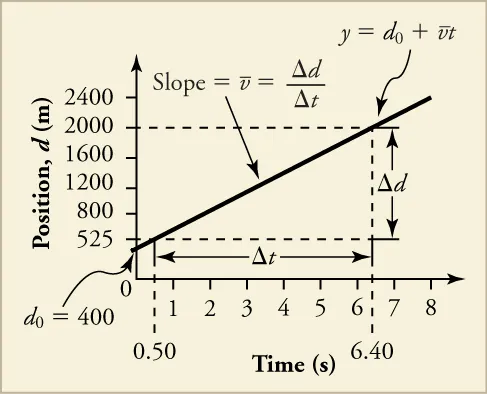
On a position–time graph, the average velocity over a chosen interval is the slope of the line connecting the two endpoints (a secant line). The marked triangle shows , making the interval-dependence explicit: changing the two times changes the computed average velocity. Source
= average velocity, in meters per second
= displacement from initial position to final position, in meters
= elapsed time between the two states, in seconds
Because the numerator is a vector, average velocity is also a vector.
In one dimension, direction is usually carried by the sign of the answer. In two or three dimensions, the direction comes from the displacement vector itself.
Core Ideas Inside the Definition
It Depends on Displacement, Not the Full Trip
Average velocity uses the change in position from start to finish. That means it is determined only by the initial position and final position. The detailed route taken between those two states does not appear in the definition.
An object may curve, reverse direction, pause, or move unevenly, but its average velocity over the interval is still found from the same overall displacement divided by the same elapsed time. This makes average velocity an interval-based quantity.
The Chosen Interval Is Part of the Quantity
Average velocity is not a single permanent label attached to a moving object. It must always be understood as the average velocity over a specific interval.
A particle may have one average velocity from 0 s to 2 s and a different average velocity from 2 s to 5 s, even though the motion belongs to the same particle. In AP Physics C Mechanics problems, identifying the correct interval is essential before doing any calculation.
The Time Interval Must Match the Displacement
The denominator is the time between the same initial and final states used for the displacement. If the position change comes from one interval and the time comes from another, the result is not a valid average velocity.
The size of the time interval also matters physically. For the same displacement, a smaller gives a larger magnitude of average velocity. For the same , a larger displacement gives a larger magnitude. Average velocity therefore always depends on both how far position changed overall and how long that change took.
Direction Is Part of the Answer
Since displacement has direction, average velocity must also have direction. A numerical value without direction is incomplete unless the motion is strictly one-dimensional and the sign convention is understood.
In one dimension, a positive average velocity means the displacement was in the positive coordinate direction, while a negative average velocity means the displacement was in the negative coordinate direction. In multiple dimensions, average velocity points from the initial position toward the final position, regardless of the shape of the path between them.
Component Viewpoint in Higher Dimensions
In two or three dimensions, one average velocity vector contains all coordinate directions at once. Each component is found by dividing the corresponding displacement component by the same elapsed time, such as and .
This component view is useful because it breaks a vector calculation into simpler pieces while keeping the same physical meaning: overall change in position per unit time.
How to Determine Average Velocity
Standard Procedure
Choose the initial state and final state.
Identify the initial position and final position.
Compute the displacement by subtracting initial position from final position.
Determine the elapsed time between those same two states.
Divide displacement by elapsed time.
Report the answer with appropriate units, usually m/s.
Include sign, direction, or vector components as required.
Interpreting the Result
A computed average velocity tells you how rapidly and in what direction the object's position changed overall during the chosen interval. It does not mean the object necessarily moved with that same velocity throughout the interval.
This is important in mechanics problems. A particle can speed up, slow down, stop briefly, or reverse direction, and the average velocity over the interval is still defined by the same start-to-finish comparison. Only when the velocity remains unchanged throughout the interval does the average velocity equal the velocity at every moment in that interval.
Common Mistakes to Avoid
Frequent Errors
Using final position instead of displacement.
Forgetting to subtract times to get the actual time interval.
Omitting the sign or direction from the answer.
Mixing units without converting them consistently.
Using information from one interval with time from a different interval.
Treating average velocity as a description of the entire path followed.
Reporting only a magnitude when the question asks for a vector.
A Useful Check
After calculating average velocity, check whether the direction of your result matches the direction from the initial position to the final position. Also check whether the size of the result is reasonable for the stated displacement and time interval. These quick checks often catch sign errors, interval mistakes, and unit mismatches.
FAQ
On a position-time graph, slope means change in position divided by change in time.
A secant line joins the points for the initial and final states, so its slope is $\Delta x/\Delta t$. That matches the definition of average velocity over that interval.
A tangent line, by contrast, refers to one instant rather than a whole interval.
No, not if you simply shift the origin.
Both the initial and final positions change by the same amount, so their difference, the displacement, stays the same. Since average velocity depends on displacement and elapsed time, the average velocity is unchanged.
If you rotate the axes, the numerical components may change, but the physical vector does not.
Only if the average velocities come from equal time intervals.
If the intervals are unequal, the overall average velocity must be found from total displacement divided by total time. Equivalently, you may use a time-weighted average.
A simple arithmetic mean can be misleading because it gives the same importance to a short interval and a long one.
Average velocity depends on both displacement and elapsed time, so uncertainty in either one affects the result.
If displacement comes from two position measurements, uncertainty in both positions matters. If the time interval is very short, even a small timing uncertainty can have a large effect.
To reduce uncertainty, experimenters often use a clear timing trigger and positions that are far enough apart to make the displacement easier to measure reliably.
No. The definition requires division by $\Delta t$.
If $\Delta t=0$, the expression is undefined, so average velocity cannot be assigned to that interval. In practice, you must use a non-zero elapsed time.
Very short intervals can still be used, but they must remain finite if you are calculating an average velocity directly.
Practice Questions
A cart moves along the x-axis from at to at . Determine the cart's average velocity.
1 mark: Correct use of with and
1 mark:
A particle is at position at and at position at .
(a) Find the displacement vector.
(b) Find the average velocity vector.
(c) Find the magnitude of the average velocity.
1 mark:
1 mark: Correct setup,
1 mark:
1 mark: Correct magnitude method,
1 mark: or
