

AP Syllabus focus: 'Average acceleration equals the change in velocity divided by the time interval over which that change occurs.'
Average acceleration describes how rapidly velocity changes over a chosen time interval. In AP Physics C Mechanics, understanding the interval, the vector nature of velocity, and the meaning of the result matters more than memorizing a formula.
What Average Acceleration Measures
Average acceleration compares an object's velocity at two instants and describes the net change across the interval between them. It does not describe every moment in between. Instead, it compresses the motion into one vector quantity tied to a specific start time and end time.
Average acceleration: The vector quantity equal to the change in velocity divided by the time interval over which the change occurs.
Because the quantity is based on velocity, it depends on both magnitude and direction. A change from one velocity to another can come from speeding up, slowing down, reversing direction, or changing direction without changing speed. In each case, the acceleration is determined by how the velocity vector changes over the chosen interval.
= average acceleration vector, meters per second squared
= change in velocity vector, meters per second
= time interval, seconds
This equation is only meaningful when the initial and final velocities are taken from the same time interval. The time interval must be nonzero, and the result describes the average rate of change of velocity during that interval. In AP Physics C Mechanics, always attach the interval mentally to the answer. Saying an object has an average acceleration without stating the interval is incomplete. A short interval and a long interval can produce different average accelerations because they summarize different parts of the motion.
Interpreting the Vector Quantity
Direction and Sign
Average acceleration is a vector.
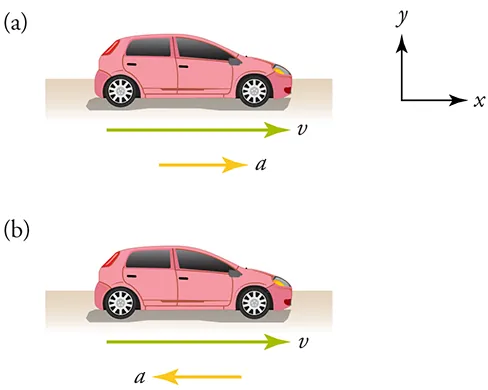
Two cases are shown with velocity and acceleration vectors: (a) v and a point in the same direction (speeding up), and (b) v points one way while a points the opposite way (slowing down). The figure visually separates “direction of motion” (velocity) from “direction of velocity change” (acceleration). Source
Its direction is the direction of the change in velocity, not automatically the direction of motion. In one-dimensional motion, the sign of the answer tells you whether the average acceleration points along the positive axis or the negative axis. A negative value does not mean the object is slowing down by itself; it only indicates direction relative to the chosen coordinate system. Whether the object is speeding up or slowing down depends on how the velocity and acceleration directions compare.
A particularly important consequence is that opposite velocities produce a large change. If an object goes from a positive velocity to an equal-magnitude negative velocity, the velocity change is substantial even though the speeds match. Average acceleration therefore captures reversals of direction just as naturally as changes in speed.
Magnitude and Units
The SI unit of average acceleration is meters per second squared, written as . This unit means that velocity changes by a certain number of meters per second during each second of the interval, on average. The word average matters: the change does not need to happen uniformly from one moment to the next.
Only the net velocity change and the elapsed time determine the value.
An average acceleration of zero means there was no net change in velocity over the interval. It does not necessarily mean the object was at rest, and it does not prove the acceleration was zero at every instant between the endpoints. For that reason, average acceleration is most useful when comparing clearly defined intervals rather than trying to describe a complicated motion with one number alone.
Applying the Definition in Problems
When you compute average acceleration, organize the information before substituting anything into the equation. Small sign mistakes often come from choosing inconsistent initial and final states.
Identify the initial velocity and the final velocity for the exact interval named in the problem.
Use velocity, not speed, since direction must be included in the change.
Use the same starting and ending times for both the velocity change and the time interval.
Keep track of the coordinate axis so the sign of each velocity is interpreted correctly.
Report units as and interpret the sign as a direction, not as a statement about speeding up or slowing down.
In calculus-based mechanics, the same idea remains valid in more than one dimension. If motion is described with components, average acceleration can be determined from the change in each velocity component over the same time interval. The full acceleration vector is built from those component changes, so consistency in the interval is still essential. This keeps the analysis focused on velocity change rather than on the path alone.
Another common pitfall is mixing acceleration with displacement. Displacement divided by time gives average velocity, not average acceleration. Average acceleration comes only from how velocity changes over time. If a problem provides positions rather than velocities, you must first determine the relevant velocities before discussing average acceleration.
Subtleties That Matter
Average acceleration gives limited information about the motion within the interval. Many different motions can share the same initial and final velocities, so they can have the same average acceleration even if one motion is smooth and another is irregular. This is why average acceleration is useful for describing net change but not for reconstructing every detail of the motion between the endpoints. That same feature also makes it practical in experiments, where only endpoint data may be available reliably.
Two ideas are especially important in AP questions:
The result depends only on the change in velocity and the elapsed time, not on the distance traveled during the interval.
A larger time interval does not automatically mean a larger average acceleration; the ratio depends on how much the velocity changed.
If the initial and final velocities are identical, the average acceleration over that interval is zero, regardless of what happened in between.
Because of this endpoint-based nature, average acceleration is best viewed as a summary of motion over a finite interval. It is precise and measurable, but it should never be mistaken for a complete description of how the object moved at every moment.
Practice Questions
A particle moving along the x-axis changes velocity from -3.0 m/s to 5.0 m/s in 2.0 s. Determine its average acceleration.
1 mark for using with the correct signed change in velocity.
1 mark for the answer 4.0 m/s² in the positive x-direction.
A cart moves along a straight track. At , its velocity is 10.0 m/s in the positive x-direction. At s, its velocity is 4.0 m/s. At s, its velocity is 7.0 m/s.
(a) Calculate the average acceleration from to s.
(b) Calculate the average acceleration from s to s.
(c) Calculate the average acceleration from to s.
(d) Explain why the answer to part (c) is not found by taking the simple arithmetic mean of the answers to parts (a) and (b).
1 mark for (a): m/s².
1 mark for (b): m/s².
1 mark for (c): m/s².
1 mark for stating that average acceleration depends on total change in velocity divided by total time.
1 mark for stating that the two intervals have different durations, so any combination of parts (a) and (b) would need time weighting rather than a simple average.
FAQ
They are exactly equal when the acceleration is constant throughout the interval.
If acceleration varies, average acceleration can still be close to instantaneous acceleration if the interval is very short and the motion changes smoothly. The shorter the interval, the more local the average becomes.
Average velocity depends on displacement over time, whereas average acceleration depends on change in velocity over time.
An object could return to its starting position, giving zero displacement, but finish with a different velocity from the one it started with. In that case, average velocity could be zero while average acceleration is not.
Average acceleration uses the difference between two velocity measurements. If those two values are close together, even small uncertainties can produce a large percentage error in the result.
To reduce this problem:
use consistent timing
repeat trials
avoid overly short intervals unless the data are very precise
If you reverse both parts consistently, the final answer is unchanged. For example, swapping the order in both velocity difference and time difference still gives the same ratio.
If you reverse only one part, you create a sign error. That is one of the most common mistakes in acceleration calculations.
Yes, and there is nothing unusual about that.
Velocity and acceleration have different units, so their numerical values are not directly comparable in a physical sense. A velocity might be 2 and an acceleration might be 10, but those numbers describe different quantities: m/s versus m/s².
