

AP Syllabus focus: 'An object accelerates whenever the magnitude of its velocity, its direction, or both are changing.'
Acceleration describes any change in motion, not just speeding up. For AP Physics C Mechanics, the essential idea is that velocity can change in size, direction, or both.
Understanding Acceleration
In mechanics, acceleration is tied to velocity, not simply to motion itself. An object may be moving and still have no acceleration, or it may even be momentarily at rest and still be accelerating. The deciding question is always whether the object's velocity is changing.
Acceleration: A change in velocity over time. An object accelerates if the magnitude of its velocity changes, its direction changes, or both change.
Because velocity includes both magnitude and direction, acceleration has two possible causes. The object can change how fast it moves, it can change the way it is pointed in space as it moves, or both can happen together.
This is why acceleration is broader than many everyday uses of the word suggest. In ordinary language, people often use “accelerate” to mean “speed up.” In physics, that is only one case. A full mechanics definition must include every situation in which velocity changes.
When Speed Changes
If an object's direction stays the same but its speed changes, its velocity changes, so the object accelerates.
Speeding Up
When speed increases in a straight line, acceleration is present. In one-dimensional motion, this often means the acceleration and velocity point in the same direction. The object covers more distance in equal time intervals, showing that the magnitude of velocity is increasing.
This kind of acceleration is usually the easiest to recognize because the motion looks more energetic over time. However, the important idea is still not the appearance of motion, but the change in velocity.
Slowing Down
When speed decreases in a straight line, acceleration is also present. This is sometimes called deceleration, but in physics it is still acceleration. In one dimension, the acceleration points opposite the velocity during slowing down.
A common mistake is to think acceleration must mean “speeding up.” In mechanics, slowing down is just as much a case of acceleration because the magnitude of velocity is changing. If an object goes from fast to slow, its velocity has changed, so acceleration must be present.
When Direction Changes
An object can accelerate even if its speed never changes. If the direction of motion changes from one instant to the next, then the velocity vector changes, so acceleration is nonzero. This is why turning motion matters.
A car rounding a bend at constant speed, a satellite moving in orbit, or a ball attached to a string moving in a circle all accelerate while turning.
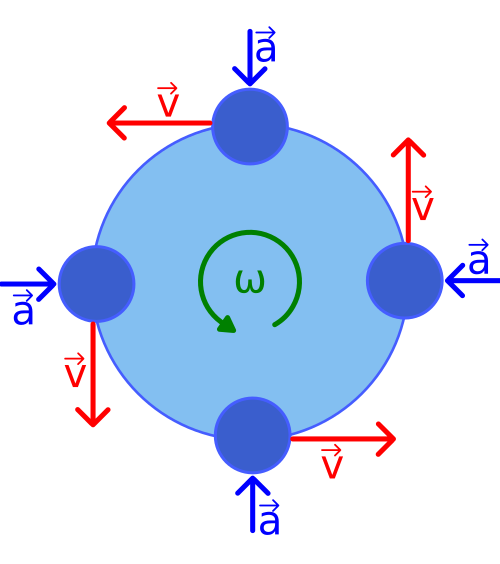
In uniform circular motion, the velocity vector is always tangent to the circular path, so its direction changes continuously even when its magnitude (speed) is constant. The acceleration vector points toward the center (centripetal), showing that turning requires a nonzero acceleration even without speeding up. Source
Their speed may stay constant, but the direction of their velocity does not.
This idea is essential because it shows that constant speed does not guarantee zero acceleration. Only constant velocity guarantees zero acceleration, and constant velocity requires both constant speed and constant direction.
When Both Change at Once
In many realistic situations, an object's speed and direction change together. A cyclist entering a curve while braking, or a skater leaving a turn while pushing harder, experiences acceleration from both effects at once.
This kind of motion is especially important to recognize conceptually. You should not try to classify acceleration using just one word such as “speeding up” or “slowing down” if the path is also changing. Instead, ask two separate questions:
Is the magnitude of velocity changing?
Is the direction of velocity changing?
If the answer to either question is yes, the object is accelerating. If both are yes, the acceleration reflects both types of change.
How to Decide Whether an Object Is Accelerating
A reliable way to analyze a motion description is to compare the velocity at two nearby instants.
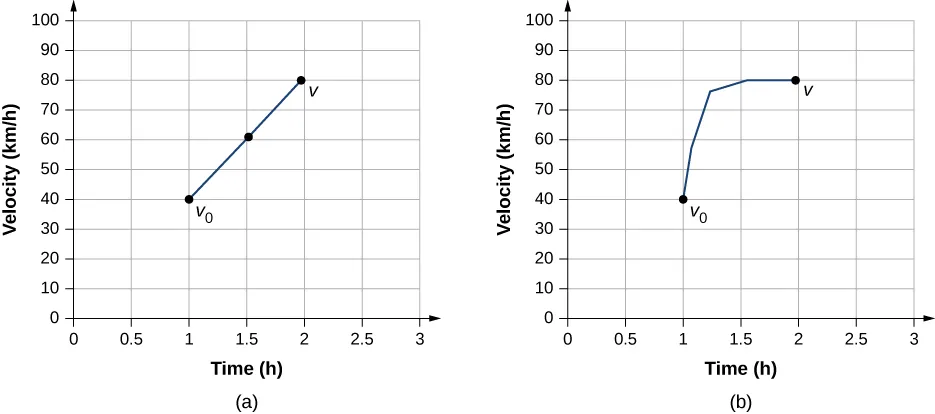
These velocity–time graphs illustrate that acceleration is the slope of a – curve: a straight line indicates constant acceleration (constant slope), while a curved line indicates acceleration changing with time. The shaded/interval interpretation also highlights how average velocity over a time interval relates to the graph’s geometry. Source
If the later velocity is larger in magnitude, the object is accelerating.
If the later velocity is smaller in magnitude, the object is still accelerating.
If the direction is different, the object is accelerating even if the speed matches.
If both magnitude and direction are unchanged, there is no acceleration.
This approach keeps the focus on the real physics quantity: change in velocity. It also helps prevent confusing motion with acceleration. An airplane cruising in a straight line at constant speed is moving, but not accelerating. By contrast, a runner changing lanes may accelerate even if the speedometer reading stays the same.
Common Misconceptions
Several errors appear often in early mechanics work.
Moving fast means accelerating. False. A very fast object can have zero acceleration if its velocity stays constant.
Only speeding up counts as acceleration. False. Slowing down is also acceleration because velocity is changing.
Constant speed means zero acceleration. False. Turning at constant speed still changes the direction of velocity.
Zero acceleration means the object is at rest. False. Zero acceleration means velocity is constant; that constant velocity can be zero or nonzero.
A change in path is separate from acceleration. False. Any change in direction is a change in velocity, so it is acceleration.
Practice Questions
A car travels around a circular track at constant speed. Is the car accelerating? Explain your answer.
1 mark: States that the car is accelerating.
1 mark: Explains that the direction of the velocity is changing even though the speed is constant.
A particle moves in three separate intervals:
(a) It moves east in a straight line while its speed increases.
(b) It moves east in a straight line at constant speed.
(c) It moves along a curved path while its speed stays constant.
For each interval, state whether the particle is accelerating and justify your answer in terms of changes in velocity.
(a)
1 mark: States that the particle is accelerating.
1 mark: Justifies that the magnitude of velocity is increasing.
(b)
1 mark: States that the particle is not accelerating.
1 mark: Justifies that both the magnitude and direction of velocity remain constant.
(c)
1 mark: States that the particle is accelerating because the direction of velocity changes.
FAQ
Your body tends to keep moving in a straight line because of inertia. The seat or door must exert a sideways force on you to make your velocity change direction.
That sideways force causes the acceleration. What you feel is the contact force from the car, not a separate outward force acting on you.
Acceleration can be split into two useful parts:
Tangential acceleration changes the speed.
Normal acceleration changes the direction.
If an object is speeding up while turning, both components are present. If it is turning at constant speed, the tangential part is zero but the normal part is still nonzero.
In a tighter turn, the direction of the velocity must change more rapidly. That means a larger change in velocity occurs in a short time.
So, even if the speed stays the same, sharper curvature demands a greater acceleration towards the inside of the turn.
Not always. Deceleration means the speed is decreasing. Negative acceleration only means the acceleration points in the negative direction of the chosen axis.
If an object is moving in the negative direction and also has negative acceleration, its speed can actually increase. The sign depends on coordinates; speeding up or slowing down depends on the relationship between velocity and acceleration.
Your body does not directly sense constant speed in a straight line very well. If motion is smooth and unchanging, it can feel almost the same as being at rest.
You notice acceleration because forces act on your body when velocity changes. Your inner ear and contact forces from seats, floors, or straps help you detect those changes in motion.
