

AP Syllabus focus: 'As the time interval approaches zero, average quantities approach instantaneous values; differentiation and integration connect position, velocity, and acceleration as functions of time.'
Instantaneous kinematics uses the limiting behavior of average motion over very small time intervals. Calculus then connects motion functions, allowing precise relationships among position, velocity, and acceleration at any moment.
The Limiting Idea
In kinematics, a function such as gives the position of an object at each time . The value of at one specific instant is the object’s instantaneous position. Unlike an average quantity, it does not describe a whole interval; it describes a single moment.
Average quantities are often easier to measure first, but they do not capture exactly what is happening at one instant. The key AP Physics C idea is that an instantaneous value is found by shrinking the time interval until it becomes arbitrarily small. This is the limiting process that leads to derivatives.
A central quantity is instantaneous velocity.
Instantaneous velocity: The velocity of an object at a specific moment, equal to the limiting value of average velocity as the time interval approaches zero.
Average velocity over a finite interval uses the ratio of change in position to change in time. Taking the limit of that ratio gives the derivative of position with respect to time.
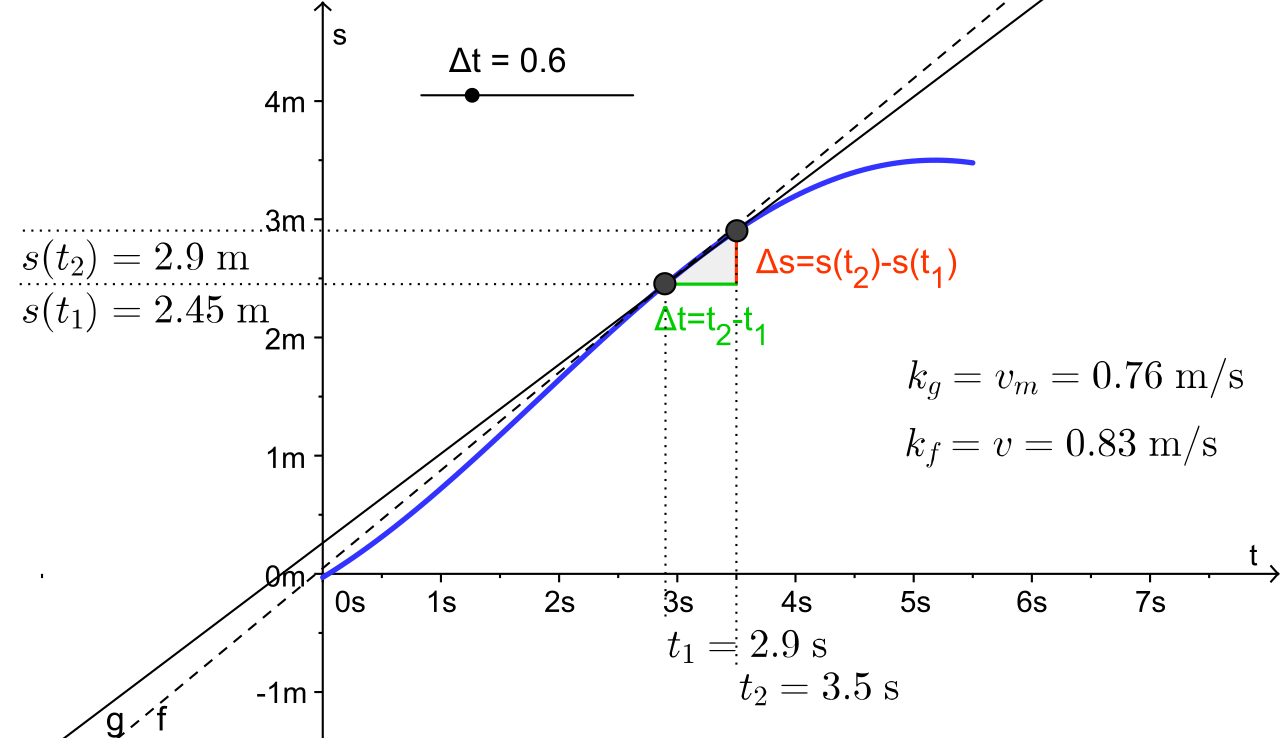
On a position–time graph, the average velocity over a finite interval corresponds to the slope of a secant line, while the instantaneous velocity at a moment corresponds to the slope of the tangent line. As the interval shrinks (), the secant slope approaches the tangent slope, illustrating geometrically. Source
= instantaneous velocity at time , in meters per second
= position, in meters
= change in position over the interval, in meters
= time interval, in seconds
This derivative tells how rapidly position is changing at that exact instant. A positive value means the coordinate is increasing at that moment, while a negative value means it is decreasing.
Another essential quantity is instantaneous acceleration.
Instantaneous acceleration: The acceleration of an object at a specific moment, equal to the limiting value of average acceleration as the time interval approaches zero.
Just as velocity comes from how position changes, acceleration comes from how velocity changes. It is the derivative of velocity with respect to time.
= instantaneous acceleration at time , in meters per second squared
= velocity, in meters per second
= change in velocity over the interval, in meters per second
= time interval, in seconds
The final form, , shows that acceleration is the second derivative of position. If position is known as a function of time, velocity and acceleration follow from differentiation.
Differentiation Connects the Motion Functions
Differentiation is the mathematical operation that turns one motion function into the next. In one-dimensional motion:
describes where the object is
describes how quickly position is changing
describes how quickly velocity is changing
These are not separate ideas.
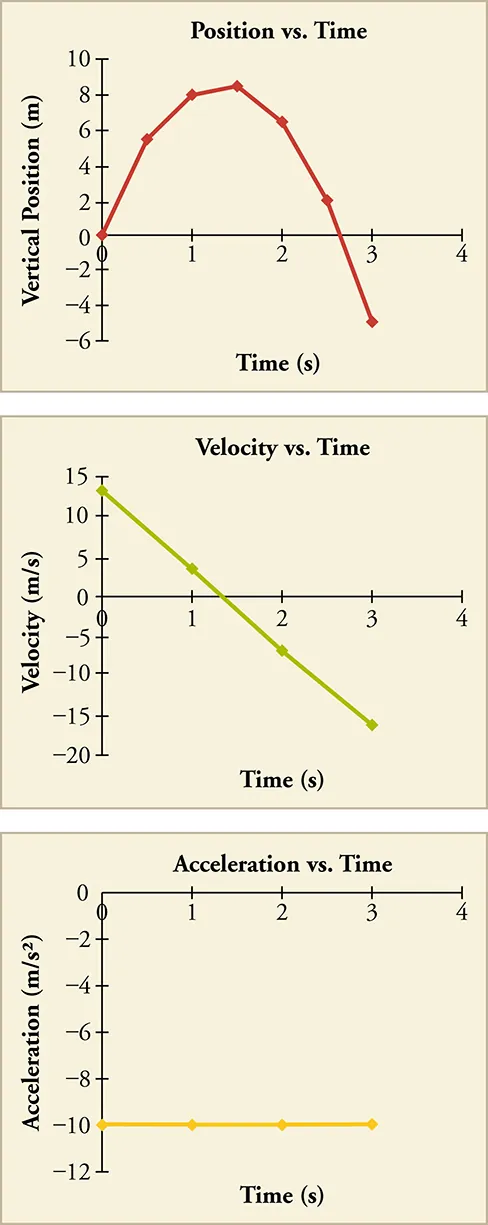
A matched set of , , and graphs for the same motion highlights how differentiation and integration connect kinematic quantities. The slope of at each time gives , and the slope of gives ; with constant acceleration, is a horizontal line while is linear and is curved (quadratic). Source
They are linked descriptions of the same motion. Because of this connection, knowing one function can allow you to determine another, provided the function is expressed in terms of time and is differentiable.
The derivative is local, meaning it depends on behavior very near the chosen time. That is why an object can have different instantaneous velocities at nearby times even if its overall trip seems simple. Instantaneous quantities describe motion with much more detail than averages do.
Integration Reverses the Process
Integration reverses differentiation. If acceleration is known as a function of time, integration gives the change in velocity over a time interval. If velocity is known, integration gives the change in position.
= initial time, in seconds
= final time, in seconds
= change in velocity over the interval, in meters per second
= change in position over the interval, in meters
These integrals give changes over an interval, not automatically the final values themselves. To identify a unique motion, you must combine the integral result with the object’s value at some starting time. For example, final velocity is found from , and final position is found from .
This is why AP Physics C often treats motion as a chain of related functions rather than isolated formulas. Differentiation moves from position to velocity to acceleration. Integration moves back from acceleration to velocity and from velocity to position.
Physical Meaning at an Instant
Instantaneous quantities should be interpreted carefully.
Instantaneous Position
The position tells the object’s coordinate at one exact time. It does not say how the object got there or how it will move next. Two different motions can pass through the same position at the same instant.
Instantaneous Velocity
Velocity describes motion at that moment, not over a long interval.
If , the position coordinate is increasing
If , the position coordinate is decreasing
If , the object is momentarily at rest in that coordinate system
A zero instantaneous velocity does not, by itself, determine the acceleration.
Instantaneous Acceleration
Acceleration describes how the velocity is changing at that moment.
If , velocity is changing in the positive direction
If , velocity is changing in the negative direction
If , velocity is not changing at that instant
Acceleration is tied directly to velocity, not directly to position.
Common Checks and Pitfalls
When working with instantaneous motion, keep these ideas in mind:
Limits matter: an instantaneous quantity comes from a limiting process, not from choosing a merely small time interval
Units matter: differentiating position gives meters per second, and differentiating velocity gives meters per second squared
Integration gives change: you still need starting information to recover the full motion
A derivative may fail to exist at a time where a motion function has a sharp corner, cusp, or jump
Practice Questions
A particle moves along the -axis with position function , where is in meters and is in seconds. Find the particle’s instantaneous velocity at .
1 mark for differentiating position to get
1 mark for evaluating at to get
A particle moves along a line with acceleration , where is in meters per second squared and is in seconds. At , the particle has velocity and position .
(a) Derive an expression for the velocity . (b) Derive an expression for the position . (c) Find the particle’s position at .
1 mark for integrating acceleration:
1 mark for using to get , so
1 mark for integrating velocity:
1 mark for using to get , so
1 mark for substituting correctly to get
FAQ
If $x(t)$ has a sharp corner, cusp, or jump at a particular time, the derivative may not exist there.
That means the instantaneous velocity is undefined at that instant, even if average velocities over nearby intervals can still be computed.
In physical terms, a truly non-differentiable motion often signals an idealisation or a sudden model change rather than smooth real motion.
In practice, you approximate the derivative using very small time intervals around the moment of interest.
Common approaches include:
using a symmetric difference over nearby data points
fitting a smooth curve to the data first
reducing noise before taking slopes
The estimate improves when the data are precise and closely spaced, but very small intervals can also amplify measurement noise.
Differentiation removes constant information. For example, many different position functions can have the same velocity function because they differ only by a constant shift.
When you integrate, that missing information reappears as a constant of integration.
To determine the actual motion, you need a condition such as:
position at a known time, or
velocity at a known time
Without that condition, you have a family of mathematically valid motions rather than one unique physical answer.
Yes.
They may:
be at different positions
have different accelerations
follow different position functions before and after that moment
Sharing the same instantaneous velocity at one instant only means their local rates of change of position match at that time.
It does not mean their past motion, future motion, or net displacement must be the same.
It helps you catch errors quickly.
For example:
$dx/dt$ must have units of $m/s$
$dv/dt$ must have units of $m/s^2$
$\int a(t),dt$ must have units of $m/s$
If your units do not transform correctly, the calculus step is probably wrong.
This is particularly helpful when differentiating powers of time or integrating polynomial motion functions, where algebraic mistakes can otherwise go unnoticed.
