

AP Syllabus focus: 'In the object model, size, shape, and internal structure are ignored, and displacement is the change in an object's position.'
This subtopic introduces the simplified model used to describe motion and the precise quantity used to express how an object's location changes between two states.
The Object Model
In AP Physics C: Mechanics, motion is often analyzed with the object model. Real objects have size, shape, rotation, deformation, and internal structure, but many questions about motion do not depend on those details. When they are not important, the entire object can be treated as if its motion is represented by a single point.
Object model: A simplified description in which an object is treated as a single entity whose size, shape, and internal structure are ignored.
This does not mean the real object literally has no size. It means those features are unnecessary for the analysis being done. A ball, cart, spacecraft, or block can often be modeled this way if the goal is simply to track where it is.
A useful way to think about the model is that one representative point stands for the whole object. That point must be used consistently throughout the description of the motion. If the tracked point changes during the analysis, then the displacement no longer refers to one well-defined model.
What the model keeps and what it ignores
The object model keeps only the information needed to describe the motion of the object as a whole.
Kept: location at a given instant
Ignored: detailed geometry, bending, spinning, vibration, and internal composition
Benefit: the motion can be described more clearly and with fewer variables
This simplification is a major part of physics problem solving. Before analyzing motion, decide whether the object's physical extent matters. If it does not, the object model is usually appropriate.
When the object model is appropriate
The object model is especially useful when:
the object's dimensions are small compared with the distances involved
the question is about where the object is, not about its detailed orientation
internal parts do not need to be studied separately
If size, shape, or internal motion affects the situation in an essential way, then the object model may not be sufficient. For this subtopic, however, the important idea is that many kinematics descriptions begin by removing unnecessary physical detail.
Position and Displacement
Once an object is represented by a single point, its motion can be described by its position, meaning where that point is relative to a chosen origin. The key quantity here is displacement, which compares the initial position to the final position.
Displacement: The change in an object's position from its initial position to its final position.
Displacement does not record every part of the motion.
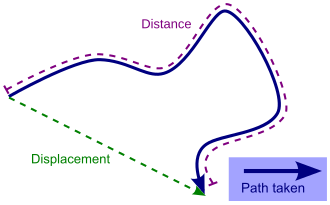
A curved path represents the actual route traveled, while a straight arrow connects the same start and end points to represent displacement. The contrast highlights that displacement is a straight-line vector between endpoints, whereas distance depends on the full path length. Source
It compares only two states: where the object started and where it ended. A long, complicated trip and a short direct trip can have the same displacement if the initial and final positions are the same.
= displacement in one dimension, m
= final position, m
= initial position, m
In any dimension, the same idea applies: displacement is found by subtracting the initial position from the final position.
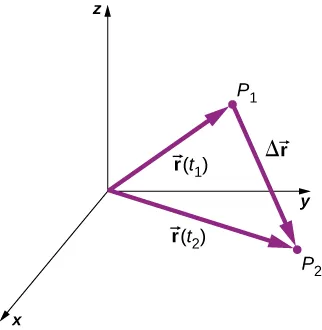
A particle is shown at two different positions, with position vectors drawn from the origin and a displacement vector drawn directly from the initial point to the final point. This makes the endpoint nature of displacement explicit: , independent of the path taken between those two points. Source
In one-dimensional motion, the sign of shows direction relative to the chosen positive axis.
A full narrative of the motion may include turns, reversals, or pauses. Displacement compresses that entire history into one change in position. That makes it very useful, but also very specific: it is not a complete description of everything that happened.
Key features of displacement
Several features of displacement are essential in mechanics.
It is based on position change. If the initial and final positions are the same, the displacement is zero.
It depends only on the endpoints. The route taken between those points does not alter the displacement.
It can be positive, negative, or zero in one dimension. The sign is determined by the coordinate system.
It has direction. Because displacement describes a change in position, magnitude alone is not enough.
A common mistake is to think that a larger amount of motion must mean a larger positive displacement. That is not correct. Positive or negative displacement depends on the chosen axis. If right is positive, motion to the left gives negative displacement. If the axis is reversed, the sign reverses as well.
How the Two Ideas Fit Together
The object model and displacement are closely connected. The model lets physicists replace a real extended object with one tracked location, and displacement tells how that tracked location changes. Without the object model, one would need to describe the motion of many different points on the same object, which is often unnecessary in introductory mechanics.
For many systems, a single representative point is enough to capture the motion relevant to the problem. The object may travel along a straight or curved path, but displacement still connects only the initial and final positions of that representative point.
Common misconceptions
Ignoring size does not mean size does not exist. It means size is not relevant to the question being asked.
Zero displacement does not mean zero motion. It means only that the final position matches the initial position.
Displacement is not a record of the whole trip. It is specifically the change in position.
Position values may depend on the chosen origin, but displacement is still found by taking final position minus initial position within one consistent coordinate system.
When reading a mechanics problem, identify the tracked object, decide whether the object model is appropriate, and then locate the initial and final positions. Clear identification of the tracked point and those two positions is the key to using displacement correctly.
FAQ
For many moving bodies, the centre of mass gives the cleanest single-point description of overall motion.
It is especially useful because external motion can often be analysed as though all the mass were concentrated there. That does not mean the object is actually compressed into one point; it simply makes the model more effective.
Yes, they can, if the object rotates or deforms while moving.
If an object undergoes pure translation, every point on it has the same displacement. If it rotates, points at different locations on the object can end at different final positions, so their displacements differ. That is one reason the chosen representative point must be specified carefully.
Displacement is found from two position measurements, so uncertainty in both measurements matters.
In practice:
uncertainty in the initial position contributes
uncertainty in the final position contributes
the reported displacement should reflect the combined effect of both
This is important in experiments because a small displacement may be hard to distinguish from measurement noise.
They are faster to compute and easier to interpret.
A particle-style model reduces each object to a small set of variables, usually position and perhaps other motion variables. That lets a simulation focus on the essential behaviour before adding complications such as rotation, collisions across extended surfaces, or deformation.
Then a single-point object model may become inadequate.
If one end and the other end of the object do not move in the same way, there may be no single displacement that fully represents the motion of the whole object. In that case, physicists may track several points or use a more detailed model that includes the object's changing shape.
Practice Questions
A particle moves along the -axis from to .
State the displacement of the particle and indicate its direction.
1 mark: Uses
1 mark: Correct answer and states the displacement is in the negative -direction
A small robot of length moves along a straight track. The position of a chosen reference point on the robot is initially . The robot moves to the right, then reverses direction, and finally stops at .
(a) Explain why the object model is appropriate for describing the robot's displacement in this situation.
(b) Calculate the robot's displacement.
(c) A student claims that because the robot reversed direction, its displacement cannot be determined from only the initial and final positions. Explain why this claim is incorrect.
(a) 2 marks:
1 mark: States that the robot can be treated as a single point or representative point
1 mark: States that its size, shape, and internal structure are not needed to determine displacement
(b) 1 mark:
Correct calculation
(c) 2 marks:
1 mark: States that displacement depends only on initial and final position
1 mark: States that the path taken, including reversing direction, does not change the displacement between those endpoints
