

AP Syllabus focus: 'For motion in one dimension with constant acceleration, three kinematic equations relate position, velocity, acceleration, and time.'
These equations provide the core algebraic tools for analyzing one-dimensional motion when acceleration stays constant, letting you connect velocity, position, and time without tracking every instant of the motion.
Conditions for Using the Equations
The constant-acceleration kinematic equations apply only when motion is confined to one dimension and the acceleration does not change during the interval being analyzed. Under those conditions, position, velocity, and time are linked by a small set of algebraic relationships that replace step-by-step tracking of the motion.
Constant acceleration means the acceleration has the same value at every moment in the interval.
Constant acceleration. Acceleration that does not change with time during the interval being considered.
Here, one dimension means all motion lies along a single chosen axis, usually . You must assign a positive direction before using the equations, because the signs of , , and carry physical meaning. A negative acceleration does not automatically mean an object is slowing down; it only means the acceleration points opposite the positive axis. The object speeds up when velocity and acceleration have the same sign, and slows down when their signs differ.
The Three Equations
Velocity After a Time Interval
The first equation tells you how velocity changes over a known time interval. It is usually the starting point when time and acceleration are known, or when you need to find one of those quantities from the others.
= velocity at time , in meters per second
= initial velocity, in meters per second
= constant acceleration, in meters per second squared
= elapsed time, in seconds
Because the acceleration is constant, velocity changes by equal amounts in equal times.
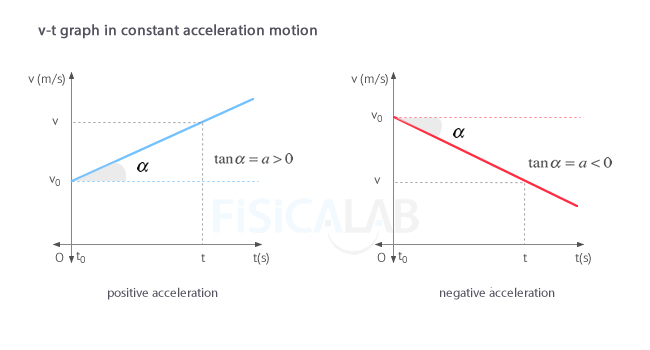
Velocity–time graphs for constant acceleration, showing that the graph is a straight line whose slope corresponds to the constant acceleration . The left panel illustrates (velocity increasing) and the right panel illustrates (velocity decreasing), highlighting how the sign of depends on the chosen positive axis. Source
This equation is linear in , so it shows that a constant acceleration produces a straight-line change in velocity rather than a curved one.
Position After a Time Interval
The second equation gives position as a function of time, starting from an initial position . It combines the effect of initial motion with the additional displacement created by acceleration.
= position at time , in meters
= initial position, in meters
= initial velocity, in meters per second
= constant acceleration, in meters per second squared
= elapsed time, in seconds
The term represents the displacement that would occur if the object kept moving with its initial velocity. The term represents the extra displacement caused by constant acceleration. This is why the equation contains both a linear time term and a squared time term.
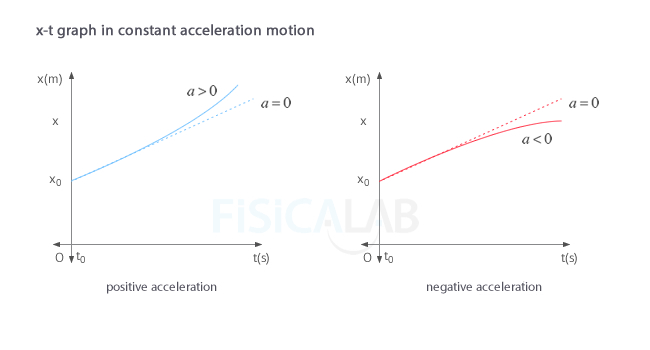
Position–time graphs for constant acceleration, illustrating the parabolic shape implied by . The dashed line indicates the constant-velocity () case for comparison, while the solid curve shows how positive vs. negative changes the curvature. Source
Velocity and Position Without Time
The third equation removes time entirely. It is especially useful when you know how far the object moved and need to connect that change in position to the change in velocity.
= velocity after the displacement, in meters per second
= initial velocity, in meters per second
= constant acceleration, in meters per second squared
= change in position, in meters
In many problems, it is clearer to write as , giving . Because velocity is squared, this equation gives information about speed change, but you must still use physical reasoning to determine the correct sign of when solving for velocity itself.
Choosing the Appropriate Equation
A good strategy is to identify which variables appear in the problem: , , , , , and . Then select the equation that contains the unknown you want and excludes any unnecessary unknown.
Use when position is not needed.
Use when time is known and position or displacement is required.
Use when time is unknown or should be eliminated.
Keep the same sign convention through the entire solution.
Check whether the problem gives position or displacement ; they are related but not interchangeable unless the origin is chosen appropriately.
Common Pitfalls
Several common errors come from using the equations mechanically instead of interpreting the physics first.
Do not use these equations if acceleration changes with time or position over the interval.
Do not replace vector signs with guesses about speeding up or slowing down; use the axis you defined.
Do not confuse initial quantities with final quantities. The subscript always refers to the start of the interval you are analyzing.
If motion is described in separate intervals, reassign the starting values for each new interval before applying a kinematic equation.
After solving, test your answer for physical consistency. Units must match, signs must make sense, and the result should agree with whether the object is expected to move faster, slower, or reverse direction.
FAQ
Because squaring removes the sign of velocity. If you rearrange to get $v$, the mathematics may allow both $+\sqrt{\cdots}$ and $-\sqrt{\cdots}$.
The correct sign must be chosen from the physical situation. You need to know which direction the object is moving at that instant, not just its speed.
That can happen because $x=x_0+v_0t+\dfrac{1}{2}at^2$ is quadratic in $t$. A single position may be reached at two different moments.
For example, one time might correspond to the object approaching that position, and the other to it moving away after turning around. You must use the context of the problem to decide which time is relevant.
They come from the assumption that acceleration is constant.
Start with $a=\dfrac{dv}{dt}$ and integrate to get $v=v_0+at$.
Then use $v=\dfrac{dx}{dt}$ and substitute the velocity expression to obtain $x=x_0+v_0t+\dfrac{1}{2}at^2$.
Eliminating $t$ between those results gives $v^2=v_0^2+2a(x-x_0)$.
So the three equations are not separate facts to memorise without connection; they are all consequences of one assumption.
It is mainly a notation choice. In some texts:
$u$ means initial velocity
$v$ means final velocity
$s$ means displacement
The physics is unchanged. What matters is identifying which quantity is initial, which is final, and whether the symbol refers to position or displacement.
Choose them to keep the algebra simple.
A common choice is:
place the origin at the initial position, so $x_0=0$
take the expected direction of motion as positive
That does not change the physics; it only changes the signs in your equations. A well-chosen axis can reduce mistakes and make the interpretation of negative answers much clearer.
Practice Questions
A particle moves along the -axis with constant acceleration . Its initial velocity is . Find its velocity after .
Uses . (1)
Correct answer: . (1)
A particle moves in one dimension with constant acceleration. At , it is at and has velocity . At , it is at .
(a) Find the acceleration.
(b) Find the velocity at .
(c) State whether the particle changed direction during the interval and justify your answer.
Uses with correct substitution. (1)
Correct acceleration: . (1)
Uses . (1)
Correct final velocity: . (1)
States that the particle changed direction because velocity went from negative to positive, or notes that at . (1)
