

AP Syllabus focus: 'Near Earth's surface, vertical acceleration due to gravity is downward, constant, and approximately equal to 10 m/s^2.'
Vertical motion near Earth’s surface is a central kinematics case because gravity gives objects a predictable acceleration: the direction is always downward and the magnitude is nearly unchanged.
Gravity as the source of vertical acceleration
When an object moves vertically close to Earth, the most important idea is acceleration due to gravity.
Acceleration due to gravity: The acceleration caused by Earth's gravitational pull; near Earth's surface it points downward and has an approximately constant magnitude of .
This means gravity affects the motion whether the object is moving upward, downward, or is momentarily at rest. The acceleration is set by Earth’s pull, not by the object’s current direction of motion.
For most AP Physics C Mechanics problems involving ordinary heights above the ground, the magnitude of this acceleration is treated as constant. That approximation makes vertical motion a special case of motion with constant acceleration.
If upward is chosen as the positive direction, the vertical acceleration is written as follows.
= vertical acceleration, in
= magnitude of gravitational acceleration near Earth, approximately
If downward is chosen as positive instead, the same physical situation would be written with a positive sign. The physics does not change; only the sign convention does. What must stay fixed is the fact that gravity points downward.
What constant downward acceleration means for motion
Object moving upward
An object can be moving upward while accelerating downward. This is one of the most important ideas in vertical motion.
The object’s velocity is upward.
The object’s acceleration is downward.
Because velocity and acceleration point in opposite directions, the object’s speed decreases as it rises.
At the highest point, the vertical velocity becomes for an instant.
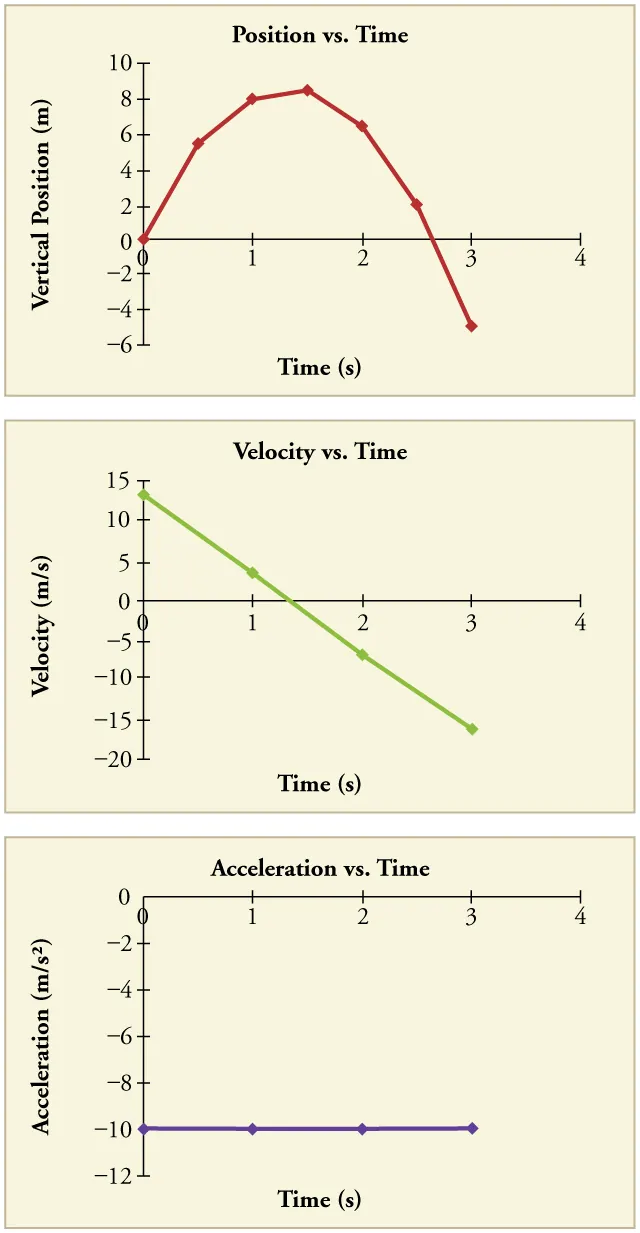
Three coordinated graphs for a vertically thrown object: vs. (curved), vs. (a straight line with slope crossing zero at the peak), and vs. (a constant horizontal line at ). Read together, they show that the turning point occurs where even though the acceleration remains constant and downward throughout the motion. Source
However, gravity has not turned off. The acceleration is still downward at that instant, so the object immediately begins to move downward afterward.
Students often confuse “zero velocity” with “zero acceleration.” In vertical motion near Earth, those are not the same. An object at the top of its path can have zero velocity and still have a nonzero acceleration because Earth continues to pull on it.
Object moving downward
Once the object is moving downward, the acceleration is still downward.
If upward is positive, both velocity and acceleration are negative.
The object’s speed increases as it falls because velocity and acceleration point in the same direction.
An object released from rest starts with zero velocity but not zero acceleration; gravity begins accelerating it downward immediately.
This behavior is why an object thrown upward slows, stops briefly, and then speeds up on the way down, all under the same constant downward acceleration.
Free fall and the ideal model
A common term for this kind of motion is free fall.
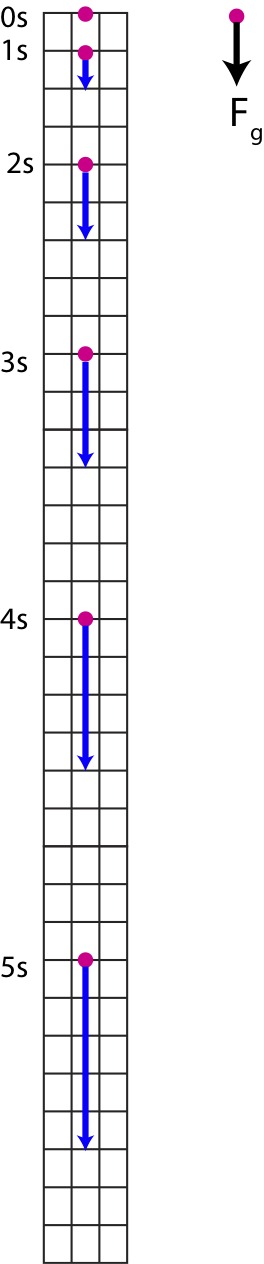
A free-fall diagram showing the object’s positions at equal time intervals along with downward acceleration and velocity vectors. The increasing spacing between successive position marks represents increasing speed, while the acceleration vector remains downward and unchanged, illustrating constant gravitational acceleration in the ideal model. Source
Free fall: Motion in which the only significant force acting on an object is gravity.
In the ideal AP model of free fall near Earth’s surface, air resistance is neglected. Under that assumption, all objects share the same gravitational acceleration regardless of their mass. A dropped metal ball and a dropped wooden ball are both modeled with the same downward acceleration.
This idealization matters because it separates the effect of gravity from complications due to drag. If air resistance is small enough to ignore, vertical motion becomes much easier to predict: the acceleration stays constant and downward throughout the motion.
The phrase near Earth’s surface is also important. Over everyday heights such as a few meters or even several buildings, the change in gravitational acceleration is so small that AP problems treat it as unchanged. That is why a single value of works throughout the motion.
Recognizing key situations in vertical motion
Released from rest
If an object is simply let go, its initial vertical velocity is zero, but its acceleration is still downward from the first moment of motion. It does not need to “gain” gravity after release.
Thrown upward
If an object is launched upward, gravity immediately opposes the motion. The object rises more and more slowly until its upward velocity reaches zero at the top. The acceleration remains downward during the entire ascent.
Thrown downward
If an object is launched downward, gravity acts in the same direction as the motion. The downward speed increases continuously as the object falls.
Common misunderstandings to avoid
Several ideas are easy to mix up when studying vertical motion.
Constant acceleration does not mean constant velocity.
Downward acceleration does not require downward motion; an object may be moving upward while accelerating downward.
At the highest point, velocity is zero only for an instant, but acceleration is still present.
The value of is treated as approximately in many AP settings, so small numerical differences from a more precise value do not change the core physics.
The direction of gravity is determined by Earth, not by the object’s path or by an observer’s preference for positive direction.
A strong understanding of this subtopic depends on separating direction of motion from direction of acceleration. Once that distinction is clear, vertical motion near Earth’s surface becomes a consistent and highly predictable application of constant downward gravitational acceleration.
FAQ
Using $10\ m\ s^{-2}$ makes arithmetic quicker and is usually accurate enough for introductory mechanics.
Using $9.8\ m\ s^{-2}$ gives a more precise numerical result. On AP-style problems, you should use the value given in the question. If no value is stated, either is often acceptable if used consistently, though $9.8\ m\ s^{-2}$ is the more exact standard.
Not exactly. It varies slightly with both altitude and latitude.
At greater altitude, $g$ is a bit smaller because you are farther from Earth’s centre.
At the equator, $g$ is slightly smaller than at the poles because of Earth’s rotation and shape.
For normal classroom heights, these differences are tiny, so treating $g$ as constant is an excellent approximation.
Astronauts in orbit are not beyond gravity. Earth’s gravity is still providing a large acceleration.
They appear weightless because they and their spacecraft are in continuous free fall together. Since the floor does not need to support them in the usual way, the normal force is very small or zero, which creates the sensation of weightlessness.
Its effects are much smaller than the effect of gravity for short times and ordinary distances.
A more complete treatment would include non-inertial effects such as slight sideways deflections, but these are far too small to matter in most AP-level vertical motion questions. Ignoring rotation keeps the model simple without changing the main physical result.
It becomes less reliable when the height change is large enough that the distance from Earth’s centre changes significantly.
It can also fail when air resistance becomes important, such as for:
very light objects
very fast motion
long falls through the atmosphere
In those cases, either $g$ must be allowed to vary, drag forces must be added, or both.
Practice Questions
A ball is thrown straight upward. At the highest point of its motion, state its vertical velocity and its vertical acceleration. Use upward as the positive direction. [2 marks]
1 mark for stating
1 mark for stating or “downward, approximately ”
A stone is projected straight upward from ground level. Air resistance is negligible. Take upward to be positive.
(a) State the sign of the stone’s vertical acceleration during its ascent, at its highest point, and during its descent. [3 marks]
(b) Explain why the stone can have zero velocity at the highest point but still have nonzero acceleration. [1 mark]
(c) State the approximate magnitude of the stone’s acceleration near Earth’s surface. [1 mark]
(a) 1 mark for “negative during ascent”
(a) 1 mark for “negative at the highest point”
(a) 1 mark for “negative during descent”
(b) 1 mark for explaining that gravity still acts downward even when the instantaneous velocity is zero
(c) 1 mark for or equivalent statement of the magnitude of
