

AP Syllabus focus: 'System properties depend on interactions among objects within the system. A macroscopic system may be modeled as a single object when the internal details are not important.'
Mechanics begins by deciding what you are actually analyzing. A careful system choice determines which interactions matter, which details can be ignored, and whether the mathematics should describe many objects or one simplified object.
What physicists mean by a system
In mechanics, the first modeling step is to choose the system you will analyze.
System: The object or collection of objects selected for analysis in a physics problem.
Everything not included in the system is part of the environment or surroundings.
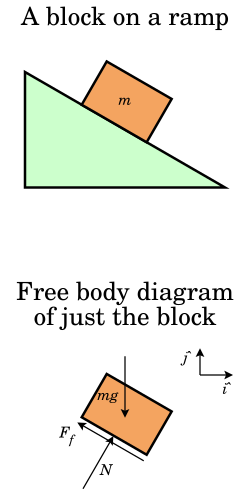
A block-on-an-incline example showing the physical situation (top) and the corresponding free-body diagram of the isolated block (bottom). The diagram makes the system boundary idea concrete: only forces acting on the chosen system are drawn, while the surrounding surfaces are replaced by contact forces. Source
The boundary between system and environment is usually an imagined boundary, not a physical wall. Its purpose is to help separate what is “inside” the analysis from what is “outside” it.
A system can be:
a single object, such as a ball
several objects treated together, such as two carts
an extended body, such as a car, beam, or planet
This choice is made by the physicist. Nature does not label one object as “the system” for you. That is why the same physical situation can be analyzed with different systems, provided the choice is clear and useful.
The syllabus emphasizes that system properties depend on interactions among objects within the system. If a system contains more than one object, the way those objects affect one another becomes part of the system’s behavior. A collection of objects is not just a list of masses; it is a set of objects connected by interactions.
Why the system choice matters
Choosing the system is not a formality. It determines what questions can be answered efficiently and what information must be included.
A well-chosen system helps you decide:
which objects are being tracked
which interactions are internal to the system
which interactions come from the environment
whether the problem should be treated in detail or simplified
For AP Physics C, this matters because mechanics is built on cause-and-effect descriptions. Before writing equations later in a solution, you must know what physical entity those equations describe.
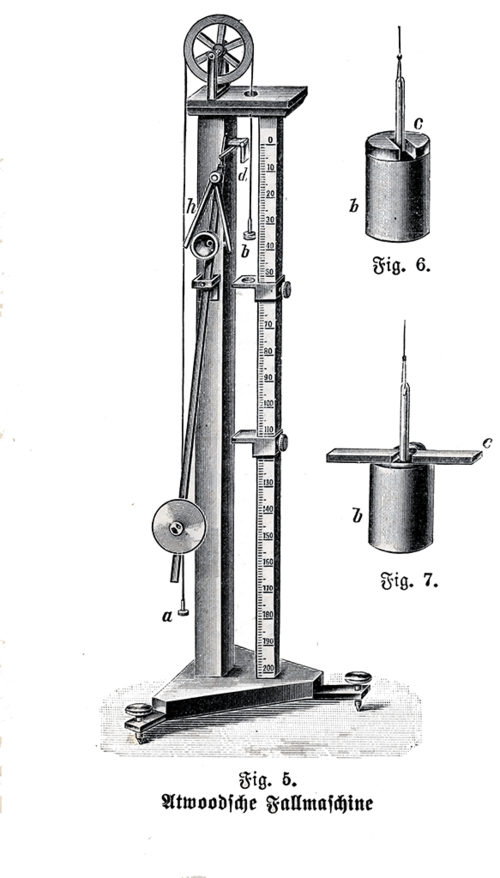
Free-body diagrams for an Atwood machine, with each hanging mass treated as its own system. The figure highlights that the same physical setup can be modeled with multiple systems, and the force labels (tension and weight) depend on which object is isolated for analysis. Source
“Mass of the system,” “motion of the system,” and “interactions on the system” all depend on the system being defined first.
A common mistake is to start reasoning about motion without stating what the system is. That often leads to mixed thinking, where some objects are treated as inside the analysis and others as outside, with no consistent rule. Clear system definition prevents that confusion.
When choosing a system, ask:
What object or collection of objects is the problem really about?
Do I care about the overall motion, or about the behavior of parts within it?
Would including more objects make the description simpler?
Internal interactions and system behavior
If a system contains multiple objects, their internal interactions can shape how the system behaves.
These interactions may hold the system together, allow parts to influence one another, or change how different parts move relative to each other.
This is important because a system is often more than a mere collection of masses. Its structure comes from interactions among its parts. For example, a train is made of coupled cars, and a chain is made of linked segments. In each case, the system’s behavior depends on how the included parts interact.
However, not every problem requires that level of detail. Sometimes the internal interactions are present but not relevant to the quantity you are asked to find. In that case, the details may be safely ignored without losing the important physics.
That idea leads directly to one of the most useful simplifications in mechanics: treating a complex macroscopic system as a single object.
Modeling a macroscopic system as a single object
A macroscopic system is large enough to be described with ordinary classical mechanics rather than by tracking individual atoms or molecules. Real objects contain enormous numbers of particles, but mechanics usually does not require atomic detail.
A macroscopic system may be modeled as a single object when its internal details are not important. This means the analysis focuses on the system’s overall motion rather than on differences among its parts.
This simplification is appropriate when:
the size of the system is small compared with the scale of the motion being studied
the question asks only about overall translational motion
internal stretching, bending, or rearrangement does not affect the result
different parts of the system do not need to be analyzed separately
For example, a baseball in flight is made of many molecules, but its internal structure is usually irrelevant when studying its path. A car traveling along a straight road can often be treated as one object if the question is only about its overall motion. In both cases, the detailed behavior of the parts does not need to be tracked.
This model is not “more true” than a more detailed one. It is simply more useful when the extra detail does not change the answer you need. Good modeling in mechanics is about choosing the simplest representation that still captures the relevant physics.
Good practice when defining a system
At the start of a mechanics problem, it is good practice to:
state the system explicitly in words
identify what is outside the system
decide whether the internal details matter
choose a level of modeling that matches the goal of the problem
If the system’s parts behave nearly as one whole, a single-object model is often appropriate. If the parts must be distinguished to answer the question, then the system should be analyzed in more detail.
FAQ
Yes, but only if you say so clearly. Physicists sometimes change the system when the question changes focus or when a different model becomes more useful.
The key is consistency. Once you redefine the system, every statement after that point must match the new choice.
Yes. In more advanced modelling, you can choose part of an object as the system, such as one section of a rod or one segment of a rope.
If you do this, the interaction across the cut becomes something the surroundings do to your chosen subsystem. That requires careful bookkeeping.
No. A single-object model only says that internal details do not matter for the question being asked.
A body might deform slightly and still be treated as a single object if that deformation has no meaningful effect on the quantity being analysed. Rigidity is a stronger assumption.
Ask whether including that detail would noticeably change the quantity you are trying to find. If it would not, the simpler model is usually acceptable.
Useful clues include the scale of the motion, the precision required, and whether different parts of the system are moving very differently from one another.
A larger system can make the analysis cleaner by placing more interacting objects inside the boundary.
That can reduce the number of outside influences you must track directly. The trade-off is that the system may become conceptually larger, even though the mathematics becomes simpler.
Practice Questions
A student is analyzing a bicycle and rider moving together along a straight road. The problem asks only for the motion of the bicycle-rider combination as a whole. Explain why it is reasonable to define the system as the bicycle and rider together and model it as a single object.
1 mark: States that the system is the bicycle and rider together.
1 mark: Explains that only the overall motion is relevant, so internal details of the bicycle-rider combination do not need to be analyzed separately.
Two carts are connected and move together across a horizontal track. A student wants to analyze the motion of the pair, not the interaction between the carts.
(a) State a useful choice of system for this situation. (1 mark)
(b) Identify what is meant by the environment for this system. (1 mark)
(c) Explain why the two-cart system may be modeled as a single object for this analysis. (2 marks)
(d) Describe one change to the problem that would make the single-object model inappropriate. (1 mark)
(a) 1 mark: States that the system is both carts together.
(b) 1 mark: Identifies the environment as everything outside the chosen system, such as the track and surrounding objects.
(c) 1 mark: States that the question concerns only the overall motion of the pair.
(c) 1 mark: Explains that the internal details or interaction between the carts are not needed if the pair moves together as one combined system.
(d) 1 mark: Gives a valid condition such as needing to know how the carts interact with each other, or a situation where the carts do not behave as a single combined object.
