

AP Syllabus focus: 'An object or system cannot exert a net force on itself. Every force included in analysis must come from another object or from the environment.'
In mechanics, force analysis begins by choosing a system. Once that choice is made, only interactions crossing the system boundary can change the motion of that system.
Forces require an interaction
A force is not something an object simply creates and then uses on itself. A force describes an interaction between the chosen system and something outside it. This is why a correct analysis always begins with one question: what external agent is exerting this force? If no external agent can be identified, that force should not appear in the analysis.
System: The object or collection of objects chosen for analysis.
When the chosen system changes, the list of forces in the analysis can change, even though the physical situation stays the same.
External force: A force exerted on the chosen system by an object or agent outside the system boundary.
This definition explains the key idea of the syllabus statement. If a force does not come from outside the system, then it is not an external force on that system. As a result, an object or system cannot be the source of its own net force.
The system boundary decides what counts
When you analyze motion, imagine drawing a boundary around the system.
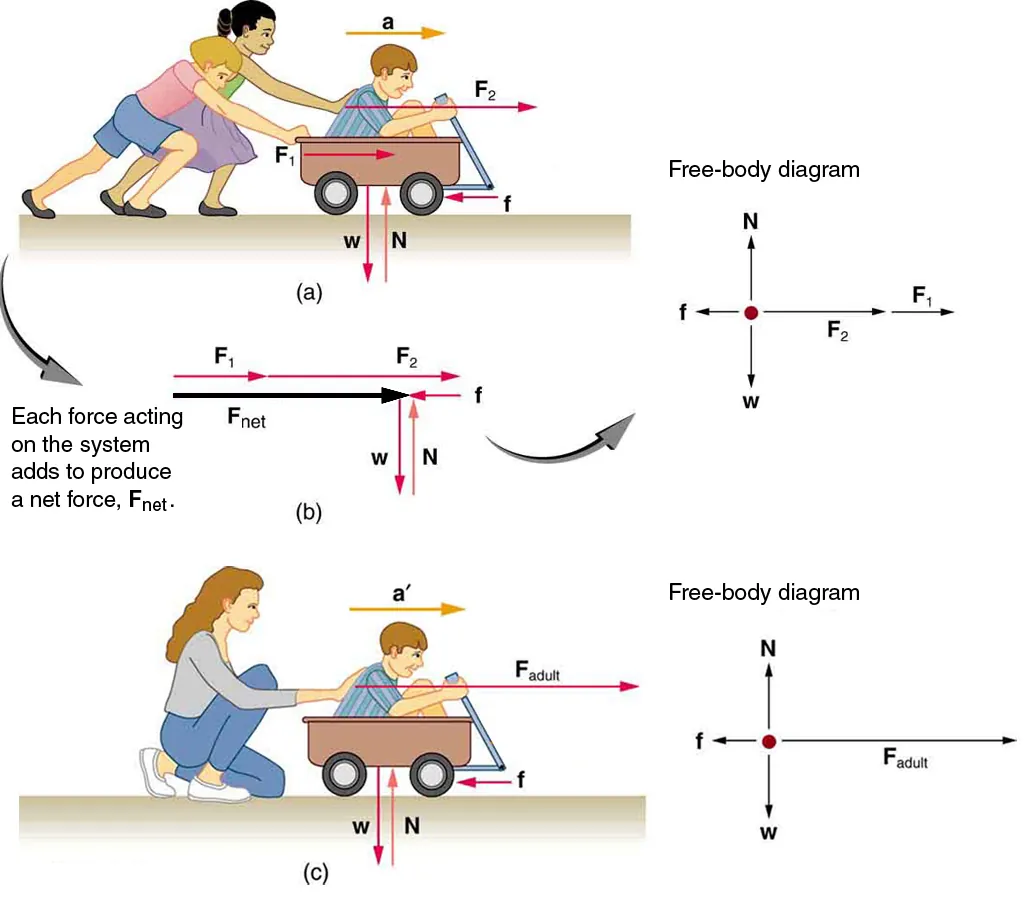
A real-world scene (wagon plus rider) is paired with a free-body diagram that includes only forces exerted by the environment on the chosen system: applied pushes, friction, weight, and the normal force. It highlights how selecting the system boundary determines what counts as an external force and therefore what contributes to for translational motion. Source
That boundary decides which interactions count as forces on the system and which do not.
If the system is a single object, every force on it must come from another object or from the environment.
If the system is a group of objects, then interactions among those objects occur inside the boundary.
Interactions inside the boundary may matter for how the parts move relative to one another, but they are not external forces on the whole system.
This is the real meaning of “an object cannot push itself.” A skater may push on a wall, but the skater accelerates because the wall pushes on the skater. A person may push down on the floor, but the person rises because the floor pushes up on the person. The force that changes the motion always comes from outside the chosen object.
Why a self-force is not valid
A statement such as “the object exerts a forward force on itself” is not acceptable in mechanics. If the source of the force and the system are the same thing, then no interaction crosses the system boundary. Without an external interaction, there is no force to include as the cause of the system’s translational motion.
This idea prevents a common mistake: inventing forces that sound convenient but do not have a physical source. In AP Physics C, labels such as force of motion, force of acceleration, or self-pushing force are invalid. A force must always be tied to a real interaction with another object or with the environment.
A valid force label always identifies two things:
the object or system experiencing the force
the external object or agent exerting it
So “force of Earth on the ball” is valid. “Force of the rope on the block” is valid. “Force of the block on itself” is not.
How to test whether a force belongs
A useful habit is to check every force arrow by asking, what is touching or influencing the system from outside? If you cannot point to another object or part of the environment, the force does not belong.
Use this checklist:
Choose the system clearly.
List the objects outside the system that interact with it.
Name the source of each force explicitly.
Reject any force said to come from the system itself.
If two interacting objects are both inside the system, do not count that interaction as an external force on the whole system.
This matters especially when a system contains moving parts. Muscles, motors, springs, and mechanisms can create large internal forces. Those forces may stretch, compress, or rearrange parts of the system. But internal activity does not remove the need for an outside agent if you are explaining the motion of the system as a whole.
Interpreting motion without inventing forces
Many confusing situations become clearer once the system is chosen carefully. A device may contain a motor or fan, and one part may strongly push on another part. That can certainly change the motion of individual parts. However, if the entire device is treated as one system, those pushes are inside the boundary. They do not become new external forces just because they are large.
The same logic applies whenever a system seems to “act on itself.” Internal pushes and pulls can change shape, create tension, or cause parts to move relative to each other. What they cannot do is serve as the explanation for the whole chosen system gaining a net force from nowhere. For translational analysis, the source must be outside the system.
Common reasoning errors to avoid
Drawing a force arrow without naming its source
Treating an internal interaction as an external force on the whole system
Confusing internal activity with a net force from the environment
Assuming that if parts push hard on each other, the whole system must have a net force
Forgetting that every force in analysis must come from another object or from the environment
A correct force analysis never allows a system to be the source of its own net force.
FAQ
No. The key is the choice of system.
If the system is the rocket alone, then the exhaust gases leaving the rocket are no longer part of that system. Their interaction with the rocket counts as external to the rocket-only system.
If the system is taken as rocket + fuel + exhaust together in empty space, then internal forces still cannot give that entire larger system a net force. The total motion of the whole isolated set does not come from self-pushing.
Yes. Internal forces can change how different parts move relative to one another.
That means a system can spin, twist, or reorient itself internally without acquiring a net external force. A familiar idea is that parts can move in opposite ways so that the overall translational effect cancels while the arrangement changes.
So “cannot push itself” applies to net translational force, not to every possible internal change in motion.
The physical interactions do not change, but the classification does.
If you choose one part only, a force from another part may be external. If you choose both parts together, that same interaction becomes internal because it no longer crosses the system boundary.
This is why system choice is so important in mechanics. Different system choices can be equally correct, but the force list must match the chosen boundary.
Yes. Contact is not required.
For gravity, the source is another mass. For electric or magnetic interactions, the source is another charged object, magnet, or an externally produced field associated with such objects.
So the rule is not “the force must come from something touching the system.” The rule is that the force must come from something outside the system.
It is usually shorthand, not a separate kind of force.
In simple problems, the source may be obvious from the diagram, so “applied force” is used to save space. However, the phrase can hide mistakes if students stop asking who or what is actually applying it.
A safer habit is to replace “applied force” with a full label such as “force of the hand on the box.” That keeps the source explicit and avoids accidental self-force reasoning.
Practice Questions
A student says, “When I jump, my body pushes itself upward.” Explain why this statement is incorrect and identify the external object responsible for the upward force on the student.
1 mark: States that an object cannot exert a net force on itself, or that the force must come from another object or the environment.
1 mark: Identifies the floor or ground as the external object exerting the upward force on the student.
An astronaut floats inside a spacecraft far from other objects. The astronaut pushes on an interior wall.
(a) For the system consisting of the astronaut alone, identify the external force and state the astronaut’s motion immediately after the push begins.
(b) For the system consisting of the spacecraft alone, identify the external force and state the spacecraft’s motion immediately after the push begins.
(c) For the combined system of astronaut + spacecraft, explain whether the push can produce a net force on the combined system.
1 mark: Identifies the force of the wall or spacecraft on the astronaut as the external force for the astronaut-alone system.
1 mark: States that the astronaut accelerates away from the wall.
1 mark: Identifies the force of the astronaut on the spacecraft as the external force for the spacecraft-alone system.
1 mark: States that the spacecraft accelerates in the opposite direction to the astronaut.
1 mark: Explains that for the combined astronaut + spacecraft system, the push is internal, so it cannot produce a net external force on the combined system or change the combined system’s overall translational motion.
