

AP Syllabus focus: 'A force is a vector that describes an interaction between two objects or systems. Any force on an object must come from something outside that object or system.'
Understanding force begins with understanding interaction: a force is never isolated, never self-generated, and never just a number. Clear force analysis starts by identifying what exerts the force and what receives it.
Forces as interactions
In mechanics, a force is not something an object “has” by itself. A force exists only because one object or system interacts with another. If you cannot identify the other object or system involved, your description is incomplete.
Force: A vector interaction exerted by one object or system on another object or system.
This idea comes before any later use of diagrams or equations. First identify the chosen object or system. Then identify every external source that can interact with it.
Every force has an agent
A force must be exerted by something. The object or system producing the force is the agent, and the object or system experiencing it is the recipient of the force. Good physics language includes both. “Force of the table on the book” is precise; “force on the book” is only partial.
System: The object or collection of objects selected for analysis.
A system can be one object, several objects, or a larger collection treated as a single unit. This choice matters because the same physical interaction may count as external in one analysis and not in another.
Because of this, a correct force description should answer three questions:
Who exerts the force?
What object or system experiences it?
In what direction does it act?
That level of precision matters whenever more than one object can interact with the chosen system. A block on a floor may interact with Earth, the floor, a rope, or the air. Each force must be traced to one specific source.
Force is a vector
A force is a vector, so it has both magnitude and direction.
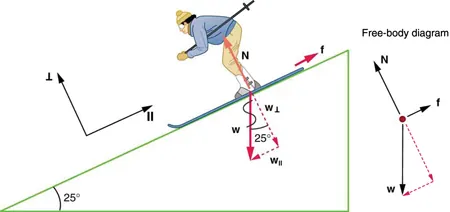
Free-body diagram of a skier on a slope showing weight , normal force , and friction , with resolved into components parallel and perpendicular to the incline. The figure reinforces that each force is a separate interaction with its own direction, and that choosing axes aligned with the surface makes component reasoning transparent. Source
Two forces can have the same size but still be different if they point in different directions. Two forces can also point in the same direction and still be different forces if they come from different external agents.
The vector nature of force means that several interactions can act on the same object at the same time. Even if those forces are later combined in analysis, they do not stop being separate interactions. Each one still has its own source.
Direction is part of the interaction itself. A push, pull, or other influence cannot be described fully without saying where it points. This is why force arrows and verbal descriptions must include orientation, not just size.
The role of the system boundary
The phrase “outside that object or system” is essential. Start by imagining a boundary around the chosen system. Everything beyond that boundary is the environment. A force on the system must come from something in that environment.
External force: A force exerted on the chosen object or system by something outside the system boundary.
Once the system is chosen, this rule is strict: if an interaction occurs entirely among parts inside the system boundary, it is not a force from the environment on the whole system. The interaction is real, but it is not an external force on that system.
This is why changing the system changes the force list. If you analyze one object alone, a rope may exert a force on it. If you analyze the object and rope together as one system, that same rope-object interaction is no longer external to the system. The physics has not changed, but the language of the analysis must match the boundary you chose.
Naming forces precisely
Precise naming prevents confusion. Labels such as weight, normal force, or tension can be useful shorthand, but they should not hide the source object or system. A better habit is to say:
force of Earth on the ball
force of the table on the book
force of the rope on the cart
This wording makes the interaction explicit. It also helps when similar forces come from different places, such as two ropes pulling on the same object or several surfaces touching one body.
A reliable method for identifying forces is:
Choose the object or system.
Mark the boundary of that system.
List all external objects or systems that can interact with it.
Describe each force as “force of A on B.”
Check that each force has a physically reasonable direction.
If you cannot name an external agent, you probably have not identified a real force.
Contact and noncontact interactions
Some interactions require physical contact, and some do not. That difference does not change the basic meaning of force. Whether objects touch or interact across space, the force still comes from another object or system, not from the object itself.
This idea also separates force from motion. An object can move without “carrying” a force in the direction of travel. Motion describes what the object is doing. Force describes an external interaction acting on it.
Common misconceptions
Students often make the same errors when learning force:
Treating force as a built-in property of an object. Force is not stored inside an object like mass.
Using motion as proof of a force. A moving object is not automatically experiencing a force in the direction of motion.
Forgetting to name the source. “There is a force upward” is incomplete unless you say what exerts it.
Assuming a system can push or pull itself overall. Any force on the chosen system must come from outside that system.
Replacing a real interaction with a vague cause such as “the motion,” “the energy,” or “the acceleration.” These are not external agents.
In each case, the missing step is failure to identify the chosen system and the external source.
FAQ
Yes. Real forces from surfaces, fluids, or muscles are often distributed across an area or volume.
In many mechanics models, that distribution is replaced by a single resultant force because it gives the same overall translational effect on the object. If deformation or turning effects matter, the full distribution may need to be considered instead of a single simplified force.
Yes. The source does not have to be a single compact object.
You might model the source as Earth, the atmosphere, a wall, a fluid, or even a larger mechanical assembly. What matters is that the source lies outside the chosen system boundary and interacts with the object or system you are analysing.
A field does not replace the source object. It is a way of describing how the source influences the space around it.
When another object enters that region, the field model tells you what force that source would exert there. The force still comes from another object or system; the field is the mathematical description used to represent the interaction.
Both approaches can describe the same interaction.
A surface may exert one overall contact force on an object. For convenience, that single vector is often resolved into components relative to the surface. This does not create new interactions; it is just a more useful way to describe the same external force for a particular analysis.
Yes. A force is not fixed just because the same objects are involved.
Its magnitude or direction can change if:
their separation changes,
their relative orientation changes,
the contact conditions change,
one or both objects deform.
So the interacting pair can remain the same while the force vector changes continuously.
Practice Questions
A student says, “The puck has a forward force because it is sliding forward across the ice.” State whether this statement is correct and justify your answer using the idea of force as an interaction.
1 mark: States that the statement is incorrect.
1 mark: Explains that a force must come from an external object or system, so motion alone does not establish a force.
A crate is pulled across a floor by a rope.
For parts (a) and (b), define the system as the crate only.
For part (c), redefine the system as crate + rope.
(a) Explain why each force on the crate must be associated with another object or system. (1 mark)
(b) Identify three different external objects or systems that can exert forces on the crate, and state the force each exerts. (3 marks)
(c) When the system is changed to crate + rope, one force from part (b) is no longer external to the system. Identify that force and explain why. (1 mark)
(a) 1 mark: States that a force is an interaction and must come from outside the chosen system.
(b) 1 mark each for any three valid source-force pairs, such as:
Earth exerts a gravitational force on the crate.
The floor exerts a contact force on the crate.
The rope exerts a pull on the crate.
(c) 1 mark: Identifies the force of the rope on the crate and explains that it is no longer external because the rope is now inside the system boundary.
