

AP Syllabus focus: 'Contact forces arise when objects touch. These macroscopic forces are caused by underlying interatomic electric interactions between the materials in contact.'
Contact forces seem obvious in daily life, but AP Physics C treats them carefully: the familiar push, pull, or support force is a large-scale effect produced by microscopic electric interactions at touching surfaces.
What Counts as a Contact Force
A contact force acts only when two objects are physically touching. At the macroscopic level, this includes familiar forces such as a table supporting a book, a hand pushing a box, or a rope pulling on a block. In each case, the force appears because matter in one object interacts with matter in the other object at the region of contact.
In mechanics, we usually do not analyze billions of separate atomic interactions. Instead, we replace them with a single net force that represents the overall effect on the object. This simplification is essential for modeling real systems.
Contact force: A force exerted on an object by another object that is in physical contact with it.
A contact force is therefore not a new fundamental interaction by itself. It is a useful macroscopic description of what many microscopic interactions are doing together.
Microscopic Origin of Contact Forces
At the atomic scale, matter is made of charged particles. Atoms contain positively charged nuclei and negatively charged electrons, and neighboring atoms interact through electric forces. When two objects touch, the atoms near their surfaces do not behave like tiny hard spheres simply crashing into each other. Instead, the charged particles in those atoms exert electric attractions and repulsions on one another.
Interatomic electric interactions: Electric attractions and repulsions between the charged particles in neighboring atoms or molecules.
As two surfaces are pressed together, the outer electron regions of their atoms are forced closer than their preferred spacing. This produces strong electric repulsion. That repulsion is what prevents ordinary objects from passing through each other. At larger separations within materials, electric attraction also helps hold atoms in stable arrangements, so both attraction and repulsion matter in understanding how materials respond to contact.
For AP Physics C, the key idea is that contact forces are macroscopic consequences of interatomic electric interactions. The force you draw on a free-body diagram is the large-scale result of many microscopic electric interactions acting across the contact region.
How Microscopic Interactions Produce Different Contact Forces
Normal force
The normal force is the contact force exerted perpendicular to a surface.
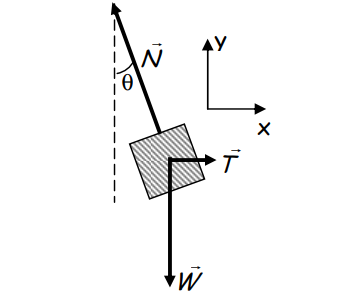
Free-body diagram of a block on an incline, showing perpendicular to the surface and vertically downward. The included coordinate axes emphasize the standard AP Physics C strategy of resolving forces into components aligned with the surface and normal to it. Source
When an object presses on a table, floor, wall, or incline, the material deforms slightly. Even rigid-looking materials compress by tiny amounts. That deformation changes the spacing of atoms in the material, and the resulting interatomic electric interactions produce a restoring force. On the object, that restoring force is the normal force.
The normal force is not something a surface “chooses” to create independently. It arises because the surface is compressed and resists further compression through electric interactions among atoms.
Friction, tension, and other contact forces
Other contact forces come from the same microscopic origin, even though they act in different directions.
Friction comes from interactions between the irregular microscopic features of two surfaces and from small-scale electric sticking between them.
Tension in a rope or cable is transmitted through neighboring parts of the material pulling on each other through interatomic electric forces.
Spring forces also come from atoms being displaced from their equilibrium spacing, producing a restoring interaction.
These forces look different in mechanics problems, but they all fit the same underlying picture: when matter touches or transmits contact through a material, electric interactions between atoms produce the observable force.
Why Mechanics Uses a Macroscopic Model
A real contact force is usually distributed over an area, not concentrated at a single mathematical point. For example, a box on a floor is supported by many atoms across the base of the box. Still, if the object’s size and shape are not the main focus, mechanics represents the combined effect as one net force.
This model works because the motion of the object depends on the net external force, not on the details of every atomic interaction. The microscopic origin explains why the force exists, while the macroscopic model lets us analyze motion efficiently.
The exact size of a contact force depends on how strongly the materials deform and how their atoms respond to that deformation. That is why different materials can feel hard, soft, sticky, or slippery even though all contact forces ultimately come from electric interactions.
Common Misconceptions
Several mistakes are common when students first learn this topic:
Contact forces are not separate from electric forces at the microscopic level. They are the macroscopic result of those electric forces.
Objects do not need visible deformation for a contact force to exist. Tiny atomic-scale deformation is enough.
Touching does not mean nuclei are directly colliding. The important interactions are primarily among charged particles in neighboring atoms.
A smooth surface can still exert a large contact force. Surface roughness is not required for the basic normal force.
Not every force is a contact force. Gravity, for example, acts without physical touching.
Understanding this origin helps prevent contact forces from seeming mysterious. In AP Physics C, they are modeled simply, but their source is always the same: electric interactions between atoms in materials that are in contact.
FAQ
A fluid can still exert a contact force because its molecules touch and interact with the surface of an object.
In a fluid at rest, the contact force is usually perpendicular to the surface and is described through pressure. In a moving fluid, additional tangential effects can appear as well. The lack of fixed shape does not remove molecular contact.
A long object is not perfectly rigid. When one end is pushed, atoms near that end are disturbed first.
That disturbance travels through the material at a finite speed as a mechanical wave. So the contact force is transmitted through successive interatomic interactions, not delivered everywhere at once. Perfect rigidity is only an idealisation.
Yes, if the surfaces are close enough for short-range electric attractions between their atoms or molecules to matter, the resulting force is still a contact force.
This is important for materials such as tape, rubber, or certain biological surfaces. The force may resist separation rather than compression, but it still comes from interatomic electric interactions at the region of contact.
Atomic separations change by extremely small distances, but the electric forces associated with those changes can vary very rapidly.
As a result, even a minute compression of a solid can produce a large restoring force. That is why steel, concrete, and other stiff materials can support heavy loads while showing almost no visible change in shape.
No. A vacuum removes air, but it does not remove the atoms in the objects themselves.
If two objects touch in a vacuum chamber, their surface atoms still interact electrically, so normal forces and other contact forces can still exist. Air pressure may affect some situations, but it is not the fundamental cause of ordinary contact forces.
Practice Questions
A book rests on a table. Explain why the upward force from the table on the book is a contact force, and identify the microscopic interaction responsible for it. [2 marks]
1 mark: States that the table and book are in physical contact.
1 mark: Identifies the force as arising from interatomic electric interactions, such as electric repulsion between atoms or electron clouds in the touching materials.
A student presses a foam block against a wall and says, “The wall pushes back only because the block cannot pass through it. That push is not related to electric forces.” Explain why this statement is incomplete. In your answer, describe: (a) why the wall’s force is classified as a contact force, (b) the microscopic origin of the force, and (c) why mechanics can model the many microscopic interactions as one macroscopic force on the block. [5 marks]
1 mark: States that the wall and block are touching, so the force is a contact force.
2 marks: Explains that the force comes from interatomic electric interactions between atoms in the wall and block, especially when the materials are compressed or deformed.
1 mark: States that the force is not a separate fundamental force; it is the combined effect of many microscopic electric interactions.
1 mark: Explains that mechanics replaces the distributed microscopic interactions with a single net macroscopic force acting on the block.
