

AP Syllabus focus: 'Selecting a coordinate system with one axis parallel to the acceleration simplifies the algebra. On an incline, it is often best to align an axis with the surface.'
Choosing axes well does not change the physics, but it can greatly reduce algebraic complexity. A smart coordinate system makes force components cleaner, sign choices clearer, and Newton’s second law easier to apply.
Why axis choice matters
A free-body diagram shows the forces acting on an object or system, but solving the problem requires turning those force vectors into components. The axes you choose determine which forces must be split into parts and which can be used directly.
In AP Physics C Mechanics, the best axes are usually the ones that match the motion. If one axis is parallel to the acceleration, then only that direction has a nonzero acceleration component. This often lets one component equation carry the main dynamics, while the perpendicular direction becomes much simpler.
Coordinate system: A chosen set of perpendicular axes used to represent vectors by components and to assign positive and negative directions.
A coordinate system is a mathematical choice, not a physical part of the situation. You may rotate the axes in any convenient way, as long as you remain consistent for the entire analysis.
General strategy for choosing axes
Align an axis with the acceleration
When possible, choose one axis so that it points in the same direction as the object’s acceleration. This matters because Newton’s second law is applied component by component. If the acceleration lies entirely along one axis, then the perpendicular acceleration component is often zero.
That means the equations often take a simpler form.
= net force along the chosen -axis, N
= mass of the object or system, kg
= acceleration component along the chosen -axis,
= net force along the chosen -axis, N
= acceleration component along the chosen -axis,
If the acceleration is entirely along the chosen -axis, then . In that case, the -equation often becomes a condition equation rather than a motion equation.
Match axes to physical constraints
A second guideline is to align axes with important surfaces, paths, or allowed directions of motion. If an object is constrained to move along a track or surface, one axis along that direction and one axis perpendicular to it will usually minimize the number of trigonometric components.
Inclined-plane situations
Why axes along the incline help
On an incline, the most efficient choice is usually:
one axis parallel to the surface
one axis perpendicular to the surface
This works well because the acceleration is often along the incline, not horizontally or vertically.
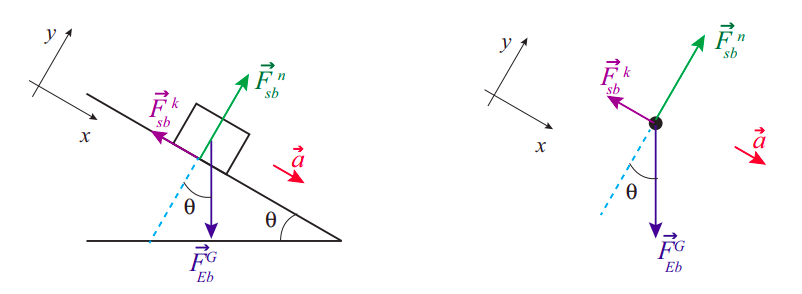
A side-by-side schematic of a block on an incline and its free-body diagram with axes chosen along the plane () and perpendicular to it (). Because the normal force and friction lie along these axes, the only force that must be decomposed is gravity into components proportional to and , making the Newton’s second-law component equations straightforward. Source
It also matches two common forces:
the normal force acts perpendicular to the surface
friction, if present, acts parallel to the surface
With this axis choice, those forces usually do not need to be broken into components. Instead, the force that is typically resolved is the weight.
For an incline at angle , the weight is separated into:
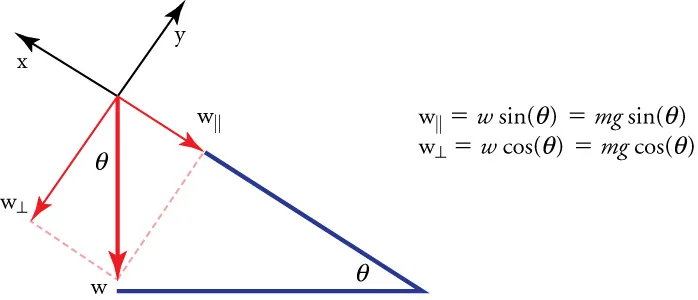
A block on an incline with the weight vector resolved into components parallel and perpendicular to the plane. The diagram makes the geometry behind (downslope) and (into the surface) visually explicit, reinforcing why incline-aligned axes reduce the amount of trigonometry needed. Source
a component parallel to the surface,
a component perpendicular to the surface,
The sign of each component depends on the positive directions you chose, but the geometry does not change. This is why incline-based axes are so effective: only one force is decomposed, and the component equations directly match the motion and the contact force.
Why horizontal and vertical axes are often less convenient
You could choose standard horizontal and vertical axes for an incline problem, and the physics would still be correct. However, that often makes the algebra harder:
the normal force must be resolved into components
friction may also require components
the acceleration is not usually along either axis
As a result, more forces require trigonometry, and the equations become harder to organize. Since AP Physics C often rewards efficient setup, an awkward axis choice can lead to unnecessary errors even if the ideas are correct.
Sign conventions and consistency
After choosing axes, assign a positive direction for each one and keep that choice throughout the problem. Signs come from whether a force component points with or against the positive axis, not from guesswork.
Useful habits include:
drawing the axes directly on or beside the free-body diagram
labeling positive directions clearly
writing each component with its sign immediately
checking whether a zero-acceleration component should appear
A negative value for acceleration or a force component does not automatically mean a mistake. It may simply show that the actual direction is opposite the positive axis you selected.
Common mistakes to avoid
Choosing axes before thinking about motion
Do not choose axes automatically. First identify the likely acceleration direction or the direction the object is constrained to move. Then choose axes that reflect that structure.
Splitting every force unnecessarily
Only resolve forces that are not already aligned with the axes. If a force lies entirely along one chosen axis, use it directly instead of creating unneeded components.
Mixing axis choices mid-solution
Once axes are defined, all force components, accelerations, and equations must use that same coordinate system. Changing conventions in the middle of a solution is a common source of sign errors.
Forgetting that axes are arbitrary
There is no single correct coordinate system for every problem. The best system is the one that makes the component equations shortest and clearest. In many AP Physics C situations, that means choosing axes based on acceleration or surface orientation, not on the page.
A practical decision process
When reading a free-body diagram, a strong axis choice usually follows this order:
identify the direction of acceleration, if known
check whether motion is constrained by a surface, rope, or track
place one axis along that direction whenever possible
place the second axis perpendicular to it
resolve only the forces that are not parallel to the chosen axes
This process does not change the laws of motion. It makes the mathematics match the geometry more directly.
FAQ
In principle, yes. Any coordinate system can describe the motion.
For AP Physics C, though, you should nearly always use perpendicular axes. Non-perpendicular axes make vector components much harder to manage, and they are not the standard expectation in exam solutions.
Choose axes based on the most likely direction of motion or the physical constraint, such as along a ramp or track.
If your final value for acceleration comes out negative, that simply means the actual acceleration is opposite to your chosen positive direction. The mathematics still works.
Usually far less than the axis directions. For translational dynamics, what matters most is how forces and acceleration break into components.
You can place the origin wherever is convenient, provided your sign convention stays consistent. In many force problems, the origin never enters the equations at all.
Yes, they can. Each object may have its own free-body diagram and its own convenient axes.
However, you must then connect the objects carefully using the correct constraint relations. If two accelerations are related by a string or surface contact, those relations must be translated consistently between the chosen coordinate systems.
They can be useful if the question asks for horizontal or vertical acceleration components directly, or if several forces are already given in horizontal and vertical form.
They may also help when comparing motion to the laboratory frame rather than to the surface. The best choice is the one that reduces the total amount of component work, not the one that looks most familiar.
Practice Questions
A block slides down a straight incline at angle to the horizontal. State the most convenient choice of axes for applying Newton’s second law, and identify which force is usually resolved into components.
1 mark: Chooses axes parallel to the incline and perpendicular to the incline.
1 mark: States that the weight is the force usually resolved into components.
A crate of mass is pushed up a rough incline of angle by a force directed parallel to the surface. The crate accelerates up the incline with acceleration . The kinetic friction force has magnitude .
Choose a convenient coordinate system from the free-body diagram and write the component equations for Newton’s second law. Explain why this coordinate choice is preferable to horizontal and vertical axes.
1 mark: Chooses axes parallel and perpendicular to the incline.
1 mark: States a clear positive direction, such as up the incline and away from the surface.
1 mark: Writes the parallel equation correctly, .
1 mark: Writes the perpendicular equation correctly, .
1 mark: Explains that this choice is better because the acceleration is along the incline and only the weight must be resolved into components.
