

AP Syllabus focus: 'Gravitational force is attractive, acts along the line joining centers of mass, and can be treated as acting at a system's center of mass. A field models this noncontact interaction.'
Gravity is a vector interaction, so direction matters as much as magnitude. In AP Physics C, you should identify where the force points, why it points there, and how a field represents that interaction.
Direction of Gravitational Force
Attractive and central
Any two masses exert gravitational forces on each other. The key directional fact is that gravity is always attractive in ordinary mechanics. If object A and object B interact, the force on A points toward B, and the force on B points toward A.
For extended objects, the line of action is taken along the straight line joining their centers of mass.
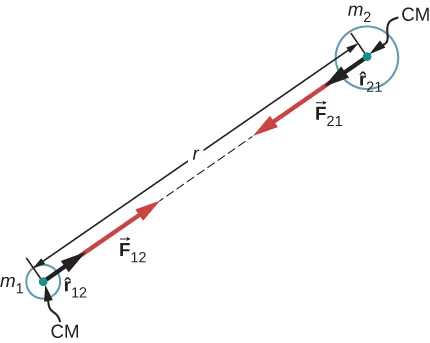
Two masses exert equal-and-opposite gravitational forces along the line connecting their centers of mass. The unit vectors indicate the direction from one mass toward the other, while the force arrows show gravity’s attractive direction on each body. Source
Center of mass: The single point that represents the average location of a system's mass and can often be used to model the system's gravitational interaction.
This idea lets a large object, such as a planet, often be treated as if all of its mass were concentrated at one point when you only need the force direction. When a problem asks for the direction of gravitational force between two bodies, draw a straight line between their centers of mass. The force vector on each body lies on that line and points inward, toward the other body.
A common mistake is to point gravity in the direction of motion. That is incorrect. The direction of gravitational force depends on the source mass, not on how the object is moving. A satellite may move sideways while the gravitational force still points inward toward the planet.
Gravitational Field as a Model
A gravitational field is a way to describe gravity without requiring physical contact between objects.
Gravitational field: A vector field that assigns to each point in space the direction of the gravitational force that a small mass would experience there.
The field is created by a source mass and exists in the space around it. If another mass is placed at some point in that space, the gravitational force on that mass points in the same direction as the field at that point.
= gravitational force on the object, in newtons
= mass of the object experiencing the field, in kilograms
= gravitational field at that location, in newtons per kilogram
Because is positive for ordinary matter, and always point in the same direction. This is why field diagrams are useful: once you know the direction of the field, you also know the direction of the gravitational force on an object placed there.
If several masses are present, each one contributes its own gravitational field. The net field direction is the vector sum of those contributions, and the net gravitational force points in that same net direction.
Reading field direction
At any location near a single isolated mass, the gravitational field points radially inward toward that mass's center of mass.
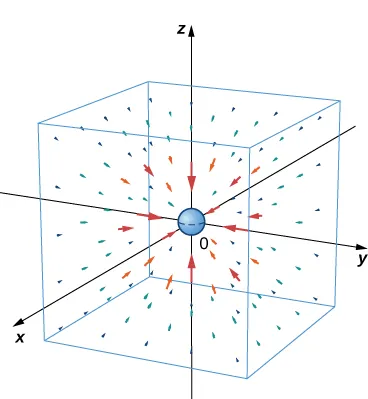
A gravitational field can be visualized as a vector field: at each point in space, the arrows indicate the direction a small test mass would accelerate. The vectors point inward toward the source mass, and their lengths increase as distance to the mass decreases, consistent with an inverse-square dependence. Source
For Earth, that means the field points toward Earth's center, not merely toward the ground beneath your feet. Everyday language often calls this direction "down," but in physics the more precise description is toward the center of Earth.
A good way to determine direction is:
Identify the source mass creating the field.
Mark its center of mass.
Draw the straight line from the object or point of interest to that center of mass.
Point the gravitational field vector and the gravitational force vector toward the source mass along that line.
Field diagrams may be drawn with arrows or with field lines.
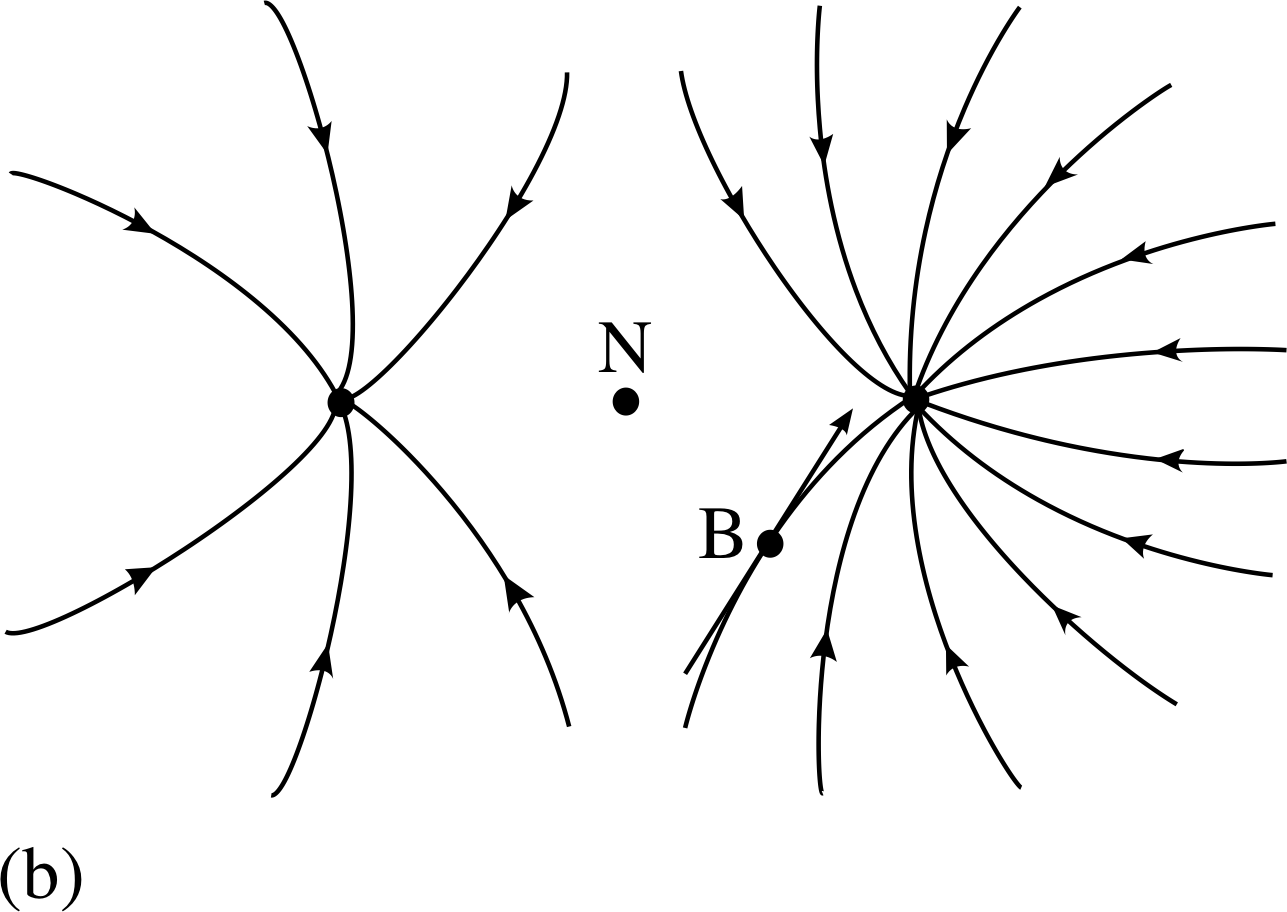
For two source masses, gravitational field lines bend because the net field at each point is the vector sum of contributions from both masses. The field direction at any location is tangent to the local field line, and the diagram highlights a neutral point where the net field is zero. Source
At any point, the field vector is tangent to the field line and points inward toward the mass. The diagram is not showing contact or a physical string between objects; it is showing the direction a test mass would accelerate if placed there.
Why the field model matters
Contact forces, such as normal force or friction, require touching surfaces. Gravity does not. Two bodies can attract each other even when separated by empty space. The field model explains this by saying that a mass affects the space around it, and another mass responds to the field present at its location.
This model is especially helpful in vector reasoning. Instead of asking how one distant object "reaches" another, you ask what the field direction is at a particular point. Once that direction is known, the force direction follows immediately.
Centers of mass and real objects
Real objects have size and shape, so different parts of one object are at slightly different distances from another object. Even so, AP Physics C often treats the net gravitational interaction as if it acts at the center of mass of each system. This simplifies an extended body into a single point for analyzing direction.
For example, if a spacecraft is attracted to a planet, the force on the spacecraft is drawn toward the planet's center of mass. If two spherical bodies attract one another, each force vector lies along the line joining their centers. In diagrams, this lets you use one gravitational force arrow instead of trying to represent the pull on every particle.
The same idea applies when discussing the field of a system that can be approximated as a point mass from outside. The field direction at any external point is toward the system's center of mass. On sketches, the field arrows therefore converge inward, showing that gravity pulls masses toward mass and that the field shows the direction of that pull everywhere in space.
FAQ
Yes. For shapes such as a ring or a horseshoe, the centre of mass can be located in empty space.
That does not mean gravity originates from that empty point. It means the mass distribution balances about that location, so in many simplified external-force models the gravitational line of action is treated as passing through the centre of mass.
It means the vector sum of all gravitational field contributions cancels at that exact point.
Gravity is not absent there. Each source mass still produces its own field, but the contributions add to zero. A small test mass placed exactly there would feel no net gravitational force, though a slight displacement would usually restore a nonzero field with a definite direction.
Yes. The net field is the vector sum of all gravitational fields present, not just the field from the nearest object.
If a second mass produces a stronger pull in the opposite direction, the combined field can point away from the nearby mass and towards the more influential one. Distance matters, but total geometry and mass distribution matter as well.
Field lines show the direction of the gravitational field at each point in space.
If two field lines crossed, the crossing point would have two different field directions at once. That would contradict the idea of a field being a single well-defined vector at each location, so properly drawn gravitational field lines cannot cross.
For a spherically symmetric planet, the gravitational field points towards the centre both outside and inside the planet.
What changes is mainly the magnitude, not the inward direction. At the exact centre, the net field becomes zero because pulls from all surrounding parts balance perfectly.
Practice Questions
A small probe is located at point near a spherical planet. State the direction of the gravitational field at due to the planet and the direction of the gravitational force on the probe.
Gravitational field at points toward the planet's center of mass. (1)
Gravitational force on the probe points in the same direction, toward the planet's center of mass. (1)
A satellite is located at point on the line joining the centers of Earth and the Moon, between the two bodies. At , Earth's gravitational pull is greater in magnitude than the Moon's.
(a) State the direction of the gravitational field at due to Earth.
(b) State the direction of the gravitational field at due to the Moon.
(c) Determine the direction of the net gravitational field at and explain your reasoning.
(d) State the direction of the gravitational force on the satellite.
(a) Toward Earth's center of mass. (1)
(b) Toward the Moon's center of mass. (1)
(c) Net gravitational field is toward Earth because the two field vectors are opposite in direction and Earth's field is larger. (2)
(d) Gravitational force on the satellite is also toward Earth because force points in the same direction as the net field. (1)
