

AP Syllabus focus: 'Inertial mass measures resistance to changes in motion, while gravitational mass relates to attraction. They are experimentally equivalent. For spherical mass distributions, shell-theorem ideas determine the net gravitational force.'
This subtopic connects the meaning of mass in dynamics with the meaning of mass in gravitation, then uses spherical symmetry to simplify how extended bodies exert gravitational forces.
Two roles of mass
In mechanics, mass appears in two conceptually different ways. One role describes how hard it is to accelerate an object. The other describes how strongly the object participates in gravitational attraction. These are not introduced for philosophical reasons; they appear in different physical laws.
Inertial mass
Inertial mass is the mass associated with an object's resistance to changes in motion.
Inertial mass: The quantity that measures how much an object resists acceleration when a net external force acts on it.
For AP Physics C Mechanics, inertial mass is the mass that appears in Newton's second law. If two objects experience the same net force, the object with the larger inertial mass has the smaller acceleration.
= net external force, in newtons
= inertial mass, in kilograms
= acceleration, in meters per second squared
This relation shows that inertial mass is not a force and not an energy. It is a property of matter that links applied force to resulting acceleration.
Gravitational mass
Gravitational mass is the mass associated with gravitational interaction.
Gravitational mass: The quantity that determines how strongly an object exerts and experiences gravitational attraction.
In AP Mechanics, gravitational mass is the mass that appears in the law of gravitation. If one object's gravitational mass is larger, the attractive force between it and another mass is larger, provided the separation stays the same.
= gravitational force magnitude, in newtons
= universal gravitational constant
= gravitational mass of one object, in kilograms
= gravitational mass of the other object, in kilograms
= distance between their centers, in meters
The important contrast is this: inertial mass tells how an object responds to a force, while gravitational mass tells how strongly gravity acts.
Experimental equivalence of inertial and gravitational mass
Physics distinguishes the two ideas because they enter different laws, but experiment shows that they are equivalent. Within experimental precision, the inertial mass of an object is proportional to its gravitational mass, and in ordinary mechanics problems they are treated as the same numerical quantity.
This matters because gravity both pulls on an object and accelerates it. If gravitational mass and inertial mass were different in a measurable way, different materials could accelerate differently in the same gravitational environment even when other forces were absent. Experiments do not show such a difference.
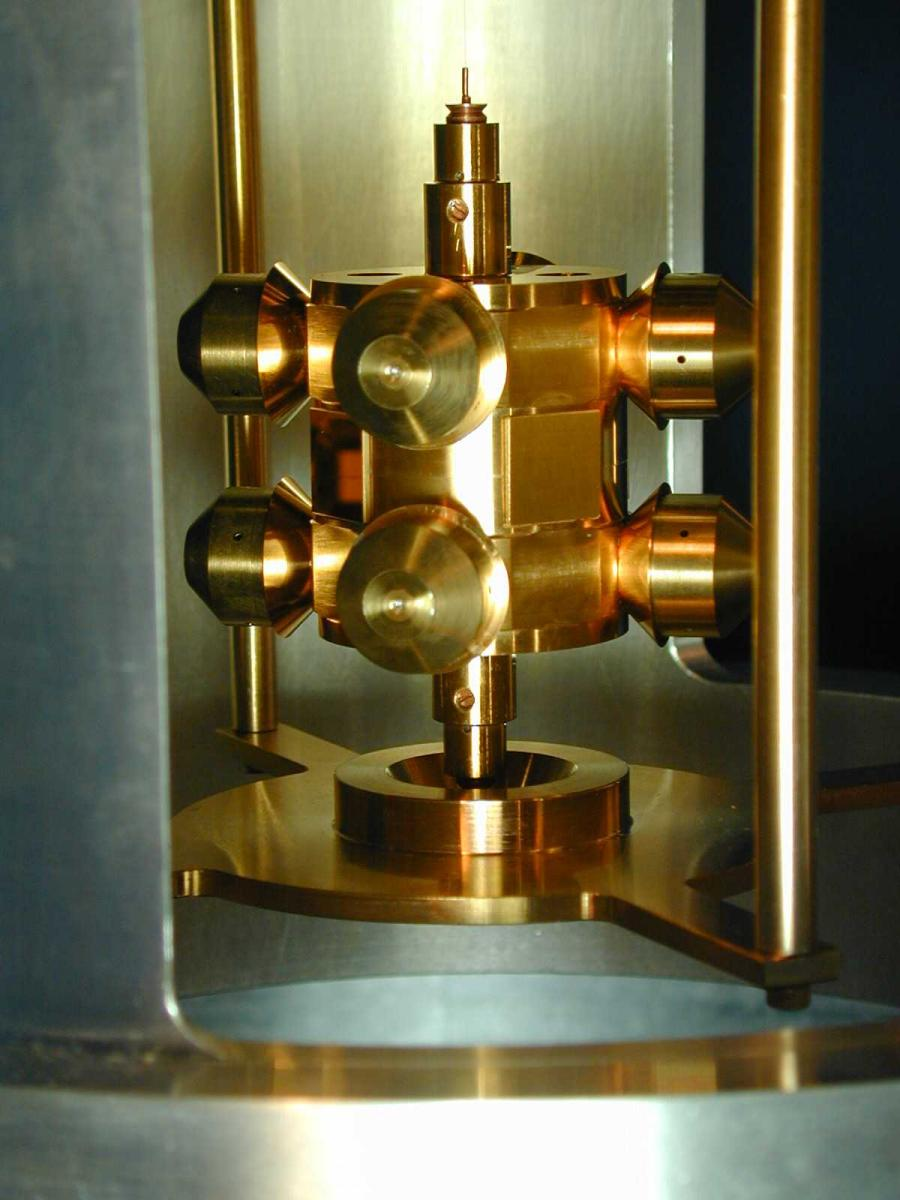
Photograph of a modern torsion-balance instrument used in equivalence-principle (universality of free fall) tests. Such experiments compare the accelerations of different materials in the same gravitational environment to extremely high precision, supporting the empirical equivalence of inertial and gravitational mass in classical mechanics. Source
For AP Physics C, the key point is practical: you do not assign one numerical mass for dynamics and another for gravity. A single mass value works consistently in both contexts.
Spherical mass distributions
A spherically symmetric mass distribution is one whose density depends only on distance from its center, not on direction. This symmetry makes the net gravitational force much easier to determine than it would be for an irregular object.
Shell theorem: A result stating that for spherical mass distributions, the external gravitational force is the same as if all the mass were concentrated at the center, and the net gravitational force inside a hollow spherical shell is zero.
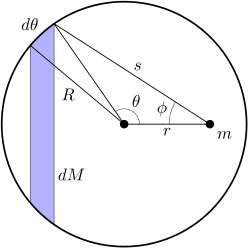
Diagram of Newton’s shell theorem for a spherical shell, showing that for the gravitational field behaves as if all mass were concentrated at the center, while for (inside a hollow shell) the net field cancels to zero. This visual reinforces the symmetry-based cancellation argument behind the theorem. Source
The shell theorem is a symmetry result about the vector sum of many gravitational forces. Individual pieces of the mass distribution pull in different directions, but the geometry makes those contributions combine in a very simple way.
Outside a spherical mass distribution
For any point outside a spherically symmetric object of total mass , the entire object behaves gravitationally like a point mass located at its center. This is true for a uniform sphere and also for any sphere whose density may vary with radius, as long as the distribution remains spherically symmetric.
= gravitational force magnitude on the outside object, in newtons
= total mass of the spherical distribution, in kilograms
= mass experiencing the force, in kilograms
= distance from the center of the sphere to the object, in meters
So when an object is outside a planet or star modeled as spherical, use the total mass and the center-to-center distance.
Inside spherical distributions
The shell theorem gives two especially important results.
Inside a hollow spherical shell, the net gravitational force is zero everywhere.
Inside a uniform solid sphere, only the mass enclosed within the object's radius contributes to the net force.
Mass located at larger radii can be treated as outer shells, and those shells contribute zero net force at the interior point.
For a uniform solid sphere of total mass and radius , the enclosed mass at radius grows in proportion to volume.
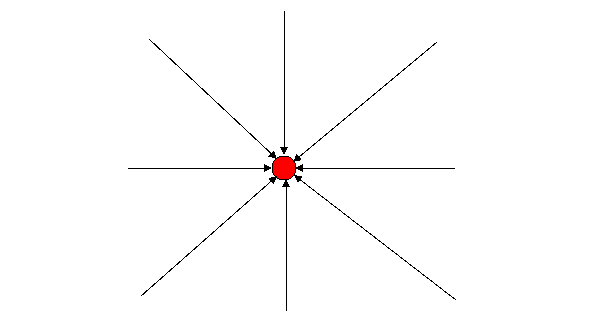
Illustration of the “enclosed mass” idea for a uniform solid sphere: only the mass inside radius contributes to the net gravitational force at that interior point. The figure supports the result that , which leads to an interior field/force proportional to (and zero at the center) before transitioning to an inverse-square dependence outside the sphere. Source
That gives a force that increases linearly with distance from the center.
= enclosed mass within radius , in kilograms
= total mass of the sphere, in kilograms
= distance from the center, in meters
= radius of the sphere, in meters
= gravitational force magnitude for , in newtons
This interior force points toward the center. At the exact center, the net force is zero. At the surface, the interior expression matches the usual exterior inverse-square expression, which is a useful check on algebra and physical reasoning.
FAQ
They arise from different physical ideas and different laws.
Inertial mass comes from dynamics: how much an object resists acceleration.
Gravitational mass comes from gravitation: how strongly an object interacts gravitationally.
Historically, there was no guarantee that the two had to match numerically. Their equality is an experimental discovery, not a definition. Distinguishing them helped physicists ask whether gravity acts universally on all matter in exactly the same way.
It has been tested to extremely high precision using sensitive experiments that compare how different materials respond to gravity.
Modern tests do not just drop objects and watch them fall. They often use:
torsion balances
precise measurements of tiny differential accelerations
astronomical observations
No violation has been found within experimental limits. For introductory mechanics, this means you can safely treat the two masses as equal, but in fundamental physics the question remains important because any tiny mismatch would signal new physics.
Yes, for points outside the object, it still works as long as the mass distribution is spherically symmetric.
That means the density may vary with radius, but it must be the same in every direction at a given radius. In that case:
outside the sphere, the field is the same as if all mass were at the centre
inside the sphere, you must use only the mass enclosed within the radius of interest
If the object is not spherically symmetric, the simple shell-theorem result no longer applies exactly.
The cancellation is a geometric effect, not a simple equal-distance argument.
A nearby patch of the shell does pull more strongly because it is closer. However, that patch covers a smaller angular region of the shell. Farther parts pull more weakly, but there is more shell spread over the corresponding directions.
When all contributions are added as vectors, the stronger pull from nearer regions is exactly balanced by the greater extent of farther regions. The result is zero net gravitational field everywhere inside an ideal hollow spherical shell.
Then the exact shell-theorem simplifications are only approximate.
For a slightly flattened or uneven planet:
the external gravitational field is close to $G\dfrac{Mm}{r^2}$, but not exact
the field can vary slightly with direction
precise satellite motion can reveal those deviations
In many AP Physics C problems, the spherical model is good enough because it captures the dominant effect. In real celestial mechanics, however, small departures from spherical symmetry matter and can cause measurable changes in orbits and gravitational measurements.
Practice Questions
State the difference between inertial mass and gravitational mass, and explain what is meant by saying they are experimentally equivalent.
1 mark: Inertial mass measures resistance to acceleration or is the mass in .
1 mark: Gravitational mass measures strength of gravitational attraction or is the mass in the law of gravitation, and experiments show the two masses are equal in practice for ordinary mechanics problems.
A planet is modeled as a uniform sphere of total mass and radius . A small object of mass is located a distance from the planet’s center, where .
Using shell-theorem ideas, derive an expression for the magnitude of the gravitational force on the object. State the direction of the force. Then state the corresponding force magnitude when the object is at a distance .
1 mark: States that only the mass enclosed within radius contributes to the net force inside the sphere.
1 mark: Uses for a uniform sphere.
1 mark: Substitutes enclosed mass into the inverse-square form, .
1 mark: Obtains for .
1 mark: States force is toward the center, and for , .
