

AP Syllabus focus: 'Apparent weight equals the normal force. It differs from gravitational force when a system accelerates. A system appears weightless when no force or only gravity acts, consistent with the equivalence principle.'
This topic separates what gravity does from what a surface or scale measures. That distinction explains heavier or lighter feelings in elevators, floating in orbit, and why acceleration can imitate gravity.
Apparent Weight
Apparent weight is the quantity associated with what a person feels and what a scale reads. It is not automatically the same as the gravitational force.
Apparent weight: The support force on an object, usually the normal force exerted by a surface. For a person standing on a scale, the scale reading equals the apparent weight.
In ordinary conditions on Earth, a person standing still has zero vertical acceleration, so the upward normal force equals the downward gravitational force. In that special case, apparent weight and gravitational force have the same magnitude, which is why they are often confused.
Apparent Weight in an Accelerating System
To find apparent weight, apply Newton’s second law to the object being supported, not to the floor or elevator around it.
= normal force, also the apparent weight or scale reading, in newtons
= mass, in kilograms
= gravitational field strength near Earth, in meters per second squared
= vertical acceleration of the object, taken as positive upward, in meters per second squared
This equation shows that the scale reading depends on acceleration. If the system accelerates upward, then and the object feels heavier. If it accelerates downward, then and the object feels lighter. If , then , which includes both rest and constant-velocity motion.
A useful way to interpret common situations is:
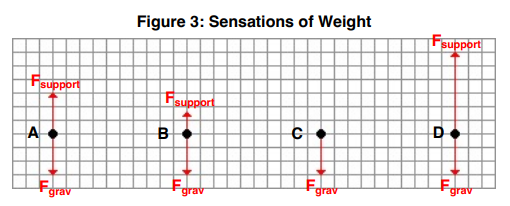
Free-body diagrams comparing the gravitational force () to the support force () across four cases, including perfectly weightless motion where . The figure makes the key AP point explicit: the “heavier/lighter” feeling tracks changes in the contact/support force, not changes in gravity. Source
Upward acceleration: apparent weight increases.
Downward acceleration: apparent weight decreases.
No acceleration: apparent weight equals gravitational force.
Free fall: apparent weight becomes zero.
The sensation of heaviness or lightness comes from changes in the support force, not from gravity suddenly changing.
Weightlessness
Students often think weightlessness means there is no gravity. In AP Physics C, that is usually incorrect.
Weightlessness: A state in which an object’s apparent weight is zero, so the normal force on the object is zero.
A system appears weightless when no force acts or when gravity is the only force acting. In both cases, there is no supporting contact force, so nothing pushes up on the object. As a result, a scale reads zero.
When Weightlessness Occurs
Several important cases produce weightlessness:
Deep space with negligible forces: if no significant force acts, there is no normal force and no apparent weight.
Free fall near Earth: gravity still acts, but the object and its surroundings accelerate together, so no support force is needed.
Orbit: a spacecraft, astronaut, and loose objects inside all fall together under gravity, so they can float relative to one another.
In orbit, gravity is not absent. It is usually strong enough to keep the spacecraft moving in its curved path. The key idea is that gravity alone does not create a scale reading; a scale reading requires a contact force.
A common AP mistake is to say that astronauts are weightless because they are “beyond gravity.” The correct statement is that they are weightless because their apparent weight is zero.
Apparent Weight Versus Gravitational Force
The gravitational force on an object near Earth is . That force is exerted by Earth. Apparent weight, by contrast, is exerted by a surface or support. These are different interactions, even when they happen to have equal magnitudes.
This distinction matters whenever acceleration is present. In a falling elevator, the gravitational force remains essentially , but the floor no longer pushes up with the same force. If the elevator and person are in free fall together, the floor exerts no normal force at all, so the person’s apparent weight is zero even though Earth still pulls downward.
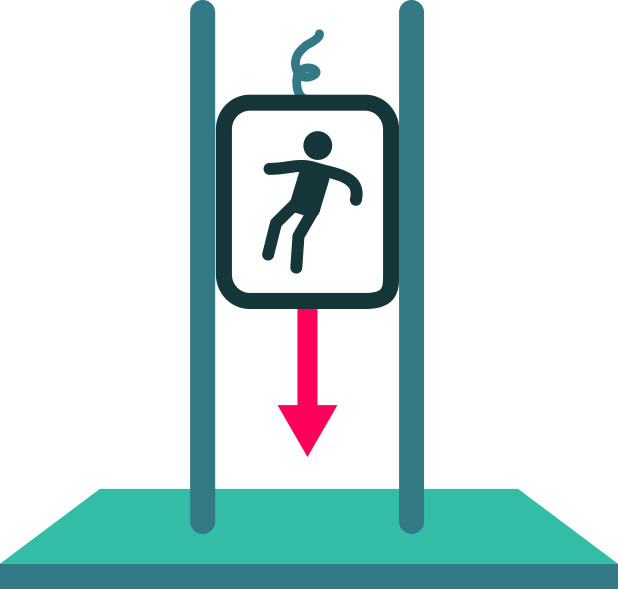
Illustration of the “falling elevator” thought experiment: when the elevator and passenger accelerate together in free fall, the floor does not need to push on the passenger. The absence of a support (normal) force corresponds to zero apparent weight even though gravity still acts. Source
Bathroom scales and spring scales respond to compression or tension caused by support forces. They therefore measure apparent weight, not gravitational force directly.
The Equivalence Principle
The equivalence principle links the physics of gravity and the physics of acceleration.
Equivalence principle: Over a small enough region, the effects of a uniform gravitational field are indistinguishable from the effects of constant acceleration.
Imagine being inside a closed elevator with no view outside.

Schematic of a windowless elevator cabin resting in a gravitational field, representing the baseline scenario where objects fall “down” and a scale can read nonzero due to a support force. In the equivalence-principle comparison, this situation can be locally indistinguishable from a gravity-free cabin undergoing constant upward acceleration. Source
If the elevator is in deep space but accelerating upward, objects fall to the floor and a scale gives a nonzero reading. Those observations can match what would happen if the elevator were standing still in a gravitational field. Locally, acceleration can mimic gravity.
The reverse idea is equally important. If the elevator is in free fall near Earth, objects float relative to the elevator, and scales read zero. That local behavior matches what would happen in a gravity-free inertial environment. This is why free fall is the essential physical picture behind apparent weightlessness.
The word local is crucial. Over large regions, gravity can vary from place to place, producing effects that a uniformly accelerating frame does not reproduce exactly. For AP Physics C Mechanics, the key takeaway is that a person inside a small laboratory cannot always distinguish gravity from acceleration using only local mechanical experiments.
Solving Questions Efficiently
Identify the object of interest.
Draw only the external forces on that object.
Recognize a scale reading as the normal force.
Decide whether the system is supported, accelerating, or in free fall.
Then use Newton’s second law to relate and .
Practice Questions
A passenger stands on a scale in an elevator moving upward at constant velocity. The passenger’s mass is . What force does the scale measure, and what is its magnitude?
1 mark: States that the scale measures the normal force, or apparent weight.
1 mark: States that the magnitude is because the acceleration is zero.
A student of mass 60 kg stands on a scale in an elevator.
(a) The elevator accelerates upward at 2.0 m/s^2. Calculate the scale reading.
(b) The cable then snaps, and the elevator goes into free fall. State the new scale reading.
(c) Explain why the student is weightless in part (b) even though gravity still acts.
(d) State one way this situation illustrates the equivalence principle.
(a) 1 mark: Uses Newton’s second law, such as .
(a) 1 mark: Correctly finds N, or 710 N to two significant figures.
(b) 1 mark: States that the scale reading is 0 N.
(c) 1 mark: Explains that apparent weight is the normal force, and in free fall the normal force is zero even though gravity still acts.
(d) 1 mark: States that free fall in gravity is locally indistinguishable from being in a gravity-free inertial environment, or an equivalent statement.
FAQ
“Microgravity” means the apparent weight is very small, not exactly zero in every moment.
Small residual effects can come from:
tiny thruster firings
air currents inside the spacecraft
vibrations from machinery or crew movement
slight differences in gravity from one part of the spacecraft to another
So astronauts are close to weightless, but the environment is not perfectly force-free.
Yes. In a strongly accelerating system, the support forces inside your body are not identical everywhere.
For example, during upward acceleration, your feet must support the parts of your body above them. That can make your lower body feel more compressed than your upper body.
This is one reason high accelerations feel physically stressful even when the whole body is moving together.
Usually no. They measure force on an internal sensor and then convert that force into a displayed mass by assuming a particular value of $g$.
That means:
on Earth at rest, the reading is usually close to your true mass
in an accelerating lift, the displayed “mass” changes because the force changes
on another planet, the same scale may give a misleading mass reading unless it is recalibrated
The underlying measurement is still force.
No.
A spring scale depends on apparent weight, so its reading changes when the local gravitational field changes. On the Moon, it would show a much smaller force than on Earth.
An equal-arm balance compares one mass against another. If both sides are in the same gravitational field, the factor of gravity affects both sides equally, so the balance can still compare masses correctly.
So the two devices are based on different physical ideas.
Ideally, no.
If the cabin and both objects are all in free fall under gravity alone, they share the same gravitational acceleration. Their relative motion inside the cabin is therefore close to zero, so neither object drops to the floor in the usual sense.
In real life, tiny differences can appear because of air resistance or slight motions at the moment of release, but those are non-ideal effects rather than the main physics.
