

AP Syllabus focus: 'If the distance between two systems changes only slightly, gravitational force can be treated as constant. Near Earth's surface, the gravitational field strength is approximately 10 N/kg.'
In many AP Physics C problems, gravity is modeled as a constant downward influence near Earth’s surface. This simplification is powerful, but it only works when the object’s distance from Earth changes by a very small amount.
What “constant gravity” means
When gravity is treated as constant, the model assumes that the gravitational force on an object does not change noticeably as the object moves through the region being studied. Near Earth’s surface, this means two things:
the magnitude of the gravitational field stays essentially the same
the direction of the field can be taken as straight downward throughout the motion
This is an approximation, not a statement that gravity is literally identical everywhere.
The useful quantity here is gravitational field strength.
Gravitational field strength: The gravitational force per unit mass at a location. Near Earth's surface, it is often modeled as a constant downward value of about .
In AP Physics C Mechanics, this local approximation is used often because it makes force analysis much simpler. Instead of letting gravity vary with position, you use one fixed value of for the entire motion.
Why the approximation works near Earth
The reason this model works is based on scale. Earth is extremely large compared with the distances involved in most introductory mechanics problems. If an object rises a few meters, falls from a roof, or moves along a ramp, its distance from Earth’s center changes by only a tiny fraction of the total Earth-object separation.
Because that change in distance is so small, the resulting change in gravitational force is also very small. For many problems, that change is too small to matter, so gravity can be treated as effectively unchanged.
The direction of gravity is also approximated as constant. Strictly speaking, gravity always points toward Earth’s center, so the direction is not exactly the same at all points. However, over a small region near the surface, those directions are nearly parallel. That is why AP problems can treat downward as one fixed direction.
This local model is sometimes described as a uniform gravitational field near Earth’s surface.
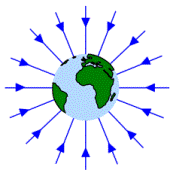
Field-line diagrams comparing Earth’s gravitational field on large scales (radially inward, decreasing in line density with distance) to the near-surface approximation (nearly parallel, evenly spaced lines). The near-surface picture visually encodes why can be treated as constant over small height changes: both the direction and the spacing (strength) vary negligibly across the region. Source
Using the approximation in force models
Once the field is treated as constant, the gravitational force on an object has a simple form.
= gravitational force, in newtons
= mass of the object, in kilograms
= gravitational field strength, about near Earth's surface
This equation shows why the approximation is so useful. If the object’s mass stays the same and is treated as constant, then the object’s weight stays constant throughout the motion.
In a free-body diagram, gravity is therefore represented by one downward force arrow of fixed size.
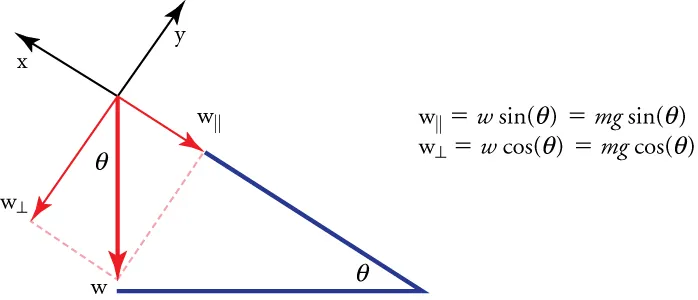
Inclined-plane force diagram showing the weight vector and its decomposition into components parallel and perpendicular to the surface. This is the standard geometric step that turns the constant near-surface force into the components used in Newton’s 2nd-law equations along chosen axes. Source
You do not need to redraw the gravitational force as changing from point to point unless the problem involves a much larger change in distance from Earth.
When this model is appropriate
The constant-gravity approximation is appropriate when:
the object remains near Earth’s surface
the change in distance between Earth and the object is small
the problem only requires ordinary near-surface accuracy
modeling gravity as one constant downward field captures the important physics
Typical cases include:
objects falling short vertical distances
motion on inclines near the ground
projectiles launched over ordinary terrestrial distances
blocks, carts, or masses moving in laboratory-scale systems
In these situations, treating gravity as constant lets you focus on the net force without needing a more detailed gravitational model.
What “approximately ” means
The specification says that near Earth’s surface, gravitational field strength is approximately . This is a rounded value used for convenience.
That means:
a mass has a gravitational force of about
a mass has a gravitational force of about
a mass has a gravitational force of about
The important idea is not the exact decimal value, but the fact that the field can be treated as locally constant. Some problems may use a more precise value such as , but the physics idea is the same: near the surface, the field is nearly uniform over small height changes.
When the approximation is no longer good
The model should not be used blindly.
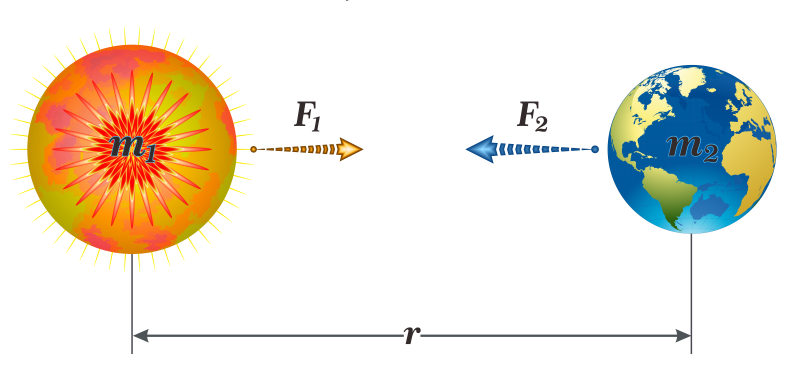
Diagram of two masses separated by distance with forces shown acting along the line joining their centers (an illustration of Newton’s universal gravitation setup). It reinforces that gravity is fundamentally a distance-dependent interaction, motivating why the constant- model must be restricted to small changes in distance from Earth. Source
It becomes less appropriate when the distance from Earth changes enough that the gravitational force changes noticeably.
Examples include:
very high-altitude motion
long-range space travel
satellite motion
situations where small changes in gravity matter to the required precision
In those cases, gravity should no longer be treated as exactly constant throughout the motion. The field can vary enough that a simple near-surface model is no longer accurate.
How to justify the approximation on an exam
A strong AP explanation does more than say “ is constant.” It explains why the approximation is valid for the situation.
A good justification usually says that the object’s change in height is negligible compared with its distance from Earth’s center, so the change in gravitational force is negligible. That is the key reasoning the model depends on.
This matters because physics often uses approximate models that are valid only within a certain range. Here, the range is a small region near Earth’s surface, where gravity can be treated as a constant downward field.
FAQ
$10\ N/kg$ is a rounded value that makes arithmetic quicker, especially in timed work.
$9.8\ N/kg$ is more precise. On an exam, use the value given in the question. If none is specified, use the convention your course or teacher expects, and stay consistent throughout the solution.
A rough estimate comes from comparing the height change with Earth’s radius, about $6.4\times10^6\ m$.
For heights of a few metres or even a few kilometres, the error is tiny. At heights of hundreds of kilometres, the change becomes much more noticeable, so a constant-$g$ model is less suitable for precise work.
Not exactly. At each location, gravity points towards Earth’s centre.
Over a small region, those directions differ so little that they can be treated as parallel. Over very large horizontal distances, the difference becomes measurable, so the “same downward direction” idea is only a local approximation.
Because $g$ describes the gravitational field at the location, not a property of the object itself.
A larger mass has a larger weight because $F_g = mg$, but the local field strength is the same for both objects if they are in the same place. The field tells you the force per unit mass.
Yes, provided the object stays close to that body’s surface and the height change is small compared with the body’s radius.
The key point is that the local field value would be different. You would use that planet’s or moon’s near-surface value of $g$, not Earth’s. The approximation is about small changes in distance, not about Earth specifically.
Practice Questions
A box of mass is lifted vertically by near Earth's surface. Explain why the gravitational force on the box can be treated as constant during the lift, and state its magnitude using .
States that the change in distance from Earth's center is very small, so the gravitational force is approximately constant. (1)
Calculates downward. (1)
A instrument is moved from ground level to the top of a tower. A student models Earth's gravitational field as constant with for the entire motion.
(a) State one reason this model is appropriate.
(b) Determine the gravitational force on the instrument at ground level.
(c) Determine the gravitational force on the instrument at the top of the tower.
(d) Explain why the answers to parts (b) and (c) are the same in this model.
(e) State one situation in which this model would no longer be appropriate.
(a) Height change is tiny compared with the distance to Earth's center / the instrument remains near Earth's surface. (1)
(b) downward. (1)
(c) downward. (1)
(d) In the model, is constant throughout the motion, so the weight does not change with position. (1)
(e) Any valid example, such as a satellite, a high-altitude rocket, or motion where the distance from Earth changes substantially. (1)
