

AP Syllabus focus: 'The magnitude of kinetic friction equals the coefficient of kinetic friction times the normal force. It depends on the materials, not on the contact area.'
Kinetic friction is modeled simply in AP Physics C Mechanics, but applying that model correctly requires careful attention to what sets the force magnitude and what does not.
Core Relationship
The coefficient of kinetic friction is the material-dependent factor in the standard friction model.
Coefficient of kinetic friction: A dimensionless constant, written as , that describes how strongly two surfaces resist sliding relative to each other in the kinetic-friction model.
Once that coefficient is known for a given pair of surfaces, the friction magnitude is found by multiplying it by the normal force.
= magnitude of kinetic friction, N
= coefficient of kinetic friction, no units
= normal force magnitude, N
This equation gives the magnitude of the kinetic friction force. The result is always nonnegative. In mechanics problems, the direction is handled separately, but the size of the force comes from the expression above.
Interpreting the Factors in the Equation
The Coefficient
The value of depends on the pair of materials in contact. A wood block on wood, rubber on concrete, and steel on ice all have different coefficients because their surfaces interact differently while sliding.
For AP Physics C purposes, is treated as a property of the contacting surfaces in the chosen model. That means:
it is usually taken as a constant for a problem
it has no units
it must match the specific surfaces involved
A larger value of means a larger friction force for the same normal force. A smaller value means less friction under the same contact conditions.
The Normal Force
The second factor is the normal force magnitude. Because is proportional to , anything that changes the normal force also changes the friction magnitude.
This is why students should not automatically replace with . That works only in some situations. On a horizontal surface with no other vertical forces, . On an incline, the normal force is smaller than , often written as .
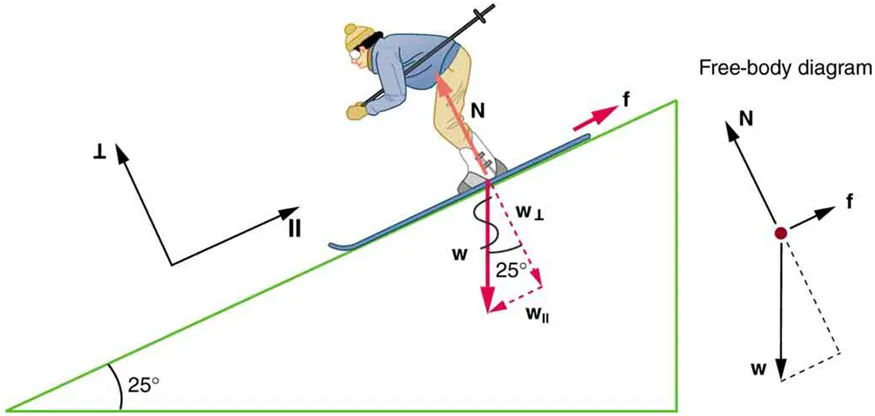
Free-body diagram for motion on an incline with friction, showing the normal force perpendicular to the surface and kinetic friction parallel to the surface opposing motion. The weight is decomposed into components along and perpendicular to the incline, making it clear why the normal force magnitude is set by in the common no-other-vertical-forces case. Source
If an external force pushes downward on the object, the normal force increases, and so does the kinetic friction magnitude.
The key idea is that kinetic friction is not determined by mass alone. It is determined by the actual normal interaction between the surfaces.
What the Magnitude Depends On
The syllabus emphasizes two central points:
Kinetic friction magnitude depends on the materials
Kinetic friction magnitude does not depend on contact area
The first point comes directly from . If the surfaces change, the coefficient can change. Even with the same object and the same weight, replacing one surface with another can change the friction magnitude because the material pairing is different.
The second point is often surprising. In this model, a larger visible contact area does not automatically produce a larger kinetic friction force. If two objects are made of the same materials and have the same normal force, the model predicts the same kinetic friction magnitude even if one has a much wider contact patch.
For AP Physics C, this means apparent contact area is not a variable in the equation. If a problem gives contact area but does not connect it to some other force or effect, it is usually not needed for the kinetic-friction magnitude.
Using the Model in Mechanics Problems
Step-by-Step Use
When finding the magnitude of kinetic friction in a problem, a good process is:
identify the two sliding surfaces
determine the correct value of for that surface pair
find the normal force from the force balance perpendicular to the surface
apply
This keeps the model connected to the physical situation rather than turning it into a memorized shortcut.
Why Finding Correctly Matters
Many errors in friction problems come from finding the wrong normal force.
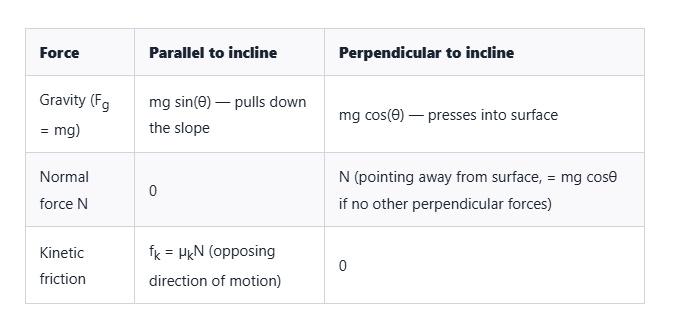
Inclined-plane free-body diagram explanation emphasizing that the normal force is perpendicular to the surface while the weight splits into (parallel) and (perpendicular). This visualization helps prevent the common mistake of assuming and clarifies how the perpendicular component of weight sets the contact interaction that determines friction magnitude via . Source
Since is proportional to , any mistake in immediately gives the wrong friction magnitude.
Common situations that change include:
motion on an incline
an applied force with an upward or downward component
contact with more than one surface
Because of this, the friction equation is often easy to write but harder to use correctly unless the normal force has already been analyzed carefully.
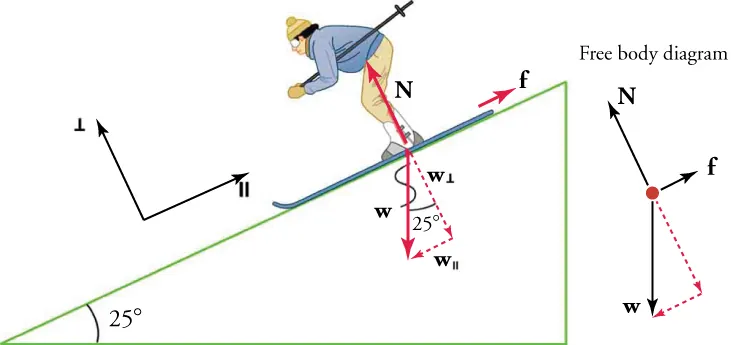
Diagram of a skier on an inclined plane with force vectors labeled, illustrating how is perpendicular to the surface while friction acts along the surface. The figure supports solving by rotated axes: resolve weight into components, determine from the perpendicular balance, then use for the friction magnitude. Source
Constant Magnitude in Many Models
In many AP problems, is constant and the normal force is constant, so the kinetic friction magnitude is also constant throughout the motion. This is especially common for a block sliding across a level surface or along a fixed incline.
That constant-force model is useful because it makes the translational dynamics more manageable. However, the reason the friction stays constant is not that all kinetic friction is always constant. It is because the model assumes constant and constant .
Common Mistakes
Assuming in every problem
Forgetting that is unitless
Using the wrong coefficient for the materials in contact
Letting contact area affect the answer when the model does not include it
Treating friction magnitude as independent of the normal force
Missing changes in caused by inclines or angled applied forces
FAQ
Yes. There is no rule that says $\mu_k$ must be less than $1$.
A value greater than $1$ simply means the kinetic friction force can be larger than the normal force for that particular surface pair. This can happen with very rough or adhesive materials.
In many introductory problems, $\mu_k$ is less than $1$, but that is a common pattern, not a physical limit.
One common method is to pull an object across a surface at constant speed and measure the applied force.
If the speed is constant, the net horizontal force is zero, so the pull equals the kinetic friction magnitude. Then use $F_k=\mu_k N$ to solve for $\mu_k$.
Another method uses an incline and motion data, then works backwards from the dynamics to infer the coefficient.
In practice, repeated trials are important because surface conditions can vary.
The AP model is an idealisation. Real surfaces may heat up, deform, vibrate, or interact with thin films of air or lubricant.
Because of that, the measured friction force can vary with speed, sometimes only slightly and sometimes a lot.
For many classroom situations, however, taking $\mu_k$ as constant gives a very good approximation and keeps the mechanics tractable.
Not always. They often reduce friction by separating the surfaces, but the outcome depends on the regime of motion.
Some lubricants lower direct surface contact and reduce friction.
Some viscous fluids can create drag-like resistance.
Temperature and speed can change how the lubricant behaves.
So lubrication usually changes the effective frictional behaviour, but not always in the same way for every system.
Because “same materials” does not guarantee identical surface conditions.
Small differences can matter, such as:
roughness or polish
dust, moisture, or oil
temperature
wear of the surfaces
how steadily the object was sliding
So $\mu_k$ is best thought of as a model parameter for a particular contact situation, not as a perfectly fixed universal constant for a named material pair.
Practice Questions
A block slides across a rough horizontal surface. The coefficient of kinetic friction is , and the normal force on the block is . What is the magnitude of the kinetic friction force?
Uses correctly. (1 mark)
Calculates . (1 mark)
A block slides down a rough incline that makes an angle of with the horizontal. The coefficient of kinetic friction between the block and incline is .
(a) Derive an expression for the magnitude of the kinetic friction force in terms of , , , and .
(b) Calculate the magnitude of the kinetic friction force.
(c) A second block of the same mass slides on the same incline, made of the same materials, but with twice the contact area. State whether the kinetic friction magnitude changes in this model and justify your answer.
Identifies the normal force as . (1 mark)
Uses . (1 mark)
Combines the two to obtain . (1 mark)
Substitutes values correctly: . (1 mark)
Evaluates to to two significant figures. (1 mark)
States that the kinetic friction magnitude does not change and justifies that, in this model, it depends on materials and normal force, not contact area. (1 mark)
