

AP Syllabus focus: 'Kinetic friction acts when contacting surfaces move relative to each other. The friction force points opposite the relative motion of the surfaces.'
Kinetic friction is one of the most common forces in mechanics problems. The key idea is not just contact, but sliding contact between surfaces that are touching each other.
What kinetic friction means
When two surfaces are in contact and move relative to one another, the interaction between them can include kinetic friction. In AP Physics C Mechanics, this force is treated as a contact force that acts along the surface of contact, not perpendicular to it.
Kinetic friction: A contact force that acts between two surfaces that are sliding relative to each other and is directed opposite that relative sliding.
This means kinetic friction depends on two conditions being true at the same time:
the surfaces must be touching
the surfaces must be sliding past each other
If either condition is missing, then kinetic friction does not act. For example, if an object is not touching a surface, there is no friction force from that surface. If the object is touching but not sliding relative to the surface, then the situation is not one of kinetic friction.
When kinetic friction acts
The phrase “contacting surfaces move relative to each other” is the central test. It is not enough to say that an object is moving. What matters is whether the surface of the object is sliding past the surface it touches.
Common situations where kinetic friction acts include:
a box sliding across a floor
a block sliding down a ramp
a skidding tire sliding across the road
an object slipping on a moving belt
In each case, the surfaces are rubbing while sliding relative to each other.
A useful warning is that the motion of the object through the room is not always the deciding factor. An object may be moving and still have no kinetic friction if the surface beneath it moves in exactly the same way so that there is no sliding at the contact point. The question is always about relative motion at the interface.
Relative motion at the contact surface
To decide whether kinetic friction acts, focus on the point where the surfaces touch and ask:
Is one surface sliding past the other?
If yes, kinetic friction acts.
If no, kinetic friction does not act.
This idea is especially important in problems involving belts, rotating wheels, or moving platforms, because the object’s velocity relative to the ground may be different from its motion relative to the surface it touches.
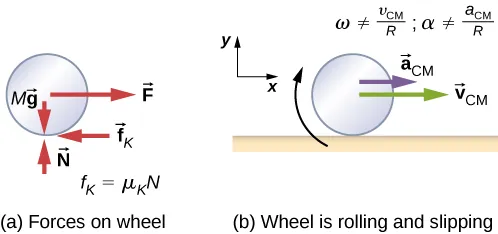
Free-body diagram of a wheel that is rolling while slipping, showing kinetic friction applied at the contact point opposite the slip direction. The figure connects the sign of to relative motion at the interface (not merely the wheel’s center-of-mass velocity), which is the key conceptual test used in AP Mechanics. Source
Determining the direction of kinetic friction
The direction of kinetic friction is set by one rule: it points opposite the relative motion of the surfaces.
This is more precise than saying it points opposite the object’s motion. Sometimes those are the same, but not always.
To find the direction correctly:
choose the object whose free-body diagram you are drawing
identify the surface touching that object
decide how the touching surface is moving relative to the object’s surface
reverse that sliding direction to get the direction of the kinetic friction on the object
For a simple sliding box on a floor, if the box slides to the right relative to the floor, the kinetic friction on the box points to the left.
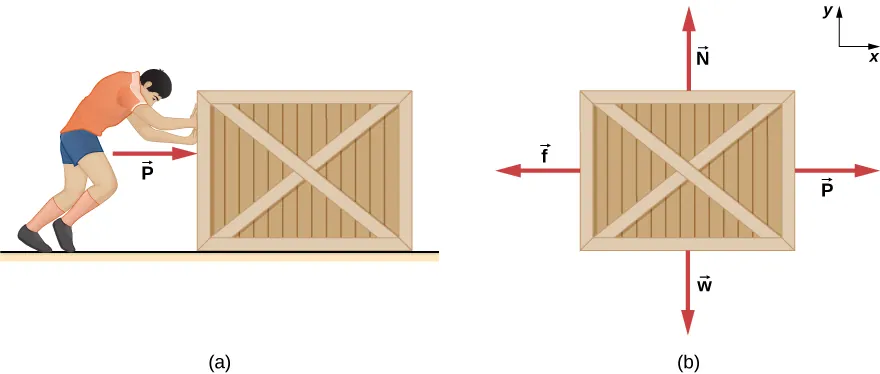
A standard free-body diagram for a crate being pushed across a horizontal surface, with forces labeled (weight), (normal), applied push , and friction opposing the motion. This directly reinforces that kinetic friction acts along the contact surface and points opposite the relative sliding direction. Source
However, suppose a surface beneath the object is moving. Then you must compare the two surfaces directly. If the surface under the object slides to the right relative to the object, the kinetic friction on the object points to the right. In that case, friction may actually speed the object up rather than slow it down.
So the safest statement is:
kinetic friction opposes relative sliding
it does not automatically oppose velocity
it does not automatically oppose acceleration
it does not automatically oppose an applied force
These distinctions matter in AP problems because an incorrect friction direction usually leads to an incorrect sign in Newton’s second law.
Representing kinetic friction in mechanics problems
In a free-body diagram, kinetic friction should be drawn as a separate force arrow acting on the chosen object:
starting from the object’s center of mass in the diagram style used for AP Physics
parallel to the contact surface
in the direction opposite the relative sliding of the two surfaces
If the object is on a horizontal surface, the friction force is horizontal. If the object is on an incline, the friction force is along the incline. The direction may change if the direction of relative sliding changes.
Contact-based reasoning
A strong habit is to describe friction with a sentence before writing any equations. For example:
“The block slides down the ramp relative to the ramp, so kinetic friction on the block points up the ramp.”
“The belt moves right relative to the object’s surface, so kinetic friction on the object points right.”
This kind of reasoning helps prevent sign mistakes and keeps the analysis tied to the physical interaction.
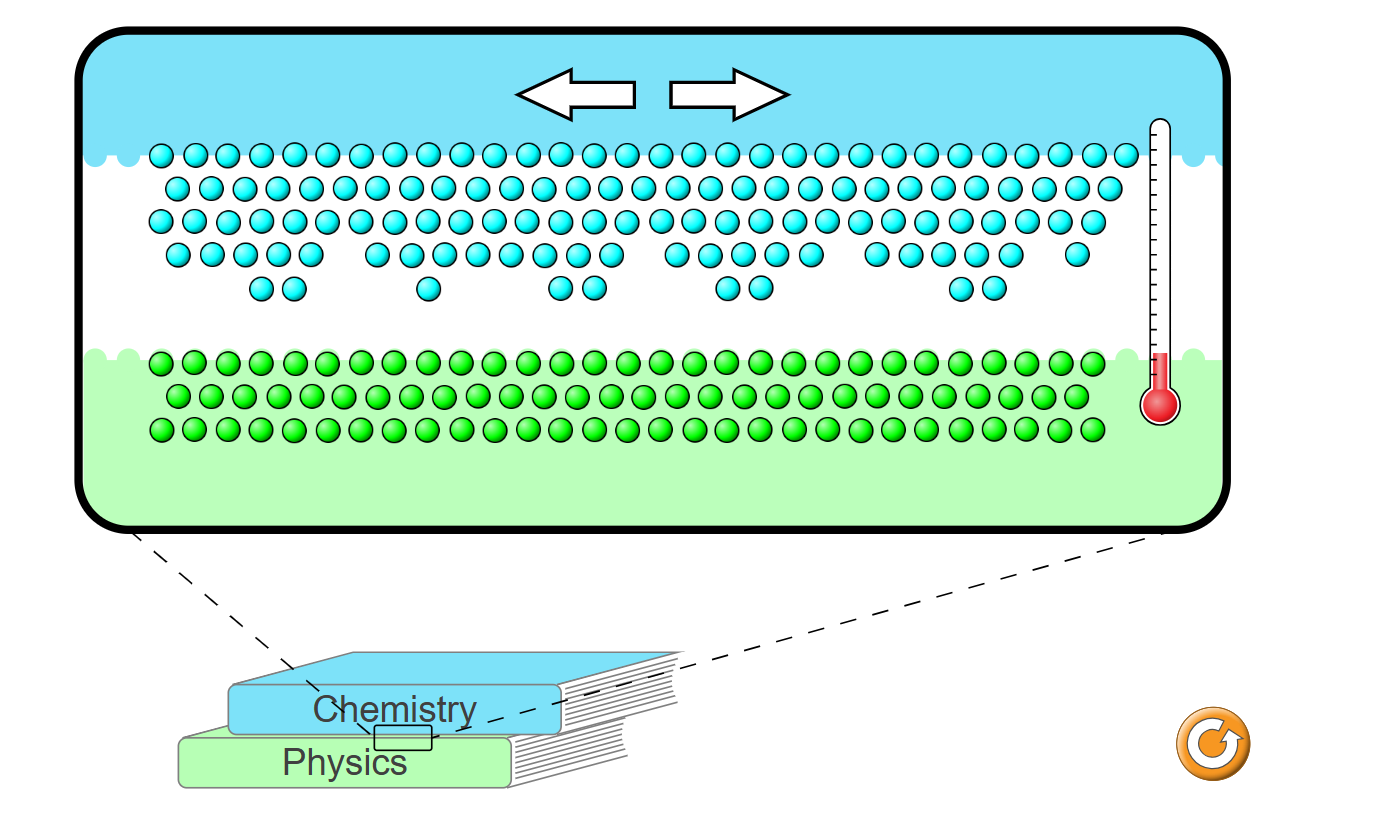
Screenshot/launch image for the PhET ‘Friction’ simulation, which lets you explore when friction acts and how it changes as surfaces transition from sticking to sliding. It is best used as a conceptual anchor: students can test scenarios where relative motion at the contact point determines the friction direction. Source
Common misunderstandings
One common mistake is assuming that any touching surface creates kinetic friction. Touching alone is not enough; there must be sliding.
Another common mistake is deciding the direction from the object’s motion through space. Kinetic friction depends on how the two contacting surfaces move relative to each other, not on how the object moves relative to the room.
A third mistake is treating friction as if it always slows motion. Kinetic friction often resists motion, but in some cases it transfers motion from one surface to another and can increase an object’s speed.
Finally, a wheel or ball that moves without sliding at the contact point is not an example of kinetic friction. Kinetic friction is specifically tied to slipping or sliding contact.
FAQ
Yes. If kinetic friction points in the same direction as the object’s displacement, it does positive work on that object.
This can happen when a moving surface drags an object along while the object is still slipping. In that case, friction transfers energy into the object’s translational motion rather than removing it.
So kinetic friction is not automatically an energy-removing force for every object involved; it depends on the direction of force compared with the object’s displacement.
The physical contact situation is the same in all inertial frames, so whether the surfaces are sliding relative to each other does not become a different physical event.
What can change is how you describe the motion. A frame change may alter each object’s velocity, but the relative sliding at the contact remains consistent, so the friction direction found from that sliding remains consistent as well.
This is why it is safer to reason from the contact surfaces than from “motion through the room”.
As surfaces slide, tiny irregularities catch, bend, break, and vibrate. Those microscopic processes convert organised mechanical motion into internal energy.
The result is usually:
warming of the surfaces
sound or vibration
wear of the materials
So the heating is not because friction is a separate substance; it is a result of energy transfer during sliding contact.
Yes. A vacuum removes air, but kinetic friction comes from the interaction of the contacting surfaces themselves.
If two solid surfaces touch and slide in a vacuum chamber, kinetic friction can still act. In some cases it may even behave differently because there is no air or moisture layer between the surfaces.
So vacuum affects air resistance, but it does not automatically eliminate kinetic friction.
Lubricants reduce direct solid-on-solid contact. Instead of many surface asperities scraping past each other, a thin layer of fluid or grease separates much of the contact.
This can:
reduce surface damage
reduce heating
make the sliding smoother
Real materials are complicated, so the reduction is not always identical in every situation, but lubrication usually lowers the friction associated with sliding contact.
Practice Questions
A block slides to the left across a horizontal floor.
(a) Does kinetic friction act on the block? (b) What is the direction of the kinetic friction force on the block?
1 mark: States that kinetic friction does act because the block and floor are in contact and sliding relative to each other.
1 mark: States that the kinetic friction force on the block points to the right.
A package is dropped onto a conveyor belt moving to the right. Immediately after contact, the package is moving more slowly than the belt, so it slides relative to the belt. After a short time, the package moves together with the belt without slipping.
(a) During the sliding stage, does kinetic friction act on the package? Explain. (b) During the sliding stage, what is the direction of the kinetic friction force on the package? (c) Once the package moves with the belt without slipping, does kinetic friction still act? Explain.
(a) 2 marks:
1 mark: States that kinetic friction acts during the sliding stage.
1 mark: Explains that the package and belt are in contact and moving relative to each other.
(b) 1 mark:
1 mark: States that the kinetic friction force on the package points to the right.
(c) 2 marks:
1 mark: States that kinetic friction no longer acts once there is no slipping.
1 mark: Explains that the package and belt have no relative motion at the contact surface.
